
Political and economic anthropology
The Price of Imagining a Future
Reading time: 22 min
Madrid, Paris and Delhi confront inequality, eighteen years after the 2008 crisis
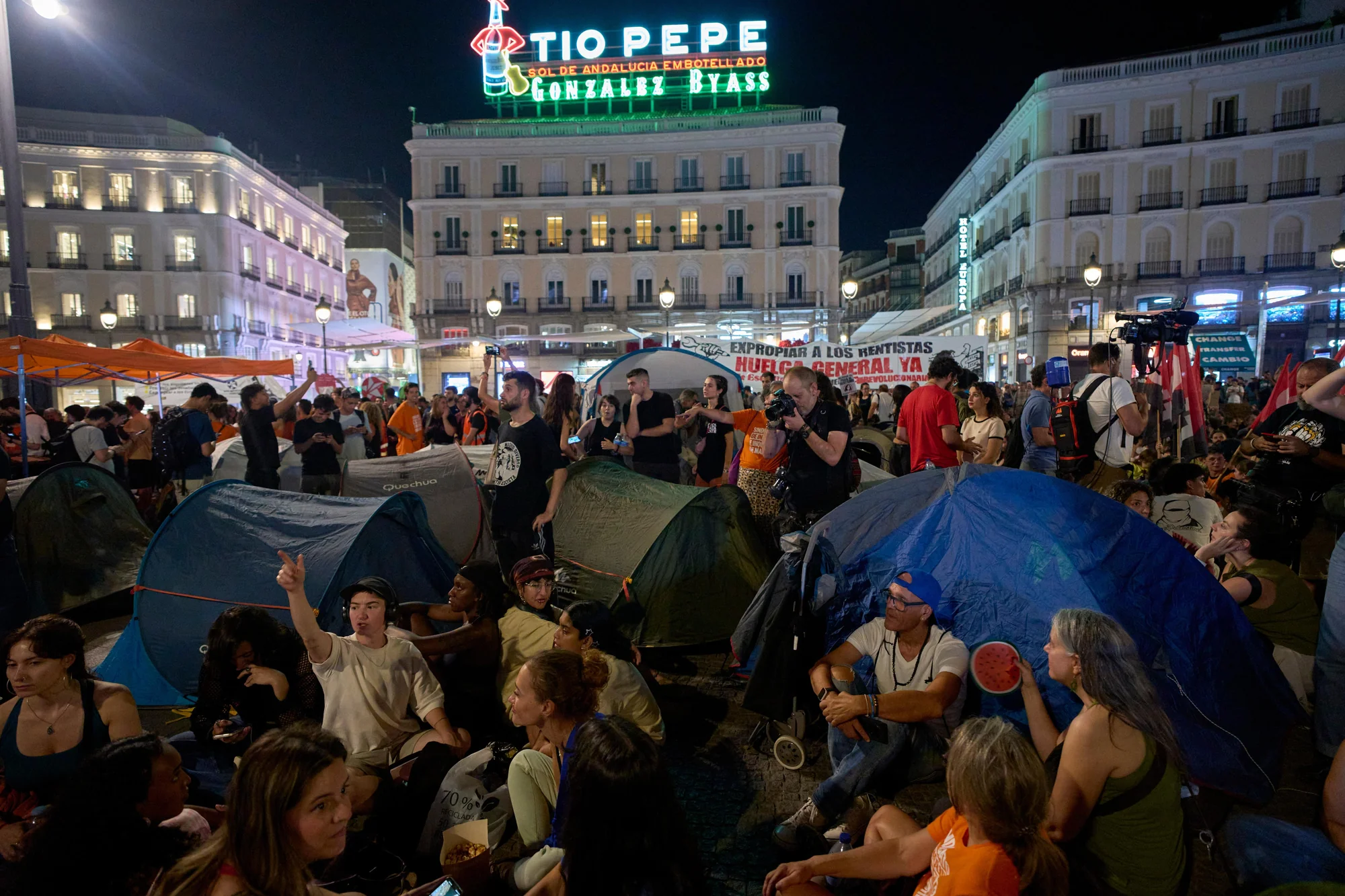
‘On n’a même pas le minimum. Je ne sais pas comment les gens veulent qu’on réussisse’ (‘We do not even have the bare minimum. I do not know how they expect us to succeed’), Le HuffPost reported during the blockade of Paul-Éluard secondary school in Saint-Denis, north of Paris. ‘We are students. We are unemployed. We are “cockroaches”, and we will be back,’ said Shranaya of the Students’ Federation of India on the day police sealed off central Delhi. In Madrid, the Tenants’ Union described the death of Maricarmen Abascal, evicted at the age of 87, as ‘an entirely avoidable situation after a torturous process’. Three statements in three languages, emerging from three conflicts that are not coordinated with one another. All three speak of institutions that no longer guarantee the minimum they once promised, and of people who refuse to accept waiting as their fate.
This article argues that the 2008 crisis did not cause these protests, but marked the moment when the dividing lines of inequality began to shift. We tend to discuss inequality in terms of wages. Since 2008, and especially clearly in Spain, it also needs to be measured through ownership and age — through who has a roof over their head, who will inherit one and who arrives too late for everything. Austerity, the pandemic, the inflation of 2022 and the automation of entry-level employment subsequently compounded these divisions. In France, redistribution cushioned the blow to incomes but did not prevent public education from being experienced as unequal from one neighbourhood to another. Delhi has a different history, yet a similar question arises about who can afford to study, to wait and to aspire.
Three cities, three conflicts
In Madrid, an encampment demanding the right to housing has turned Puerta del Sol into a temporary city since 26 September. Maricarmen Abascal had lived in the same rented flat for around seven decades; she died on 7 October after being evicted. The next day, around 20,000 people marched in her memory, according to preliminary figures from the Government Delegation reported by EFE. The conflict reached national politics. On 2 October, Congress rejected two government housing decrees, one of which included a ban on evicting vulnerable people; on 5 October, an early general election was called for 29 November. On 7 October, trade unions and organisations campaigning for the right to housing announced a general strike for 11 November. The housing movement has thus extended its repertoire of action into the workplace, raising the question of how rent determines what wages are actually worth. Housing insecurity is not confined to young people. It crosses generations, even if the mechanisms differ between them.
In France, the movement began in mid-September at secondary schools in Seine-Saint-Denis and spread to other regions. Its slogan captures a sense of territorial injustice: être traité comme dans le 16e — to be treated as people are in Paris’s 16th arrondissement, one of its wealthiest districts. On 6 October, the Interior Ministry counted 266,000 demonstrators across France, including 56,000 in Paris, according to AP and Le Monde. Organisers put the national figure at around 450,000. Protesters are demanding more teachers, adequate school buildings and an end to selection through Parcoursup. The police response widened the controversy. According to police figures cited by CBS News, more than 5,000 people had been arrested by 6 October, over 4,000 of them teenagers; in Lens, a 15-year-old boy lost a hand after being struck by a police grenade. On 7 October, the government temporarily suspended the use of stun grenades, while the education minister announced 3,000 substitute teachers. Another day of action has been called for Tuesday 13 October. The dispute centres on an institution fundamental to the French republican promise of social mobility.
In Delhi, the Cockroach Janta Party (CJP) moved from denouncing irregularities in examinations and barriers to employment to questioning the revision of electoral rolls and demanding the resignation of the head of the Election Commission. According to reports published in September, two of the three election commissioners had raised written objections on at least 14 occasions to decisions concerning the revision, which allegedly removed around 130 million names nationwide. The Commission maintains that its decisions were unanimous and rejects allegations of partisan manipulation. Reuters reported around 2,000 arrests on 10 October; other outlets gave different figures. On 11 October, three CJP leaders were released on condition that they not disturb public order for a year. The issue now concerns guarantees of political participation. It is important to distinguish the movement’s allegations from confirmed facts and from the institutions’ explanations.
We have found no organisational links between the three movements. What they share are conditions and questions.
Income, wealth and age
Economic research cautions against treating 2008 as a universal explanation. Manuel Funke, Moritz Schularick and Christoph Trebesch analysed more than 800 elections across twenty advanced economies between 1870 and 2014. After a financial crisis, the far-right vote, parliamentary fragmentation and protests tend to increase, but most of these effects subside within roughly a decade. Fragmentation is the exception: it persists. Eighteen years on, 2008 is not a direct cause but the beginning of a cycle repeatedly intensified by subsequent shocks.
Its legacy is clearest in ownership. In Spain, according to the Bank of Spain’s Survey of Household Finances, the wealthiest 10% of households held around 44% of net wealth in 2008 and approximately 53% in 2022. Over the same period, age became a dividing line. The share of households headed by someone under 35 who owned their home fell from 69.3% in 2011 to 31.8% in 2022. A study produced for the Instituto Santalucía using the same microdata estimates that the share of total net wealth held by people under 35 fell from 8.2% in 2002 to 2.1% in 2022. The crisis first destroyed the assets of many younger and middle-income households; the subsequent recovery in property prices mainly benefited those who already owned homes.
France provides a useful contrast. According to INSEE, inequality in living standards had returned by 2014 to levels close to those of 2008, largely thanks to redistribution. In 2017, taxes and benefits reduced the Gini index from 0.374 to 0.289. Contained inequality in aggregate incomes does not prevent schools from being experienced as unequal across neighbourhoods. That is precisely what those demanding to be treated ‘like people in the 16th’ are denouncing.
In India, the World Inequality Lab estimates that in 2022–23 the richest 1% received 22.6% of national income, the highest proportion since 1922, and owned 40.1% of wealth. Consumption surveys offer a more moderate picture, and the methodological debate remains open. Yet this concentration at the top coexists with an especially difficult transition from education into employment.
Three cohorts aged 25
To understand these differences, we can compare three people turning 25 in 2008, 2020 and 2026. These are three cohorts, not one biography followed over eighteen years. Those turning 25 in 2026 were about seven when the Great Recession began and were still in education during the pandemic. Their expectations developed in circumstances unlike those experienced by people of the same age in 2008.
The comparison requires us to distinguish nominal wages, real wages adjusted for prices, purchasing power parity for comparing currencies, and housing costs, which shape opportunities for independent living very differently within each city. These dimensions are related, but not interchangeable. Family wealth, access to finance and the ability to move between neighbourhoods also matter.
Fifty square metres
A 50-square-metre home offers an intuitive reference point for approximating residential independence, although an identical floor area does not guarantee that the properties being compared are equivalent.
In Madrid, multiplying Idealista’s average asking price for the municipality by 50 gives indicative purchase prices of around €202,000 in December 2008, €184,850 in December 2020 and €322,900 in September 2026. The equivalent monthly rent changes from approximately €750 to €740 and then €1,170. In Paris, notarial statistics show a different trajectory. According to these figures, the same floor area would have cost around €322,500 in late 2008, €539,000 in late 2020 and €477,500 in July 2026. Madrid’s prices fell after 2008 and surged after 2020, while Paris’s rose until 2020 and subsequently declined. Madrid’s figures refer to asking prices and Paris’s to completed transactions, so they indicate trajectories rather than directly comparable price levels.
| Indicative purchase price for 50 m² | 2008 | 2020 | 2026 |
|---|---|---|---|
| Madrid, municipal asking price | €202,000 | €184,850 | €322,900 * |
| Paris, existing flats sold | €322,500 | €539,000 | €477,500 |
Madrid figures are asking prices from December 2008 and 2020 and September 2026. Paris figures are transaction prices from late 2008 and 2020 and July 2026. * The Madrid figure for 2026 is affected by the methodological change introduced by Idealista in July of that year and is not directly comparable with earlier observations.
Delhi is excluded from the table because no historical series holds floor area, property type and condition constant. Builder floors — self-contained floors in low-rise buildings — coexist with flats and other housing types in middle-income colonies, while Delhi city, Noida and Gurugram are not interchangeable markets. The cost of living somewhere extends beyond the property price. Journey times, transport links, the quality of public services and the cost of cooling a home all count. Two households on similar incomes may have very different degrees of independence depending on where they live.
Student housing makes this inequality starkly visible. On 6 September, a five-storey private boarding house collapsed in Satya Niketan, near the University of Delhi campus, killing seven people, most of them students. An economist at the university told Times Higher Education that it has around 350,000 enrolled students but approximately 9,000 places in halls of residence. According to the same report, a bed in this kind of private accommodation costs between 12,000 and 15,000 rupees per month. The CJP incorporated the collapse into its demands. In Delhi, as in Madrid, to ask about housing is to ask who can afford to study and wait.
Work, wages and waiting
According to Spain’s National Statistics Institute (INE), in 2023 employees under 25 in Spain earned an average of €1,387.40 gross per month. In Île-de-France, according to INSEE, private-sector employees under 25 earned an average of €1,550 net per month in full-time equivalent terms in the same year, compared with €1,820 across France. These are different measures, comparing gross with net pay, actual earnings with full-time equivalent earnings, and Spain with a French region. Neither represents precisely someone aged 25, so the figures cannot be used to calculate comparable housing-cost burdens for Madrid and Paris.
In India, the 2025 Periodic Labour Force Survey recorded average monthly earnings nationwide of 24,217 rupees for men and 18,353 rupees for women in regular salaried employment, showing a clear gender pay gap in a category of work that does not always mean a protected contract. State of Working India 2026, published by Azim Premji University, estimates from 2023–24 data that unemployment stood at approximately 39.3% among graduates under 25 and 20.0% among graduates aged 25 to 29, again nationally. These figures cannot in themselves explain any particular protest, but they describe the horizon within which demands take shape.
Automation is now part of that horizon. According to figures from the consultancy Xpheno reported by Outlook Business in June, technology vacancies for people with up to two years’ experience fell by 44% over a year, while TCS, one of the country’s largest IT services companies, reduced its workforce by 23,460 people in the 2026 financial year. One analyst quoted in the report said automation tools ‘reduce the need for young graduates’. The report itself attributes the fall to several causes, not artificial intelligence alone. Entry-level technology employment — one of the routes through which qualified young Indians have entered the middle class in recent decades — is narrowing just as more people reach its threshold.
Wealth matters here too. An inherited home, help with a mortgage deposit or a room available in the family home can transform the circumstances of people on similar salaries. Inequality lies in pay for work, but also in assets, guarantees and networks of support accumulated across generations.
What has happened to the value of money since 2008
Measured using Eurostat’s Harmonised Index of Consumer Prices (HICP), with August 2008 set at 100, prices reached 111.0 in Spain and 114.0 in France in August 2020, and 142.7 and 139.0 respectively in August 2026. These are national indices calculated using the same methodology in both countries; they do not represent baskets of goods and services specific to Madrid or Paris.
| Harmonised price index, August each year | 2008 | 2020 | 2026 | Cumulative rise, 2008–2026 |
|---|---|---|---|---|
| Spain | 100.0 | 111.0 | 142.7 | +42.7% |
| France | 100.0 | 114.0 | 139.0 | +39.0% |
An amount of money that had not increased since August 2008 would now retain approximately 70.1% of its purchasing power in Spain and 71.9% in France. That does not mean real wages have fallen by the same proportions: measuring that would require consistent wage series by age, hours and workforce composition. Nor does general inflation fully reflect the cost of moving out of the family home. Home purchases are not included in the consumer price index, while rent, energy, transport and food account for markedly different shares of household spending depending on income. A national basket can describe overall price increases accurately while failing to capture the pressure facing someone seeking their first rental property in a capital city. Purchasing power parities, for their part, compare currencies rather than generations; Delhi still lacks sufficiently comparable price and income series to estimate a real-terms loss rigorously.
Heat and the cost of living somewhere
According to Spain’s meteorological agency AEMET, the summer of 2026 was the hottest in the Spanish series beginning in 1961, with an average of 24.5°C in mainland Spain, 2.4°C above the 1991–2020 reference period, and 61 days classified as heatwave conditions across mainland Spain and the Balearic Islands.
Urban weather stations allow us to look more closely at each city. At Madrid-Retiro, the average temperature for June, July and August was around 24.0°C in 2008, according to the former National Meteorological Institute’s records, and around 27.6°C in 2026, according to AEMET — roughly 3.6°C higher for the same three months. That summer, Retiro recorded 64 tropical nights, when the minimum temperature was 20°C or above, and four extremely hot nights, above 25°C. At Paris-Montsouris, the annual average was 12.4°C in 2008, 14.3°C in 2020 and 13.8°C in 2025, against a climatic normal of 12.8°C according to Météo-France. Any single year can be warmer or cooler for contingent reasons, and 2008 was relatively mild in both cities, so these figures indicate a direction rather than an estimated long-term trend.
Delhi calls for a different indicator. At Safdarjung, the annual average scarcely changed: around 25.1°C in 2008, 24.9°C in 2020 and 25.2°C in 2025. A study by the Centre for Science and Environment nevertheless found that night-time cooling in the urban core declined by about 9% between 2001–2010 and 2014–2023, while humidity increased. In Delhi, exhausting heat is less visible in the annual average than in nights that never cool down and the weeks preceding the monsoon.
Protection from heat depends on infrastructure, working conditions and household resources. In Paris, deteriorating school buildings directly affect learning conditions. In Madrid, a top-floor flat or poorly insulated home increases the cost of staying safe. In Delhi, outdoor work and long commutes expose some people far more than others. These are mechanisms of vulnerability, not an automatic explanation of the protests.
Platforms, visibility and shutdowns
In When the Cockroaches Respond, we proposed three operations. Law classifies, movements reclassify words and platforms distribute attention. Autumn 2026 adds a fourth, because the state can also withdraw that attention.
The CJP originated on Instagram. Its mascot is an AI-generated cockroach, as are its campaign videos. According to the newsletter Garbage Day, the account gained around 22 million followers in the last two weeks of May, overtaking the BJP’s official account in four days. Its X account was blocked in India until the Delhi High Court ordered it restored. On 10 October, as the police sealed off the city centre, mobile internet was suspended in the central district, according to Al Jazeera. This was not an isolated event: Access Now recorded 65 internet shutdowns in India in 2025, out of at least 313 across 52 countries. When protest is organised through platforms, disconnecting the network is another way of governing it.
In Madrid, the most visible digital episode involved a manipulated image: hundreds of people were digitally added to a real photograph of a Madrid street, making it appear to show a crowd supporting Maricarmen. According to Mala Espina Check, it received more than 453,000 views on X. There is no evidence that it was made using artificial intelligence, but it shows how a legitimate cause can become vulnerable when its image is manufactured. In France, school blockades have a TikTok soundtrack, ‘No Title’ by producer Nodey, which some users call ‘the anthem of Generation Z’; the government itself opened an online platform to collect students’ demands.
James C. Scott described hidden transcripts: rumour and mockery circulating beyond the reach of power. In 2026, they barely have time to remain hidden: CJP satire became public discourse within days. Manuel Castells described networks of outrage and hope in movements which, like the 15-M movement in the same Puerta del Sol, organised themselves across both digital networks and public squares. Fifteen years later, the square is occupied again, but the infrastructures of visibility have different owners and different switches. We do not have internal platform data with which to claim that algorithms caused any movement to spread. We do know who can connect, who can disconnect and who manufactures the images that circulate.
When classifications cease to work
Mary Douglas helps us understand the classificatory boundaries that make certain presences unwelcome. Veena Das helps trace the consequences of institutional interventions in everyday experience, while Arjun Appadurai helps us understand how the tools for imagining a possible future are unequally distributed. The CJP’s transformation shows that the dispute does not end with reclaiming a name. Examinations and electoral rolls are different procedures, but both regulate participation and depend on confidence in transparent rules. When that confidence erodes, disagreement over an administrative procedure becomes a challenge to the institution administering it.
Madrid and Paris present different problems. The Sol encampment does not express only young people’s frustration. Maricarmen’s story reminds us that housing vulnerability can also reach someone who has built an entire life in the same place. French school protests question the promise that public education will, at least in part, compensate for disadvantages of social origin.
Alcinda Honwana used waithood to describe the protracted wait between youth and an adulthood that never quite arrives, with its promise of stable employment, a home and a household of one’s own. In Timepass, Craig Jeffrey described qualified young people in northern India who spent years waiting for work matching their education, showing how that waiting also became a space for political organisation. Susana Narotzky studied how, during Spain’s crisis, protests linked denunciations of inequality to a demand for dignity. They were not only asking for more, but also pointing to injustice. These three perspectives allow us to read Madrid, Paris and Delhi as distinct scenes in the same struggle over who can turn their present into a future.
The 2008 crisis altered many of these conditions. Since then, however, political decisions, property markets, a pandemic, new climatic pressures and automation have also intervened. Causality has to be investigated rather than assumed. GDP growth or a recovery in employment tells us little, on its own, about how the costs of sustaining an independent life are distributed.
Appadurai called the capacity to aspire a culturally constituted capacity that is unequally distributed. Imagining a future means being able to see the paths ahead and having the means to follow them. Stable housing, adequately resourced schools, reliable selection procedures, meaningful electoral participation and a network that cannot simply be switched off form part of the infrastructure that makes those paths possible. When that infrastructure becomes more expensive, deteriorates or loses credibility, the future becomes a site of political conflict.
In August, we asked who holds the power to name whom. Two months later, the question has shifted while remaining fundamentally the same. Inequalities distribute money, property and protection. They also distribute the possibility of imagining a future — and the means to reach it.
Sources
- Photograph: J. R. Cruciani / impermanente.es, CC BY 4.0; resized for the website.
Protests and context
- EFE, 7 October 2026, Maricarmen’s death following eviction
- EFE, 9 October 2026, report on the memorial march
- Infobae, 7 October 2026, Maricarmen’s death and statement by the Tenants’ Union
- El Salto, 8 October 2026, tribute to Maricarmen in Madrid
- France 24 (Spanish edition), 5 October 2026, snap election after the rejection of housing decrees
- Forbes España, general election on 29 November
- Reuters, 7 October 2026, general strike over housing on 11 November
- El País, 7 October 2026, general strike over housing to take place on 11 November
- Le HuffPost via Yahoo Actualités, 28 September 2026, blockade of Paul-Éluard secondary school in Saint-Denis
- Le Monde, 7 October 2026, growing support for the school protests
- Le Monde, 7 October 2026, disputed attendance figures and government response
- Associated Press, 6 October 2026, turnout according to the Interior Ministry
- CBS News, 6 October 2026, arrests and injured teenager in Lens
- France 24, 7 October 2026, suspension of stun grenades
- AFP via Boursorama, 8 October 2026, further day of action, substitute teachers and consultation platform
- The Quint, 23 September 2026, objections by two election commissioners to electoral-roll revision
- Al Jazeera, 10 October 2026, arrests, mobile internet shutdown and Shranaya’s statement
- Reuters, 10 October 2026, Delhi sealed off ahead of youth protest
- Reuters, 11 October 2026, further protests and release of CJP leaders
- The Week, 11 October 2026, conditional release of CJP leaders
- AIthropology Lab, 11 August 2026, When the Cockroaches Respond
Platforms, artificial intelligence and employment
- Garbage Day, 3 June 2026, how the Cockroach Janta Party conquered Instagram
- India Today, 7 July 2026, Delhi High Court orders CJP’s X account unblocked
- Access Now, 31 March 2026, internet shutdowns in Asia-Pacific in 2025
- Mala Espina Check, 8 October 2026, edited image of the housing demonstration
- 20 Minutes via Yahoo Actualités, 8 October 2026, the soundtrack of school blockades
- Outlook Business, 1 June 2026, fall in recruitment of recent graduates in India
Inequality and wealth
- Banco de España, 14 May 2024, Survey of Household Finances 2022
- Instituto Santalucía, 29 April 2026, wealth in Spain doubles over twenty years as the generational divide widens
- INSEE, September 2019, INSEE Première no. 1772 on inequality in living standards and redistribution
- Chancel, L., Piketty, T. and Somanchi, N. (2024), Income and Wealth Inequality in India, 1922–2023. The Rise of the Billionaire Raj, World Inequality Lab, WP 2024/09
- Funke, M., Schularick, M. and Trebesch, C. (2016), ‘Going to extremes. Politics after financial crises, 1870–2014’, European Economic Review, 88, 227–260
Incomes, prices and housing
- Idealista, house sale prices in Madrid municipality and rental prices in Madrid municipality
- Notaires du Grand Paris, property market conditions from May to July 2026 and historical flat prices
- Times Higher Education, 9 September 2026, student accommodation in Delhi after the Satya Niketan collapse
- The Quint, 7 September 2026, Satya Niketan building collapse
- The Indian Express, the age of builder floors in Delhi
- INE, Labour Force Survey, decile distribution of earnings from main employment, 2023
- INSEE, SAL T1 table for Île-de-France, 2023
- INSEE, private-sector wages in 2023
- MoSPI and Press Information Bureau, official note on the 2025 PLFS
- Azim Premji University, State of Working India 2026 and press release
- Eurostat via FRED, HICP for Spain and HICP for France
- Eurostat, 17 September 2026, inflation in August 2026
Climate
- AEMET, 9 September 2026, summer 2026 climate report
- AEMET, climate bulletins for the Community of Madrid for June, July and August 2026
- Ayuntamiento de Madrid, Municipal Statistical Yearbook 2009, chapter 1
- Météo-France, climate factsheet for Paris-Montsouris
- Infoclimat, Paris-Montsouris, 2008, 2020 and 2025
- IMD, Safdarjung climate normals, 1991–2020
- Infoclimat, New Delhi/Safdarjung, 2008 and 2020
- Centre for Science and Environment, 24 May 2024, heat, humidity and night-time cooling in major Indian cities
Anthropological and sociological references
- Appadurai, A. (2004). «The capacity to aspire. Culture and the terms of recognition», in V. Rao and M. Walton (eds), Culture and public action, pp. 59–84. Stanford University Press.
- Castells, M. (2012). Networks of outrage and hope. Social movements in the Internet age. Polity Press.
- Das, V. (2007). Life and words. Violence and the descent into the ordinary. University of California Press.
- Douglas, M. (1966). Purity and danger. An analysis of concepts of pollution and taboo. Routledge & Kegan Paul.
- Honwana, A. (2012). The time of youth. Work, social change, and politics in Africa. Kumarian Press.
- Jeffrey, C. (2010). Timepass. Youth, class, and the politics of waiting in India. Stanford University Press.
- Narotzky, S. (2016). ‘Between inequality and injustice. Dignity as a motive for mobilization during the crisis’, History and Anthropology, 27(1), 74–92.
- Scott, J. C. (1990). Domination and the arts of resistance. Hidden transcripts. Yale University Press.