
Gender-based violence
Fifteen minutes on the ground
Reading time: 17 min
Listen
Read aloud with your device's voice.
South Africa, almost a year after gender-based violence and femicide were classified as a national disaster
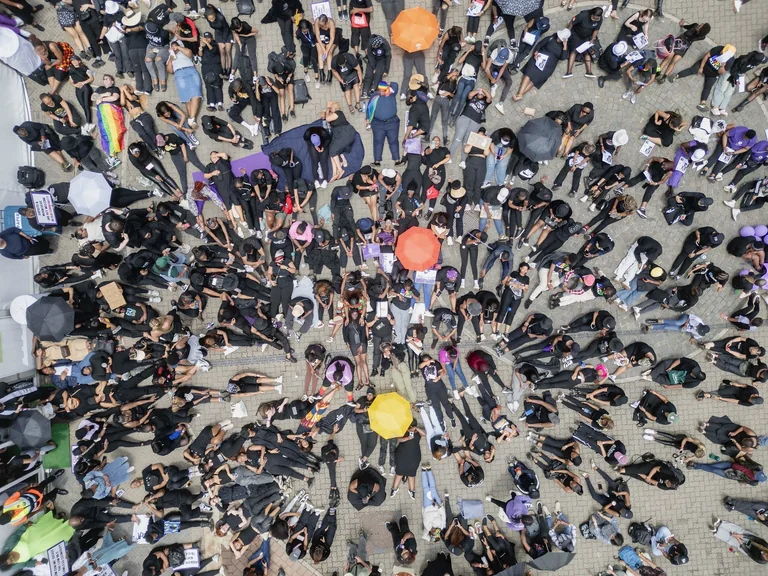
At noon on 21 November 2025, thousands of women lay on the ground for fifteen minutes in Johannesburg, Pretoria, Cape Town and elsewhere in South Africa as the names of murdered women were read aloud. Each minute represented one of the fifteen women who, according to the organisers, are murdered in the country every day. The previous day, the president had called gender-based violence and femicide a national crisis, and that very morning the Government announced that it had classified them as a national disaster. This 21 November, women are mobilising again to demand what, in their view, that victory did not deliver: a public plan with a budget, named people responsible and results that can be verified.
The call to action asked for four things: wear black as a sign of mourning, spend no money that day, stop working — whether in paid employment or domestic labour — and lie down in silence at noon. Women For Change, founded in 2016 by Sabrina Walter, called it the G20 Women’s Shutdown because it fell on the eve of the G20 summit in Johannesburg, the first to be held in Africa. The organisation addressed its appeal to women and LGBTQI+ people and coordinated fifteen official gathering points, including Constitution Hill in Johannesburg, the lawns of the Union Buildings in Pretoria, the Sea Point promenade in Cape Town and South Beach in Durban. The accompanying petition gathered more than 1.1 million signatures and called for gender-based violence and femicide to be declared a national disaster.
Before the shutdown, the National Disaster Management Centre had rejected that request. Its head, Bongani Elias Sithole, replied that gender-based violence could not be considered a disaster under the law and should instead be addressed through the National Strategic Plan and existing legislation. Days later, the same centre changed its position. On 14 November, the day the petition passed one million signatures, the Government requested an urgent meeting with Women For Change. On Thursday 20 November, President Cyril Ramaphosa described gender-based violence as a national crisis at the G20 Social Summit. Privately, however, the Government had already confirmed something else, according to the organisation’s spokesperson, Cameron Kasambala. ‘The president keeps saying “crisis” publicly, but in our meeting yesterday they confirmed that it is a national disaster,’ she told TimesLIVE on the day of the protest. On the morning of the 21st, hours before people lay down, Cooperative Governance Minister Velenkosini Hlabisa announced that Sithole had classified it as a national disaster. Walter has said she received confirmation while driving to the Sea Point gathering. On the 24th, the classification appeared in the Government Gazette under section 23 of the Disaster Management Act 2002. One year later, Women For Change has called a second shutdown for Saturday 21 November 2026. ‘In 2025, we demanded recognition. In 2026, we demand implementation, funding and accountability,’ its statement says.
What classification does — and does not — provide
South African law offers two routes in response to a disaster. Section 23 allows it to be classified; under section 26, the national executive must then manage it using existing legislation, budgets and contingency plans. Section 27 allows a national state of disaster to be declared, empowering the responsible minister to issue emergency regulations and directions. The Government took the first route, and the ministry itself clarified that classification conferred neither emergency powers nor access to emergency funding.
Lawyer Rethabile Mosese, who has led legal services for survivors for more than a decade and is working towards a doctorate at the University of Pretoria, compared the two routes in June on the university’s Centre for Human Rights blog. In March 2020, during the Covid-19 pandemic, the Government issued emergency regulations within 72 hours. On gender-based violence, Mosese noted, the February 2026 national budget contained no dedicated allocation, while the president devoted 72 seconds of a 100-minute State of the Nation Address to the issue. The National Council on Gender-Based Violence and Femicide, established by legislation in 2024, had still not been constituted at that point; Ramaphosa appointed its members with effect from 1 August. In September, the Nelson Mandela Foundation’s chief executive, Mbongiseni Buthelezi, asked what had changed ten months later and described the official Women’s Month events as ‘pageantry in a crisis’.
The Government did take action. In December 2025, the Cabinet approved a programme of action with five priorities, ranging from prevention to support for survivors. That programme sits alongside the National Strategic Plan 2020–2030, in place for six years. What Women For Change says is missing is a costed, time-bound disaster response plan. On 29 September 2026, following a series of women’s deaths in Ekurhuleni, east of Johannesburg, Ramaphosa addressed the nation from the Union Buildings and admitted that the Government had not done enough. He announced a nationwide review of unresolved cases, a funded plan to reduce forensic backlogs, safety audits for women in every municipality and a package of measures against alcohol-related violence. Most carried 60-day deadlines, falling at the end of November, with an initial progress report due after 90 days. On 21 October, the mid-term budget review included an allocation of R3.8 billion over three years to recruit more than 3,500 social workers among its measures against gender-based violence. Women For Change acknowledges those commitments in its new petition but responds with two sentences: ‘A deadline is not delivery. A promise is not protection.’ It asks the Presidency to publish, by 21 November, a fully costed implementation plan with its own transparent budget, measurable targets, quarterly reports and a designated person accountable for the results. That is the gap the second shutdown puts at its centre: the distance between an approved programme and a plan that anyone can read, measure and demand action on.
A disaster with no beginning or end
South African law defines a disaster broadly: an event that may be sudden or progressive, widespread or localised, natural or human-caused. But its exceptional instruments are designed for something that arrives, is managed and comes to an end. Mosese sets out the argument the Government might make: a state of disaster is not suited to gender-based violence because it is a structural condition, without the beginning and end of an acute crisis. She acknowledges the legal force of that argument but adds that it proves too much. It exposes the absence in South Africa of any adequate instrument for chronic crises that have crossed the threshold of an emergency; that absence is itself a legislative failure. Researcher Lisa Vetten, who has studied femicide in South Africa for decades, warned in the Mail & Guardian in September that this violence cannot be approached as a temporary emergency: it is chronic and bound up with social, economic and institutional factors.
Writer and scholar Pumla Dineo Gqola had approached the question from another direction years earlier. Chapter four of Rape: A South African Nightmare (2015) examines what she calls the female fear factory. The threat of rape, she writes, reminds women that they are not safe and that their bodies do not belong to them, ultimately restricting their movements, both physically and mentally. For this factory to operate, the perpetrator must feel secure, the woman must know she is vulnerable and he must be able to communicate that he can harm or kill without consequences. The same threat, she adds, reminds some men and trans people that they too can be raped. Gqola developed the idea in Female Fear Factory (2021) and explained in a 2023 interview that she was looking for strategies to shift fear from those who endure it to those who might perpetrate violence. In her 2015 book, she places rape within the ordering of power, gender and race in South Africa, rooted in colonial conquest and apartheid. Read through Gqola, the category of disaster falls short of describing violence that persistently structures everyday life. Lying on the ground at Constitution Hill or on the lawns of the seat of government becomes a way of occupying precisely the public space that the fear factory teaches women to avoid.
That fear became visible again in September, following women’s deaths in Ekurhuleni. In early September, Elizabeth Moselakgomo, 38, went for a run from her home in Kempton Park and did not return; her family identified her body days later. Police are also investigating the deaths of other women found in the area since July. Police have made arrests in some of those cases and are investigating possible links. In Moselakgomo’s case, no one had been charged with her death by mid-October. During those weeks, the Mail & Guardian reported on the fear felt by women runners across the country.
The figure
The figure of fifteen women murdered every day has more than one source, and tracing it reveals how difficult it is to establish how many there are. Mosese attributes it to research by the South African Medical Research Council and Gender and Firearms Studies Africa. Vetten documented that, for 2023–24, one police presentation recorded 5,578 women murdered — around fifteen a day — whereas the sum of the same police service’s quarterly reports was 3,839, just over ten a day, and its annual report gave 3,485, slightly fewer than ten. These figures appeared in the Mail & Guardian on 14 September. Women For Change also turned 5,578 into a physical object. In April 2025, when it delivered its petition at the Union Buildings, the organisation launched the Unbury The Casket campaign (called The Unburied Casket on its website) with a coffin carrying 5,578 purple beads, one for every woman murdered over a year.
In June 2025, police stopped publishing disaggregated crime figures for women and children, citing serious anomalies, including duplicate entries and annual totals that did not match the sums of the quarters. During the 2025–26 financial year, quarterly reports appeared without that breakdown, as Daily Maverick documented. The report for April to June 2026, presented in late August, once again gave a figure: 569 women murdered according to the verified count, just over six a day. In that quarter, the overall murder count fell by 5.9% against the same period a year earlier, and the Mail & Guardian ran the headline that the numbers were falling but women kept being murdered.
There is a prior problem, too. Those statistics count women who were murdered, but not all such murders are femicides in the strict sense. South African law does not establish femicide as a separate offence and the police record it as murder. In September, after the bodies were found in Ekurhuleni, Amnesty International South Africa called for femicide to be criminalised separately. Its executive director, Shenilla Mohamed, argued that lumping these killings together with other murders conceals the violence that often precedes them.
On 3 November, the article ‘Counting Those Who Are Missing’ described how Mexican activists create their own registers because they distrust official figures. The South African case shows another side of the same problem. In South Africa, the state counts, but counts in several different ways at once, stops publishing its figures and starts again; meanwhile, the slogan of fifteen a day survives because no official figure has managed to replace it with authority. Mosese identifies another gap. She cites research by Rape Crisis Cape Town Trust suggesting that fewer than one in ten reported sexual assaults ends in a conviction, while the National Prosecuting Authority reports rates of around 75% for cases that reach judgment. The two figures measure different things and, in her view, the system ends up measuring its own activity when the question that matters is whether survivors are safer. Counting, in this context, is a way of contesting who gets to decide whether things are improving.
A care strike
The form of the protest has a history. On 9 August 1956, around 20,000 women marched on those same Union Buildings against the extension of apartheid pass laws to Black women; the date is now National Women’s Day in South Africa. On 1 August 2018, the #TotalShutdown movement led another march against gender-based violence to the same building and delivered a memorandum containing 24 demands. The declaration from the presidential summit held that November acknowledges that it arose from that mobilisation, and its commitments led to the National Strategic Plan on Gender-Based Violence and Femicide 2020–2030. Some participants in 2025 experienced it as a repetition. ‘It reminds me of 2018, when we had the first shutdown and the Government started listening,’ one told Channel Africa, adding that it was sad to have to come together again a few years later. #TotalShutdown had already urged women not to go to work and not to spend money. The 2025 shutdown replaced the march with bodies lying on the ground and explicitly included domestic labour.
Withdrawing care to reveal the value of unpaid work is a familiar feminist tactic, from the Icelandic women’s strike of 1975 to feminist stoppages in Latin America and on 8 March. The organisers of the 2025 action framed it in those terms. Kasambala explained that they wanted to show the Government ‘the consequence of our social and economic absence’. Kearabetswe Moopelo of the New Economy Hub called for recognition of the unpaid work women carry on their shoulders, summing it up: ‘If we stop, the country stops.’
The form of protest nevertheless leaves a question open. For a domestic worker, a carer without an independent income or a woman surviving in the informal economy, stopping work for a day comes at a very different price from the one paid by a salaried professional; some care cannot simply be suspended without leaving someone else alone. In a country where domestic employment is still undertaken predominantly by Black women, against a background of inequalities inherited from colonialism and apartheid, that difference is also one of race and class. Geographer Malaika Mahlatsi, a researcher at the University of South Africa, raised another objection on the day of the shutdown in an Eyewitness News column. She said she would not take part because she was exhausted, argued that staying away was not a betrayal and described the brutal demand placed on survivors to reopen their wounds with every mobilisation. She called her decision to withdraw ‘a radical act of self-preservation’. A participant in Johannesburg told Channel Africa something similar: ‘We are tired women, exhausted, living in fear.’ A care strike asks women to stop working while also asking them to undertake another kind of work: bringing their bodies and their grief into the street.
The second shutdown falls on a Saturday, and the 2026 call places greater emphasis on a procession from the University of the Witwatersrand to Constitution Hill in Johannesburg, carrying an unburied coffin like the one used in the 2025 campaign. According to the organisers, it symbolises the women who were murdered and the families still waiting for justice. Constitution Hill is the former prison complex that now houses the Constitutional Court. At noon, participants will again lie down for fifteen minutes.
Women For Change explicitly included LGBTQI+ people in its 2025 call and has done so again in 2026.
Purple profile pictures
The 2025 call spread mainly through social media. In the account Walter published in January on the petition page, she recalls seeing a video on TikTok one evening of a woman announcing that on the 21st she would wear black and turn her profile picture purple. The next morning TikTok was purple, followed by Instagram and Facebook. The organisation’s website crashed under the traffic, more than 15,000 messages came in, and a petition that had been stalled at around 150,000 signatures since April passed one million. All of this happened on platforms whose recommendation algorithms decide what each person sees. In South Africa, turning a profile picture purple became the simplest way to join the mourning. The same images can serve other purposes, as the 5 November article ‘All It Took Was a Profile Picture’ recounted in relation to fabricated nude images created with artificial intelligence from photographs of teenage girls in Almendralejo.
The same screens have another side. Walter writes that the organisation ended 2024 exhausted and subject to constant harassment. Mahlatsi explains that she had been off social media for more than six months and restricted her exposure to news about gender-based violence because each new case reopens the wounds of those who have experienced it. Among the things she had decided not to do was change her profile picture in memory of another murdered woman. In January, Women For Change announced plans for its own survivor support line. The organisation now offers the service on WhatsApp. What circulates on these platforms can mobilise and can wound; the violence perpetrated through them is the subject of Thursday’s article.
Femocracy and what comes next
In 1995, Nigerian-British feminist scholar Amina Mama, one of the founders of Feminist Africa, used the term femocracy to describe, through the Nigerian case, an anti-democratic structure of female power dominated by a small elite whose authority derived from marriage to powerful men, with first ladies at the forefront, claiming to act for ordinary women without being accountable to them. South Africa in 2026 is far removed from the military-era Nigeria Mama analysed. Even so, her distinction between state feminism and feminism as popular struggle offers a way to read the intervening year. A disaster classification, a national council and a programme of action are gains won by the movement; their political meaning will depend on the resources, decisions and oversight that accompany them. South African political scientist Shireen Hassim showed in Women’s Organizations and Democracy in South Africa (2006) how women’s organisations have moved for decades between asserting their autonomy and negotiating within larger movements and institutions, and how that tension has given them real influence. The 2026 shutdown is another episode in that negotiation, and its outcome is not yet written.
The deadline Women For Change has given the Presidency expires on 21 November itself; Ramaphosa’s first deadlines follow a week later. What is published then will make it possible to assess how much that earlier victory has changed the state’s response. Four days after the shutdown, the United Nations’ 16 Days of Activism against Gender-Based Violence begin, with this year’s theme calling for justice, protection for survivors and an end to impunity. The article on Thursday 12 November will stay in Africa, covering the consultation being held by the African Commission on Human and Peoples’ Rights on Wednesday the 11th on the first continental study of digital violence against women.
This article was written in Spain using public documents, most of them produced in South Africa and in English, which were translated into Spanish for the original edition: the Women For Change calls and petition, the Government Gazette notice, Government statements, the analysis by the University of Pretoria’s Centre for Human Rights, South African journalism and works by South African and other African women writers and scholars. Statements by organisers and participants come from South African news coverage and the account published by Women For Change. We have not interviewed them or the families, and we do not speak on their behalf.
Sources and related reading
- Women’s Shutdown 2026 — Women For Change
- GBVF is a National Disaster. Now Implement and Act — Women For Change
- G20 Women’s Shutdown — Women For Change
- Women for Change protest highlights grief, frustration over SA’s GBV crisis — Channel Africa
- Women For Change at Constitution Hill — TimesLIVE
- Notice 6870, 24 November 2025 — Government Gazette
- Disaster Management Act 57 of 2002 — South African Government
- Between coordination and enforcement — AfricLaw
- Cabinet approves programme of action to address GBVF — SAnews
- Four-point plan to aid the GBVF fight — SAnews
- Medium-Term Budget Policy Statement 2026 — South African Government
- The numbers are falling but women keep being murdered — Mail & Guardian
- Why is SAPS withholding vital crime statistics on women and children? — Daily Maverick
- South Africa: Call it what it is. Femicide — Amnesty International South Africa
- 1956 Women Marchers — South African History Online
- Declaration of the Presidential Summit Against Gender-Based Violence and Femicide — South African Government
- Not participating in the GBV national shutdown is not a betrayal — Eyewitness News
- Silent Protest Excerpt 2 — Grocott’s Mail
- A World Without Fear — Falling Walls
- Amina Mama: Feminism or Femocracy? — Africa Development
- Call for Inputs: Draft Continental Study on Digital Violence Against Women in Africa — African Commission on Human and Peoples’ Rights