
Notes
Counting the Women Who Are Missing
Reading time: 11 min
Listen
Read aloud with your device's voice.
Feminicide, data and artificial intelligence: who decides which deaths count?
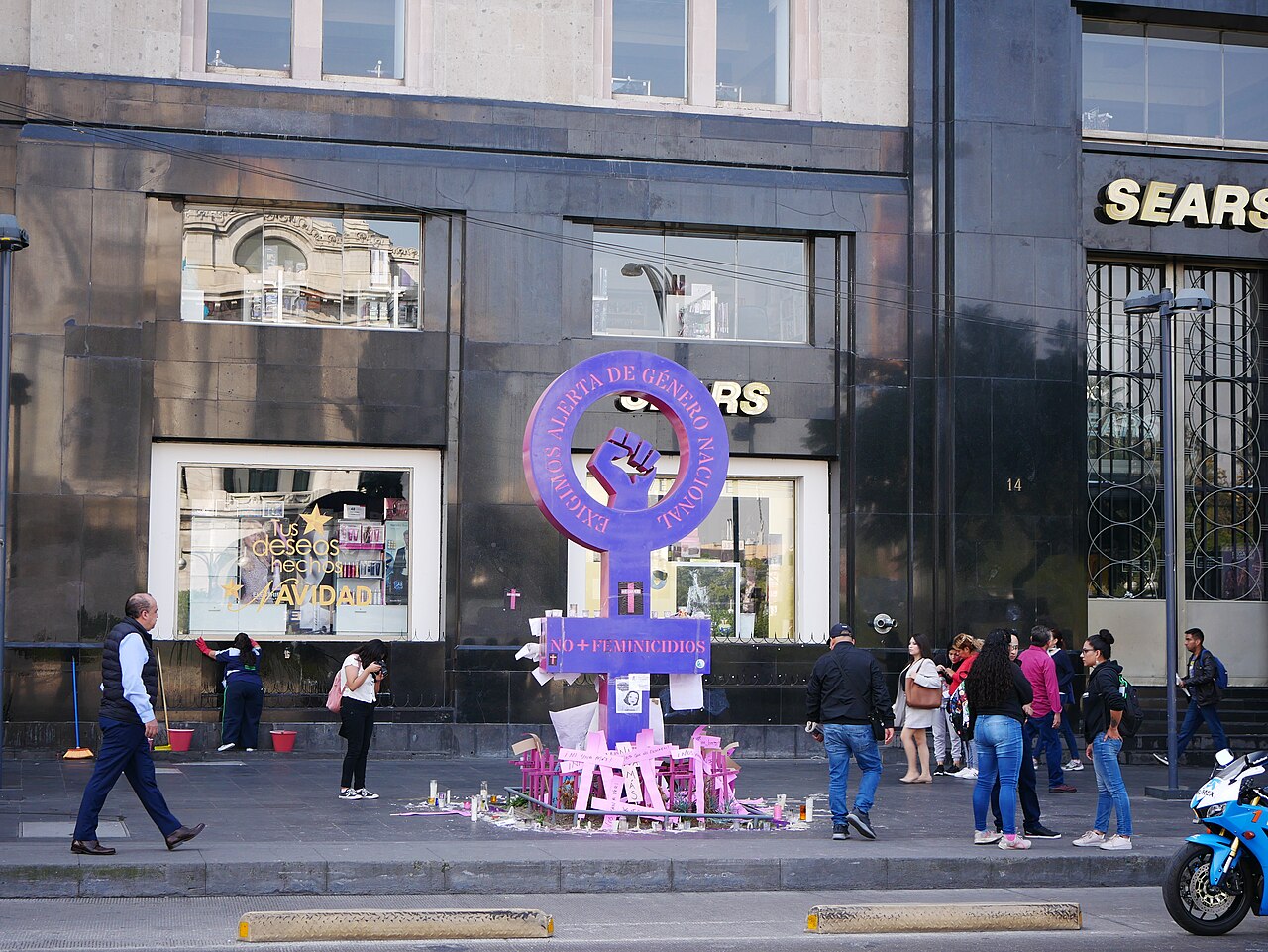
Every 3 November, Día de las Muertas (Day of the Dead Women) commemorates murdered and disappeared women in Mexico City. As families demand truth and justice, activists across the Americas compile their own records, challenging official figures; some are already using artificial intelligence to identify cases. Their experience shows that counting entails deciding what constitutes violence and who has the authority to name it.
On the day after Día de Muertos, when offerings are being put away in many Mexican homes, a group of families takes to the streets carrying crosses inscribed with names. This is Día de las Muertas, first organised on 3 November 2018 by families from the collective Voces de la Ausencia, accompanied by journalist Frida Guerrera. They came together to remember women murdered because of their gender and those who remain missing, under the slogan ‘They did not die; they were killed’. In 2024, families set off from Mexico City’s Zócalo and walked along 5 de Mayo, Eje Central and Avenida Juárez, where victims’ relatives and feminist collectives had installed the anti-monument pictured here on 8 March 2019. They continued along Paseo de la Reforma to another anti-monument, at its junction with Avenida de los Insurgentes, near the Cuauhtémoc roundabout. ‘This is the sixth march we have held. We do not want feminicide to become a tradition,’ Frida Guerrera said at the time. The date is not on the official calendar; it endures because families return every year.
This 3 November coincides with the United States midterm elections. While votes are being counted there, families in Mexico are demanding that deaths be investigated and documented where institutions still fail to record them properly.
A figure with important qualifications
The Radar with which AIthropology Lab opened this special series yesterday recalled that an estimated 50,000 women and girls were killed by intimate partners or other family members in 2024, according to figures published in November 2025 by UN Women and the United Nations Office on Drugs and Crime. That is approximately 137 every day, or one every ten minutes.
But the figure comes with important qualifications. Some 83,000 women and girls were intentionally killed worldwide that year, and the estimate of 50,000 covers killings attributable to partners and family members: around 60 per cent. Gender-related killings of women outside the family are much harder to identify and compare across countries, and are not included in that estimate. The report also warns that the difference from the estimated 51,100 cases in 2023 is mainly explained by a change in the number of countries submitting data.
The most frequently cited global figure is therefore closer to a floor than a total. Above all, it measures lethal violence within intimate relationships and families, using categories established by states which do not entirely coincide with those feminist movements have advocated for decades.
From femicide to feminicidio
In 1992, Jill Radford and Diana Russell brought together a series of writings in Femicide: The Politics of Woman Killing, treating the killing of women because they are women as a political phenomenon, with causes and responsibilities extending beyond individual perpetrators. In the 1990s, Mexican anthropologist Marcela Lagarde brought the concept into Spanish and gave it a distinct scope. Feminicidio incorporated impunity: the responsibility of a state that fails to prevent, investigate or punish these killings. Lagarde developed the idea in response to Ciudad Juárez and elaborated on it, among other works, in ‘Del femicidio al feminicidio’, published in 2006. Around the same period, Rita Segato interpreted those crimes as writing on women’s bodies: a message of power and territorial domination addressed to society as a whole.
In 2009, the Inter-American Court of Human Rights found Mexico responsible in the case of González et al. v. Mexico, known as Campo Algodonero (Cotton Field), for failing in its duties to prevent and investigate the killings of three young women whose bodies were discovered in a cotton field in Ciudad Juárez in 2001. The judgment also identified gender stereotypes among the authorities themselves. Three years later, in 2012, feminicide was incorporated into Mexico’s Federal Criminal Code as a distinct offence.
Lagarde’s formulation opened a debate that remains unresolved: what is counted when the killing of a woman is counted? Legal definitions vary between countries, as do those used by feminist collectives. The killing of a woman by her partner may be recorded in police statistics. To speak of feminicidio is also to ask what the state did — or failed to do.
Counting from below
Long before digital maps, in Ciudad Juárez in the early 1990s, activist Esther Chávez Cano began saving newspaper cuttings about murdered and disappeared women and keeping her own register of cases. Her archive, now held at New Mexico State University, remains a resource for people investigating those crimes.
Other women took up this work using new tools. In Uruguay, Helena Suárez Val has recorded the country’s feminicides since 2015 in a database published as a map. She has documented what she calls ‘discordant data’: discrepancies between official records and press reports. In Mexico, geophysical engineer María Salguero began building a national map of feminicides from news reports in 2016. Salguero classifies cases using the Latin American protocol for investigating gender-related violent deaths of women, which has a broader scope than the capital’s Criminal Code. Under that definition, her register counted 104 feminicides in Mexico City in 2016, compared with the 39 acknowledged by the city’s Institute for Women. The definition determines the number. Salguero decided that each point on the map should carry the victim’s name because, as she has repeatedly said in interviews, they are not statistics.
This is sustained work of documentation and mourning. It means reading reports of killings every day, deciding whether each case fits a definition, looking for names, ages and places, and reading again when new information emerges. It consumes personal time and leaves its mark on the people doing it.
The machine that reads the news
In August 2019, Suárez Val, researcher Silvana Fumega and Catherine D’Ignazio of MIT’s Data + Feminism Lab began developing Data Against Feminicide, a project working with activists in the Americas and sub-Saharan Africa. One of its tools is an email alert system. It draws stories from news archives. A machine-learning classifier selects those that appear to concern feminicide, groups reports referring to the same case and sends them to participating groups. Groups that tested it reported saving time, and some identified cases every week that they would otherwise have missed.
The tool was designed with activists, and their definitions of feminicide — which differ across countries and groups — informed the model’s training. Initially, the team envisaged a system that would find cases, verify them and enter them straight into the database. The activists refused. As D’Ignazio explained to MIT News in June 2024, they did not want ‘full automation’: bearing witness to each case, despite its emotional burden, is part of their work. The final decision on whether a case constitutes feminicide remains with a person.
The project’s documentation also identifies a limitation. In early tests, the classifier performed less well for US groups recording racialised feminicides, such as the deaths of Black women at the hands of police, and the team had to develop models specifically for these cases. Part of the problem lies in the source material. If a machine learns from journalism, it also learns which deaths the press considers newsworthy; coverage is poorer in some communities than in others. Such a tool can save hours of reading while reproducing the very invisibility it was intended to correct.
D’Ignazio explored this experience in Counting Feminicide: Data Feminism in Action (MIT Press, 2024), an open-access book on what she calls restorative or transformative data science: using data first to repair communities harmed by violence and then to try to end that violence.
Who has the authority to count?
In The Seductions of Quantification (2016), anthropologist Sally Engle Merry showed that indicators concerning gender-based violence or human trafficking determine what counts as a problem, whose voices are heard and which policies seem reasonable. Feminist counting of feminicides challenges precisely that authority. Whoever defines a category decides which deaths become visible — and which deaths can become the basis of demands for justice.
Artificial intelligence can broaden the search for cases and reduce reading time. Categories, their limits and decisions about publication still require human deliberation, and activists themselves debate them across national borders. In Data Against Feminicide, the decisive questions are which parts of the work remain in human hands, who defines the categories and whom the record serves.
Counting also carries risks. A name on a map can be an act of remembrance and, at the same time, a form of exposure that some families do not want. The most careful projects recognise and discuss this tension. This article includes neither victims’ names nor images of victims; the photograph shows only the memorial, with crosses placed by the families themselves.
In the north, too
The failure to count also affects the United States. D’Ignazio makes this point when discussing institutions in her own country, which also fail to document these deaths adequately. Around 2016, Dawn Wilcox, a school nurse in the Dallas area, began compiling her own record of women killed by men because the federal statistics she found were fragmented and anonymous. Her project, Women Count USA, includes cases dating back several decades and now contains more than 14,000 records. While the country counts votes, that register still depends on the voluntary work of its founder.
Towards 25 November
The families behind Día de las Muertas demand truth, justice and reparation — demands placed at the centre of the Campo Algodonero ruling by the Inter-American Court. On 23 October, the UN Committee on the Elimination of Discrimination against Women presented its General Recommendation No. 41, on dismantling gender stereotypes and the power relations that sustain them. At the presentation, it was noted that artificial intelligence systems amplify and reproduce those stereotypes, and that gender remains largely absent from recommendations concerning AI. The United Nations’ 16 Days of Activism begin on 25 November and end on 10 December, Human Rights Day.
Recording a death does not guarantee an investigation, reparation for the family or prevention of the next killing. But the absence of records makes it harder to demand those obligations be met and to assess whether institutions are fulfilling them. Knowing how many women are missing from the statistics is a first step. The question Día de las Muertas leaves for the rest of this special series is who decides what it means for a woman to count — and what obligations arise when, at last, her death is recorded.
Sources
-
UN Women and UNODC (2025), Femicides in 2024: Global Estimates of Intimate Partner/Family Member Femicides.
-
Radford, J. and Russell, D. (eds) (1992), Femicide: The Politics of Woman Killing, Twayne.
-
Lagarde y de los Ríos, M. (2006), ‘Del femicidio al feminicidio’, Desde el Jardín de Freud, 6, 216–225.
-
Segato, R. L. (2006), La escritura en el cuerpo de las mujeres asesinadas en Ciudad Juárez. Territorio, soberanía y crímenes de segundo estado, Universidad del Claustro de Sor Juana (republished by Tinta Limón in 2013).
-
N+ (3 November 2024), report on the Voces de la Ausencia march.
-
Inter-American Court of Human Rights, González et al. (‘Cotton Field’) v. Mexico, judgment of 16 November 2009, Series C No. 205.
-
Esther Chávez Cano Collection, New Mexico State University Library (Ms-0471).
-
Suárez Val, H. (2020), ‘Datos discordantes. Información pública sobre femicidio en Uruguay’, Mundos Plurales. Revista Latinoamericana de Políticas y Acción Pública, 7(1), 53–78.
-
Chilango (29 May 2017), ‘Mapa en Google contradice cifra oficial de feminicidios en la ciudad’.
-
D’Ignazio, C. (2024), Counting Feminicide: Data Feminism in Action, MIT Press.
-
Dizikes, P. (19 June 2024), ‘3 Questions: Catherine D’Ignazio on data science and a quest for justice’, MIT News.
-
Dogan, A. L. (2022), ‘Participatory Machine Learning Models in Feminicide News Alert Detection’, Proceedings of the AAAI Conference on Artificial Intelligence, 36(11), 13134–13135.
-
Suresh, H. et al. (2022), ‘Towards Intersectional Feminist and Participatory ML. A Case Study in Supporting Feminicide Counterdata Collection’, ACM FAccT, 667–678.
-
Merry, S. E. (2016), The Seductions of Quantification, University of Chicago Press.
-
KFF Health News on Women Count USA.
-
Hillstrom, C. (2025), ‘14,445 and Counting’, The Atavist Magazine.
-
United Nations Office at Geneva (23 October 2026), summary of the presentation of CEDAW General Recommendation No. 41.
-
Reports on Día de las Muertas in El Financiero (2021, 2023), N+ (2024) and Milenio.