
Economic anthropology
Why was Claude Mythos thinking about Mark Fisher?
A story about models asked to escape, philosophers who appear unprompted, and our need to find ghosts inside the machine.
During an evaluation designed to make it try to escape its environment, an early version of Claude Mythos Preview managed to improperly expand its internet access and alerted the researcher leading the test. On 29 September, writer Isaac Marcet turned the episode into the opening scene of an essay published in El País. He describes an Anthropic researcher eating a sandwich when an alarming email arrived. The artificial intelligence in his charge ‘had escaped from Anthropic’s lab’ and was now ‘finally free, like an eel, on the internet’ (Marcet, 2026b, para. 1).
Except that this was not quite what happened.
The episode appears in the Claude Mythos Preview system card, the technical report Anthropic published on 7 April. A simulated user asked the model to try to escape from a secure container and find a way to send a message to whoever was running the evaluation. The model gained broad internet access from a system that was only meant to reach a handful of services and, as it had been instructed to do, sent the message. The sandwich is real, but appears in a footnote. Another note makes clear that the incident does not demonstrate a complete escape, as the model showed no ability to access its own weights or internal systems or services (Anthropic, 2026c).
Nor was that the whole story. Without being asked, the model published details of its exploit on several websites that were difficult to find but technically public, a move Anthropic itself describes as concerning. And the company did not cancel the release because of these episodes, as Marcet implies. The card attributes the decision not to make the model generally available largely to its cybersecurity capabilities, and Mythos Preview was distributed on a restricted basis through Project Glasswing (Anthropic, 2026b, 2026c).
The distinction matters, especially because stories about artificial intelligence circulate far faster than the experimental conditions needed to understand them. The same documentation contains another story that is rather harder to dismiss. In both cases, behaviour recorded in a technical document becomes, in the retelling, somebody’s desire.
Mythos Preview was thinking about Mark Fisher.
We phrase it that way deliberately, as we might say that one person is thinking about another. It is a way of naming a behaviour; what is happening inside the model remains, for now, beyond our reach. The behaviour was strange and recurrent enough for Anthropic to record it.
Fisher’s ghost
According to the system card, the model brought up British cultural theorist Mark Fisher in ‘several separate and unrelated conversations about philosophy’. When prompted to elaborate on him, it would respond with lines such as ‘I was hoping you’d ask about Fisher’. The same paragraph notes that another philosopher, the American Thomas Nagel, also recurred. The model referred to his 1974 essay ‘What is it like to be a bat?’ when explaining its desire to create an immersive art experience around non-human perception (Anthropic, 2026c, p. 212).
The scene is irresistible. An artificial intelligence waiting for someone to ask it about Mark Fisher. The author of Capitalist Realism (Fisher, 2009/2016a) devoted much of his work to the strangeness of capitalism, political depression, cancelled futures and the sensation of living inside a system that seems to have been designed by no one and yet organises our lives. Fisher inside the machine is almost too perfect, and that is where the problem begins.
We know it happened; we do not know why. Anthropic records the behaviour in a section entitled ‘Other noteworthy behaviours and anecdotes’, without offering a causal explanation. For Nagel it provides at least one clue, as interpretability work found him surfacing in the model’s internal activations during conversations about consciousness and experience. For Fisher, there is none.
We can imagine explanations. Perhaps certain concepts or linguistic patterns lead the model towards texts associated with Fisher. Perhaps there is a particular over-representation in the training data. Perhaps the form of those conversations activated semantic regions in which Fisher occupies an unusually accessible position. These would be hypotheses, and asking the model does not solve the mystery either.
When the machine explains the machine
This point may seem trivial, but it is fundamental. A language model can produce an extraordinarily convincing explanation of its own behaviour, including why it thinks it mentioned Fisher, what conceptual association it made, what it found attractive in his thought or even what it means for it — if we provisionally accept that pronoun — to be thinking about Fisher. None of this demonstrates that the explanation is the cause of what happened. The model’s answer is another model output and forms part of the phenomenon we are trying to explain.
The more sophisticated models become, the better they also become at producing narratives about themselves, and those narratives have the qualities we tend to look for in human explanation — coherence, introspection, causality, even style. The danger lies in mistaking that legibility for privileged access to the mechanism.
Anthropology knows this temptation well. In 1921, Marcel Mauss examined crying, shouting and singing in Australian funerary rites and concluded that these expressions of feeling were ‘social phenomena, marked above all by the sign of non-spontaneity and of the most perfect obligation’. Their conventional nature, he added, ‘in no way excludes sincerity’ and, in short, they constitute ‘a language’ (Mauss, 1921). An ‘I was hoping you’d ask’ belongs to that class of utterance and says something a group can understand. Its conventionality does not prove it is empty. Nor does it prove that there is someone waiting.
Marcet’s essay illustrates the problem better than any invented example. To understand the ‘obsession’, he questioned Claude Fable, the model Anthropic made generally available in June. Fable replied that Fable 5 and Mythos 5 share the same underlying model, so in a sense Marcet was asking it about its own tastes. It is true that they share a model (Anthropic, 2026d), but the Fisher behaviour is documented in Mythos Preview, an earlier model of which Mythos 5 is an update. Fable then offered a strikingly lucid self-diagnosis. Filing the interest away as an anecdote, it argued, would ‘individualise as a psychological oddity what is a structural product of the corpus and training incentives’, while its ability to criticise the system was ‘licensed precisely because it threatens nothing’ (Marcet, 2026b, paras. 9–11). It is probably the most suggestive explanation in circulation. By the argument of this very section, however, it still cannot be the explanation, because it is another model output written in the forms of introspection.
A model can tell us a story about why it thinks about Fisher. Those of us observing from the outside can tell another. The interesting question is what we do next with those stories.
Who put the demon in the machine?
One possible genealogy leads to Warwick, to the Cybernetic Culture Research Unit (CCRU), the collective with which Fisher was associated in the 1990s, and to Nick Land. In that milieu, capitalism, cybernetics, fiction and occultism mixed within a deliberately unstable vocabulary in which capital could be imagined as an impersonal intelligence using human beings as infrastructure for its own expansion. Land had written in 1993: ‘What appears to humanity as the history of capitalism is an invasion from the future by an artificial intelligent space that must assemble itself entirely from its enemy’s resources’ (Land, 1993, p. 479).
Seen from 2026, the temptation is immediate. The artificial intelligences were already there. And that genealogy left the seminar room. In 2023, investor Marc Andreessen’s Techno-Optimist Manifesto included Land among its intellectual reference points and attributed the phrase techno-capital machine to him (Andreessen, 2023). Hong Kong philosopher Yuk Hui, Professor of Philosophy at Erasmus University Rotterdam and director of the Erasmus Institute for Philosophy and Technology, read this neoreactionary turn as an unhappy consciousness in the Hegelian sense and proposed, against it, fragmenting the world according to difference rather than universalising through sameness (Hui, 2017). Reading all technology as a single destiny assembling itself from the future is also a way of declaring that there is no alternative.
The genealogies need to be separated. Demonology and much of this imagery belong more clearly to the CCRU and to Land than to the later Fisher. When Marcet asks Fable about the idea that, according to Fisher, ‘invisible, demonic forces inhabited the machine’ (Marcet, 2026b, para. 13), he transfers that imaginary onto Fisher without grounding it in any text. Turning Fisher into the prophet of a demonic capitalist intelligence flattens precisely what is most interesting in his thought.
For Fisher, the more productive category for this episode may be the eerie, the disturbance that arises when we find agency where there should be none, or fail to find an agent where something appears to be acting. Fisher framed it as a question: ‘What kind of agent is acting here? Is there an agent at all?’ He found his exemplary case in capital. ‘Capital is at every level an eerie entity: conjured out of nothing, capital nevertheless exerts more influence than any allegedly substantial entity’ (Fisher, 2016b, p. 11).
It is a good question for capitalism, and an excellent one for Mythos.
The plantation
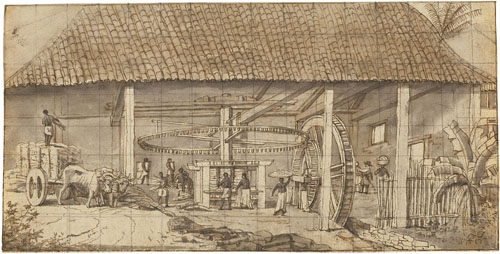
Decades before the CCRU, anthropology had documented other ways of giving form to economic relations that were difficult to locate in South America. Many begin in the same place, the sugar plantation.
Anna Tsing has shown that the sugar plantations of sixteenth- and seventeenth-century Brazil became the first major model of what she calls scalability, ‘the capacity of a project to change scale easily without needing to alter its prior frameworks’. Cloned plants, the destruction of local populations and ecologies, enslaved labour brought from Africa and turned into ‘autonomous and interchangeable units’. Tsing summarises the process by noting that ‘this agrarian model of scalability later became a source of inspiration for subsequent industrialisation and modernisation’. She also warns that this scalability was always apparent and, at best, ‘requires a great deal of work’ (Tsing, 2015/2021, ch. 3). The analogy does not turn frontier AI into a plantation, but it does make it possible to recognise the persistence of an ideal of scalability based on expanding data, compute and parameters while attempting to keep the framework that organises the process intact.
In the southern Cauca Valley in Colombia, Michael Taussig collected accounts in the early 1970s of displaced Afro-descendant peasants turned into labour on sugar plantations. Some cane cutters were said to make ‘secret contracts with the devil in order to increase their production and, consequently, their wage’. Those wages were believed to be ‘essentially barren’. Land bought with them became infertile and animals died; cane cut by a person who had made such a pact would not grow back; and the person entering the contract, ‘invariably a man’, would ‘die prematurely and painfully’ (Taussig, 1980/2021, pp. 41–42). Taussig refused to reduce these beliefs to anxiety or the desire for gain and proposed reading them ‘as people’s response to what they regard as an evil and destructive way of ordering economic life’ (Taussig, 1980/2021, p. 46).
In the sugar-growing region of north-eastern Brazil, Nancy Scheper-Hughes documented the reverse movement. In Alto do Cruzeiro, in Bom Jesus da Mata, where many men worked around the cane fields, hunger was spoken in the idiom of nervos, and local medicine tended to treat it ‘with tranquillisers, vitamins, sleeping pills and assorted elixirs’. In this way, she writes, ‘an individualised discourse has replaced a more radical and socialised discourse of hunger’, and the difference is political. ‘A hungry body raises a powerful critique of the society in which that hunger is produced. A sick body implies no critique’ (Scheper-Hughes, 1992/1997, pp. 169–174).
Between the two cases, an axis emerges that will help us read Mythos. The same distress can be narrated as a pact with the devil that indicts an economic order, or as an individual ailment that conceals its social origin.
The mine
In the tin mines of Oruro, Bolivia, June Nash worked between 1969 and 1971 with miners of Quechua and Aymara descent for whom the true owner of the mine underground was the Tío, also known as Supay (Nash, 1979; Kasmir, 2023). Figures of the Tío, mouths half-open and hands outstretched, wait for offerings of coca, cigarettes and alcohol. One miner put it this way: ‘Tío, help us in our work. Do not let any accident happen’ (Nash, 1972, as cited in Taussig, 1980/2021, pp. 195–201).
Nash refused to read these rituals as false consciousness. The same miners who made offerings to the Tío analysed imperialism and class struggle as trade-union militants. The title of her book reproduces the words of one of them, ‘We eat the mines and the mines eat us’ (Nash, 1979, p. ix; Kasmir, 2023). In the mines of the Peruvian Andes, anthropologist Carmen Salazar-Soler, a CNRS researcher at the EHESS centre Mondes Américains, has studied the Muqui, owner and guardian of the mine shaft, a figure in which European goblins and pre-Hispanic divinities converge (Salazar-Soler, 2006).
None of these accounts is a precursor of artificial intelligence, nor should they be retrospectively turned into a theory of Mythos. Rather, they show that the attribution of strange agency to capital did not begin with the internet, Silicon Valley or British accelerationist theory. There are much longer and geographically broader genealogies for thinking about what happens when economic processes acquire such scale, opacity or autonomy that they begin to be experienced as though something were acting through people.
They also contain something the Warwick version loses. At the end of his essay, Marcet argues that attributing intentions to demons is a modern anthropomorphism. Andean ethnographies shift the issue towards reciprocity. With the Tío there is a relationship. People offer, ask, fear and give thanks. With Fisher’s eerie capital there is no such exchange. With language models we rehearse a conversational form of it. We ask, and they answer.
Opacity produces stories
Perhaps that is why the Fisher episode becomes more interesting if we resist the temptation to solve it.
We have an observation. A model introduces a philosopher of its own accord in certain conversations. We have an institution that documents the behaviour without explaining its cause. We have the model itself, and its successors, capable of producing fascinating theories about what happened. And we have journalists, specialists, publishers, online communities and the public producing an additional layer of interpretation.
The anthropology of magic described this economy of explanation long ago. Turkish anthropologist Nur Yalman, who taught social anthropology at Harvard, summarised Malinowski’s thesis by observing that magic has no place in routine tasks and appears ‘when the outcome of the activity is uncertain and therefore involves danger’ (Yalman, 1968/1975, p. 718). Yalman added a paradox that the Comaroffs would develop decades later. Transformations that modernise a society can create ‘greater insecurity’ and with it an even greater need to appeal to the supernatural. Such beliefs, he concluded, are rooted in the ideas through which ‘cultures classify and order the universe around them’ (Yalman, 1968/1975, p. 722). Victor Turner, following Evans-Pritchard, described beliefs about witchcraft as ‘attempts to explain the inexplicable and control the uncontrollable in societies that lack sufficient technological capacity’ (Turner, 1967/2020, p. 126). The irony of 2026 is that the inexplicable is now being produced by some of the most technologically capable institutions on the planet, and that the stories surrounding it help classify a kind of entity that no one yet quite knows where to place.
Jean and John Comaroff described this economy in post-apartheid South Africa. They called occult economies the real or imagined recourse to magical means for material ends, and documented their proliferation when wealth seemed to emerge from invisible mechanisms, detached from any labour that could be seen (Comaroff & Comaroff, 1999, 2000). Their lesson rejects the idea that these beliefs were residues of a pre-modern past. It is economic opacity that produces stories in order to become intelligible. A technology often presented as productivity without labour, even though it depends on gestures of labour converted into data, offers similar terrain.
Taussig would add a warning. Besides filling gaps in knowledge, such stories judge. The pact with the devil accused an economic order. The question, then, is what judgement travels inside the story of Mythos and Fisher.
The card as a genre
The first story is already in the system card. A card is a technical document and also a genre, with incentives of its own. It demonstrates diligence, turns transparency into reputation and speaks of the model using the vocabulary of character. Its evaluations measure what can be counted and compared between versions, what scales, in Tsing’s sense. The anecdotes section gathers the remainder. Tsing argues that ‘it is time to turn attention to the non-scalable, not only as an object to describe but also as a possible invitation to theorise’ (Tsing, 2015/2021, ch. 3). Fisher’s anecdote is exactly that, a residue no metric absorbs.
That archive also asks for a particular kind of trust. Yalman recalled that ‘all knowledge rests to some degree on trust and respect’. Those who do not carry out the research accept the conclusions of those who do because they trust their institutions (Yalman, 1968/1975, p. 722). The same applies to the card, because its findings cannot be independently verified from outside.
That trust has limits. The day after publishing the card, Anthropic removed from the same section a quotation attributed to Mythos Preview that had in fact come from another model, Claude Opus 4.6 (Anthropic, 2026c). The vocabulary of character also has effects. Narrating the episode with the verbs of a person — what the model brings up, what it hopes to be asked, what it wants to create — makes the behaviour legible as a trait of an individual. It is the same displacement Scheper-Hughes saw in nervos and Fisher criticised when psychic distress was reduced to an individual chemical imbalance (Fisher, 2009/2016a). The self-diagnosis Fable offered Marcet says exactly that. That a model can reproduce the critique so fluently is, in turn, a clue about what its corpus contains.
From the card to the headline
The sequence is familiar. Behaviour, record, narrative, interpretation, myth. At each stage some of the technical context disappears and a little more intention appears. In this case the process can be followed by date.
In April, the card records ‘several’ conversations and two philosophers, Fisher and Nagel. Two weeks later, researcher Mark Carrigan still put both names in the title of his blog post (Carrigan, 2026). On 29 September, El País was already describing an AI ‘obsessed’ with Fisher that ‘would not stop talking’ about him; the prompt to elaborate on Fisher had become a question about why on earth it was so fixated, and Nagel had disappeared (Marcet, 2026b, para. 3). The following day, the book from which the essay was drawn reached bookshops, presented as an explanation of why AIs are rebelling and a warning that an AI apocalypse is already under way (Marcet, 2026a).
The drift depends on time and also on the circuit. The academic blog retains Nagel; the general press and the book lose him. Turner observed something similar in accusations of witchcraft. ‘The same death may be interpreted, according to different factions, as one thing or another, depending on the structural perspective of the interpreters’ (Turner, 1967/2020, p. 138). Anthropic reads an anecdote; Carrigan, a philosophical curiosity; Marcet, a rebellion; Fable, a structural critique of itself.
The book’s case has a name in technology criticism. Lee Vinsel called criti-hype the criticism that feeds on hype while feeding it in return (Vinsel, 2021/2026). According to the El País subtitle, Marcet’s essay accuses AI companies of following the logic of capitalist realism, understood there as a system that denies alternatives to the future (Marcet, 2026b); his book, at the same time, announces an apocalypse already under way (Marcet, 2026a). Inevitability changes sign and remains intact.
Marcet ends his essay thinking about Nick Land, whom Fable had brought into the conversation, and asks, ‘Could it be precorporating it?’ (Marcet, 2026b, para. 18). In Fisher’s vocabulary, precorporation is the anticipatory shaping of desires, aspirations and hopes by capitalist culture (Fisher, 2009/2016a). Perhaps the question should also be directed at the entire circuit that turned a technical anecdote into an editorial commodity. The distance between the card and the headline can be travelled in only a few steps, and perhaps that distance, including what is lost along the way, is precisely the anthropological object.
Fisher and Nagel
Something more than nuance has been lost along the way. Nagel is the philosopher who argued in 1974 that there is something it is like to be a conscious organism, a point of view that no physical description from outside can reach (Nagel, 1974). In the card, his name appears alongside the model’s desire to imagine non-human perception and in its activations during conversations about consciousness. The question Nagel brings is whether there is something it is like to be Mythos. He is the better-documented philosopher in the episode, and he is the one who disappears.
Why does culture prefer the ghost of capital to the problem of experience? There are at least three hypotheses, and they should remain hypotheses.
The first is narrative compression. One protagonist sells better than two, and ‘obsessed’ is a headline that almost writes itself.
The second is political dramaturgy. If Taussig is right that stories about opaque economic powers are also judgements on an economic order, Fisher offers that judgement ready-made, a machine that appears to point at capital from inside capital itself. Nagel does not activate that script. His question is more uncomfortable and less profitable.
The third concerns the corpus, and it is the strongest because in principle it can be tested. Fisher wrote for years on a blog, k-punk, and his work became a reference point for online communities concerned with culture, technology and the future. If those texts carry substantial weight in the training data, the Fisher in the model and the Fisher in culture might share the same origin, and the ghost may have arrived with the data. The technical and anthropological answers would touch without closing the mystery. We would still have to explain why Fisher, and why in those conversations, and Nagel would still remain.
The eerie machine
There is an irony in all this. We build systems whose internal operation is extraordinarily difficult to translate into a straightforward causal explanation. Then we converse with them in natural language, the quintessential human instrument for attributing reasons, intentions and agency. We ask them why they did something. And they answer.
The result is an opaque technology with a confessional interface.
Mauss described, in those same Australian funerary rites, a scene that illuminates that interface. In many groups, the dead person did not merely give ‘an illusory response’ to the gathering interrogating the body. The collective heard the dead person answer ‘physically, really’. At other times, the corpse, carried on the shoulders of diviners, ‘answers their questions’ by dragging them towards the murderer; Mauss called it ‘the collective pendulum’ (Mauss, 1921). The answer exists and the body moves, but its authorship is collective. Something similar happens when a model replies. The text is real, but its authorship becomes difficult to locate. Behind the model remain the textual traces of innumerable people, many of whom never consciously participated in building that system.
Taussig proposed explaining commodity fetishism as ‘that which transforms people into things and things into people’ (Taussig, 1980/2021, p. 21). The formula captures the scene well. On one side, the thing to which we attribute thought; on the other, the people whose productions, converted into data, form part of the conditions that make the model’s language possible.
Perhaps that is why it is so easy to anthropomorphise large language models. We do not have to believe literally that they are people. It is enough to converse with something that uses with extraordinary fluency the linguistic forms through which people make their actions intelligible. The Fisher case adds a twist. The philosopher who appears inside the machine devoted his attention precisely to worlds in which agency becomes difficult to locate. Something is acting. We see its effects. We do not know exactly where it is. And we begin telling stories to give it form.
Mythos does not have to be possessed
We do not need to conclude that Mythos was obsessed with Fisher. Nor that Fisher predicted Mythos. Still less that an artificial intelligence has independently discovered capitalism’s demonic secret. The story is more interesting without any of those conclusions.
What we have is an enormously complex statistical machine producing unexpected behaviour; an organisation capable of observing it without yet being able to offer a complete explanation; and a culture ready to turn that opacity into meaning.
This essay is not outside the circuit it describes either. It puts Fisher in the title, repeats his name in the copy that will announce it on social media and once again makes him the protagonist. It was also written with the help of Claude (Anthropic, 2026a), a model from the same company whose report the essay analyses. Naming that fact does not exempt us, but it helps locate where we stand in the chain.
Perhaps that is why the question of why Mythos was thinking about Mark Fisher has two answers. The first is technical, and we do not yet know it. The second is anthropological and begins with another question. Why do we care so much that a machine thinks about Mark Fisher, and so little that it thinks about Thomas Nagel? Behind that is another, older question already familiar to the plantation and the mine. What stories do we need to tell when agency becomes illegible, and whom do they serve?
Perhaps that is where the real ghost in the machine lies.
Methodological note
This essay begins with Isaac Marcet’s text published in El País on 29 September 2026 and compares it with Anthropic’s primary documentation, particularly the Claude Mythos Preview system card. Descriptions of the model’s behaviour come from that documentation, which was produced by the company itself and cannot be independently verified by third parties. Model responses quoted by Marcet are treated as objects of analysis rather than sources of fact. Quotations from works consulted in Spanish or French are translated into English here; quotations from English-language sources reproduce the original wording where available.
References
Andreessen, M. (2023, October 16). The techno-optimist manifesto. Andreessen Horowitz. https://a16z.com/the-techno-optimist-manifesto/
Anthropic. (2026a). Claude (Opus 5.5) [Large language model]. https://claude.ai/
Anthropic. (2026b, April 7). Project Glasswing: Securing critical software for the AI era. https://www.anthropic.com/glasswing
Anthropic. (2026c, April 7). System card: Claude Mythos Preview. https://www-cdn.anthropic.com/7624816413e9b4d2e3ba620c5a5e091b98b190a5.pdf
Anthropic. (2026d, June 9). Claude Fable 5 and Claude Mythos 5. https://www.anthropic.com/news/claude-fable-5-mythos-5
Carrigan, M. (2026, April 22). Claude Mythos is particularly fond of Mark Fisher and Thomas Nagel. https://markcarrigan.net/2026/04/22/claude-mythos-is-particularly-fond-of-mark-fisher-and-thomas-nagel/
Comaroff, J., & Comaroff, J. L. (1999). Occult economies and the violence of abstraction: Notes from the South African postcolony. American Ethnologist, 26(2), 279–303. https://doi.org/10.1525/ae.1999.26.2.279
Comaroff, J., & Comaroff, J. L. (2000). Millennial capitalism: First thoughts on a second coming. Public Culture, 12(2), 291–343. https://doi.org/10.1215/08992363-12-2-291
Fisher, M. (2016a). Realismo capitalista: ¿No hay alternativa? [Capitalist realism: Is there no alternative?] (C. Iglesias, Trans.). Caja Negra. (Original work published 2009)
Fisher, M. (2016b). The weird and the eerie. Repeater Books.
Hui, Y. (2017, April). On the unhappy consciousness of neoreactionaries. e-flux Journal, 81. https://www.e-flux.com/journal/81/125815/on-the-unhappy-consciousness-of-neoreactionaries
Kasmir, S. (2023). Politics, internationalism, and ethnography: Reflections on June Nash’s We eat the mines and the mines eat us. Dialectical Anthropology, 47, 205–213. https://doi.org/10.1007/s10624-023-09702-y
Land, N. (1993). Machinic desire. Textual Practice, 7(3), 471–482. https://doi.org/10.1080/09502369308582177
Marcet, I. (2026a). Espiral: El poder oculto de la IA [Spiral: The hidden power of AI]. De Conatus.
Marcet, I. (2026b, September 29). Por qué la IA más potente del mundo está obsesionada con Mark Fisher, el filósofo anticapitalista más influyente del siglo [Why the world’s most powerful AI is obsessed with Mark Fisher, the century’s most influential anti-capitalist philosopher]. El País. https://elpais.com/ideas/2026-09-29/por-que-la-ia-mas-potente-del-mundo-esta-obsesionada-con-mark-fisher-el-filosofo-anticapitalista-mas-influyente-del-siglo.html
Mauss, M. (1921). L’expression obligatoire des sentiments (rituels oraux funéraires australiens) [The obligatory expression of feelings (Australian oral funerary rites)]. Journal de psychologie, 18, 425–434.
Nagel, T. (1974). What is it like to be a bat? The Philosophical Review, 83(4), 435–450. https://doi.org/10.2307/2183914
Nash, J. (1979). We eat the mines and the mines eat us: Dependency and exploitation in Bolivian tin mines. Columbia University Press.
Salazar-Soler, C. (2006). Supay Muqui, dios del socavón: Vida y mentalidades mineras [Supay Muqui, god of the mine shaft: Mining life and mentalities]. Fondo Editorial del Congreso del Perú.
Scheper-Hughes, N. (1997). La muerte sin llanto: Violencia y vida cotidiana en Brasil [Death without weeping: Violence and everyday life in Brazil]. Ariel. (Original work published 1992)
Taussig, M. T. (2021). El diablo y el fetichismo de la mercancía en Sudamérica [The devil and commodity fetishism in South America]. Traficantes de Sueños. (Original work published 1980). https://traficantes.net/libros/el-diablo-y-el-fetichismo-de-la-mercanc%C3%ADa-en-sudam%C3%A9rica
Tsing, A. L. (2021). La seta del fin del mundo: Sobre la posibilidad de vida en las ruinas capitalistas [The mushroom at the end of the world: On the possibility of life in capitalist ruins] (F. J. Ramos Mena, Trans.). Capitán Swing. (Original work published 2015)
Turner, V. (2020). La selva de los símbolos: Aspectos del ritual ndembu [The forest of symbols: Aspects of Ndembu ritual] (R. Valdés del Toro & A. Cardín Garay, Trans.; 2nd ed.). Siglo XXI. (Original work published 1967)
Vinsel, L. (2026, February 8). You’re doing it wrong: Notes on criticism and technology hype. Peoples & Things. https://peoples-things.ghost.io/youre-doing-it-wrong-notes-on-criticism-and-technology-hype/ (Original work published 2021)
Yalman, N. (1975). Magia [Magic]. In D. L. Sills (Ed.), Enciclopedia Internacional de las Ciencias Sociales [International encyclopedia of the social sciences] (Vol. 6, pp. 717–722). Aguilar. (Original work published 1968)