
Anthropology of work and AI
The gesture as data
Reading time: 18 min
From Meta to Gurugram, how clicks, skills and bodily techniques are turned into data to train automation.
On 14 June 2026, Donald Trump celebrated his eightieth birthday with the mixed martial arts gala UFC Freedom 250 on the south lawn of the White House. Mark Zuckerberg attended and was seen talking with the president. The evening brought together a fighting cage, corporate sponsorships, a military flypast, cryptocurrencies, donors and figures from political and economic power. It was the first professional sporting event held at the United States presidential residence. In its ostentation, the scene could bring Caligula to mind sooner than the sobriety one might expect from a constitutional democracy. Reuters described the crossover between spectacle, business and state power, and People documented Zuckerberg’s presence.
This is not an anecdote detached from what follows. Meta is not an isolated app but a corporate infrastructure that ties together Facebook, Instagram, WhatsApp, Messenger and a digital advertising service of global reach. In its latest quarterly report, the company declared an average of 3.56 billion people active each day across that family of apps during March 2026. This is neither the sum of accounts on each platform nor an exact census of individuals, but the corporate metric with which Meta estimates the combined daily reach of its services. The figure appears in its official first-quarter 2026 results. The European Commission recognises it as a gatekeeper under the Digital Markets Act, a category meant for platforms that work as decisive gateways between businesses and users. That designation is not, in itself, a monopoly conviction. It does name a concentrated power of intermediation over communication, attention, advertising and the circulation of data. The Commission’s official portal lists the current designations.
The United States antitrust dispute remains open. In November 2025, Judge James Boasberg concluded that the Federal Trade Commission had not shown that Meta retained a monopoly in the market the agency had defined, and refused to force the sale of Instagram and WhatsApp. On 20 January 2026, the FTC appealed the ruling and held to its argument that the purchases of Instagram in 2012 and WhatsApp in 2014 eliminated nascent competitive threats. Reuters reports the agency’s position, the ruling and Meta’s response. Beyond the judicial outcome, a political question remains. What does it mean that a single company can organise such different spheres of digital life and turn them, directly or indirectly, into resources for its expansion into artificial intelligence.
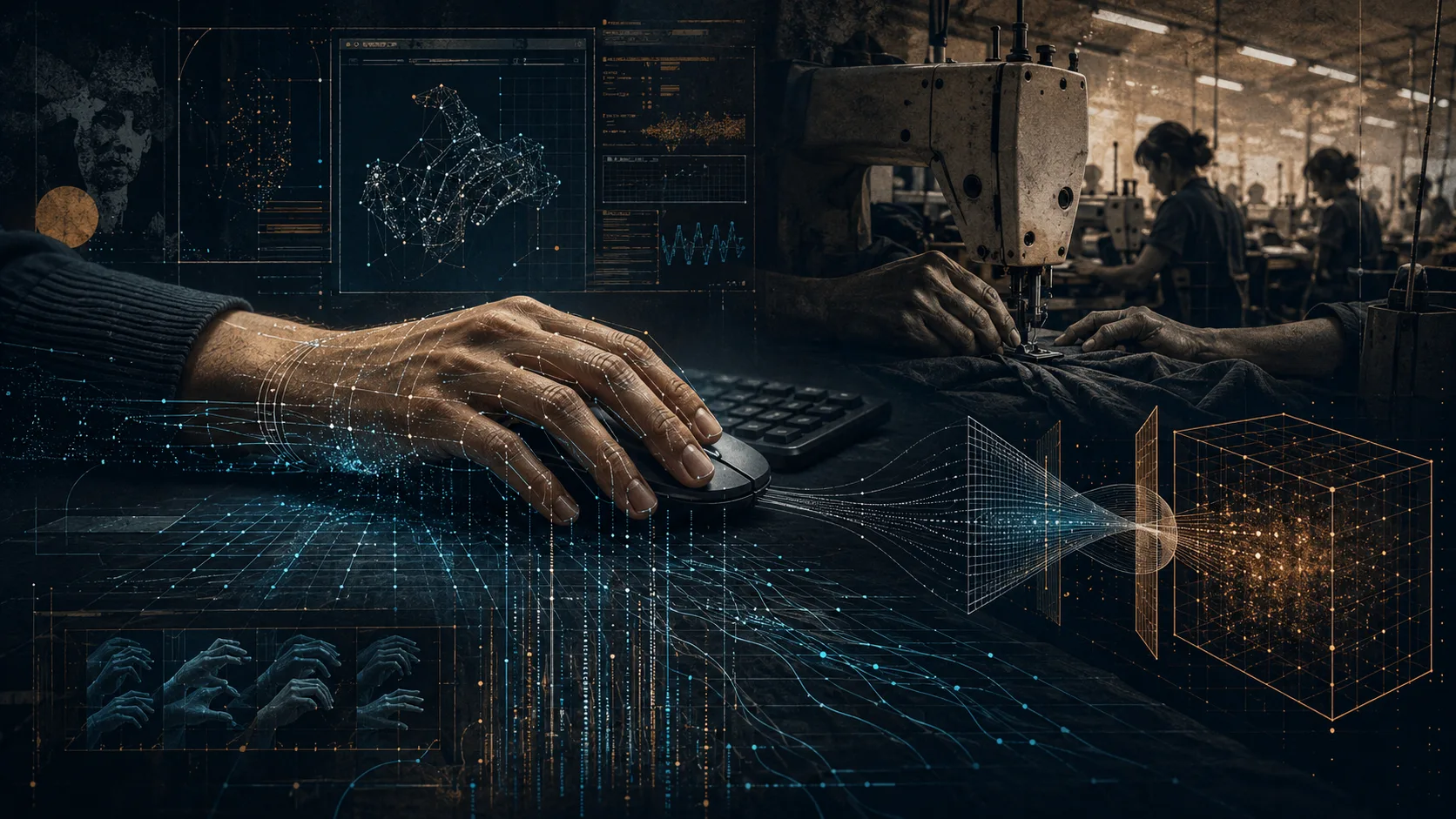
In April 2026 it emerged that Meta had begun installing, on the computers of part of its workforce in the United States, a program that records mouse movements, clicks, keystrokes and occasional screenshots. The aim was to train agents able to use a computer as a person would. The company put it plainly: its models needed real examples of navigation, correction and decision, and each member of staff could contribute simply by doing their everyday job. Reuters reported the launch of the Model Capability Initiative.
Here a decisive reversal appears. The employee does not merely use a tool. Their way of using it becomes raw material to train another tool. Work produces outcomes, but it also produces examples of behaviour that feed systems designed to carry out similar tasks. In an interview published by El País, the philosopher Carissa Véliz, professor of philosophy at the University of Oxford and author of Prophecy, warns that predictions about human beings are not neutral descriptions. Presented as facts, they order expectations and help bring about the very world they announce. The question is not limited to whether a machine will replace jobs. It begins earlier, the moment human work becomes the material from which the machine learns to intervene in work.
A captured gesture is not an innocent gesture
Workplace surveillance is nothing new. For a long time it served to measure presence, performance, hours and compliance. What is new is that the recording can aim at something different. It no longer only monitors the person who works. It turns their ways of solving a task into a reusable technical capacity.
Michel Foucault helps to pin down the scale of that shift. His analysis does not reduce power to prohibition or punishment. It attends to technologies that organise bodies, times, spaces, forms of knowledge and norms, and that in doing so produce subjects and realities. Discipline works on individual bodies through distribution, examination, recording and correction. Biopower extends that logic to the government of populations, rhythms, risks and capacities. It is not only about watching one person, but about producing a population that is legible, comparable and manageable.
Here George Orwell’s 1984 can work as a literary reference, with one decisive caution. The novel’s telescreen belongs to a totalitarian state that aspires to control intimacy, conduct and thought. Meta is not that state, and the monitoring of a workforce is not the totalitarian surveillance Orwell imagines. But the contrast illuminates something relevant. The screen ceases to be only a tool that one uses and also becomes a device that observes. What is at stake here is not a thought police, but a corporate power able to capture working practices, classify them and reuse them to train automation. 1984 works better as a warning about the normalisation of observation than as a label for describing the present.
Meta’s program operates at that intersection. It gathers individual micro-actions, but it seeks to compose from them a population of traces from which to model conduct. The click, the sequence of windows, the pause before correcting a mistake or the keyboard shortcut are turned into units of calculation. The mechanism does not merely observe work. It decides which part of work will be visible to the company, which will be quantifiable and which may become training for a future automation. Disciplinary surveillance once sought to correct the body present. Now it can extract from that body a pattern that will function once the body is no longer there.
From gesture to embodied knowledge
The paradigm of embodiment set out by Thomas Csordas, in dialogue with Marcel Mauss’s bodily techniques, helps to specify what is at stake. The body is not a store of knowledge or a passive archive from which data are extracted. It is the condition from which one perceives, attends, anticipates and acts in the world. A work skill is not just a visible sequence of movements. It includes a situated relation with materials, interfaces, co-workers, rhythms, interruptions and risks.
That difference matters in a factory and in an office alike. The hand that sews does not run through a mechanical series of movements. It adjusts force and speed to the resistance of the fabric, corrects when faced with an irregularity, anticipates the next step and coordinates with the rhythm of other people. In the same way, someone who has mastered a complex program does not add up isolated clicks. They recognise signals, remember exceptions, interpret contexts and decide when a rule stops being useful. There are years of learning, cooperation, tiredness, improvisation and practical memory in each apparently elementary sequence.
A first-person camera or an activity log can capture traces of that practice. It does not capture the whole practice. It produces an operational representation, ready to be classified and to train a model. That representation can then return to the workplace as a productivity metric, an automatic recommendation, a surveillance system or the design of a robot. The problem is not that the data are unreal. It is that they present, as the equivalent of knowledge, a technically cropped and commercially exploitable portion of that knowledge.
Two scenes of one and the same extraction
The first scene is the office. Meta’s program, called the Model Capability Initiative, gathers the invisible choreography of administrative work in order to teach its agents how a person moves through a digital environment. The company stated that the information would be used to train models, not to assess individual performance. After weeks of internal protest, it introduced a pause of up to thirty minutes and a procedure for requesting exemptions. Reuters documented both the launch and that partial retreat.
Meta maintains that the data are not used to assess individual performance. It is wise not to attribute to the company more than it declares. But it is also wise not to soften the underlying question. When refusing can affect the employment relationship, consent stops being a simple tick-box. The deployment was formally limited to the devices of staff based in the United States, although the tool could capture messages sent to that staff from other countries. Reuters reported that MCI recorded activity across more than two hundred apps and websites, and the doubts about purpose, proportionality and rights under the GDPR. The source of the legal friction would not be a single rule, but the combination of data protection, labour law and national safeguards against the surveillance of the workforce.
The second scene is the manual body. In South Korea, RLWRLD films staff in hospitality, logistics and retail with cameras strapped to the head, the chest and the hands. At the Lotte hotel in Seoul, a worker folds banquet napkins while the devices record movements, positions and forces. Similar material is gathered in logistics warehouses and shops. The declared aim is to build learning systems for humanoid robots able to act in real environments. Associated Press explains how the process turns footage of work into machine-readable data.
In early April 2026, videos filmed in India showed garment workers sewing with cameras mounted on their heads, pointing at their hands. An investigation by Scroll identified the plant as a unit of Pearl Global Industries in Gurugram and traced the devices to Egolab.AI, a company founded in early 2026 to gather egocentric video of factory workers and sell it as datasets to robotics firms. Soon afterwards, Egolab was acquired by Build AI, a United States firm registered in Delaware. Build AI made one hundred thousand hours of that kind of material available on an open platform. The route is clear. The gesture of a pair of hands in Gurugram becomes a technical and corporate asset in California.
Consent is the first point of friction. According to Scroll, the people who wore the cameras at Pearl Global said they were asked for no authorisation, neither verbal nor written. Asked directly, an Egolab manager replied that consent had been obtained “in their own way”, without clarifying further. Those who used the cameras distrusted the devices, which grew hot beside their temples and forced them to take them off to go to the toilet or hold a private conversation. When the images circulated, some workers realised that they might be taking part in a technology that would reorganise their employment.
The second point is even more telling. The same recording served two simultaneous extractions. While the video was sold as raw material to train robots, Egolab offered the factory a labour-efficiency report that ranked the “best” and the “worst” worker, quantified supposedly idle minutes and flagged groups who gathered to talk. The same gesture fed both the discipline of the body present and the model of its possible replacement. This is not a technological metaphor. It is a concrete form of power over work.
Agency the system does not record
Speaking of biopower must not turn those who work into passive figures. There is agency and there is resistance, even if neither appears in full on corporate dashboards. At Meta, the response was collective. Part of the workforce handed out leaflets in United States offices and promoted a petition against the program; in the United Kingdom, some employees launched a unionisation campaign with United Tech and Allied Workers. Reuters documented both initiatives. The pressure did not cancel MCI, but it forced Meta to introduce pauses and an exemptions procedure. That does not make the episode a complete victory. It shows that the capture was not received as an inevitable technical decision.
In Gurugram, agency appears in more fragile, everyday acts. The workers asked why they needed new cameras if the factory was already under surveillance, took the device off to protect their privacy and, in some cases, switched it off. Scroll’s report records those decisions and the discomfort that motivated them. These are not minor gestures. They are ways of contesting the reach of observation from an unequal position. Sherry Ortner’s practice theory helps us understand agency as the capacity to act within relations of power, not as sovereign freedom. And Lila Abu-Lughod’s warning keeps us from romanticising it. Resistance does not automatically place anyone outside power. It helps to show where power concentrates, how it operates and what costs it imposes.
Why are these workers barely heard? Because the device is designed to translate gestures into performance, not to gather reasons, disagreements or knowledge about the craft. Egolab’s report counts conversation between co-workers as “idle time” and turns the pause, the care or the privacy into quantifiable loss. The same data architecture that makes a movement visible renders invisible the interpretation that gives it meaning.
The materiality and geography of data
Artificial intelligence does not inhabit a cloud separate from the world. In Atlas of AI, Kate Crawford proposes that we read it as a material infrastructure that depends on minerals, energy, water, data centres, logistics networks and human labour. This perspective helps avoid two errors. The first is to think that automation arises from software alone. The second is to imagine that its costs are distributed in the same way as its benefits.
Paola Ricaurte insists, from Latin America, that artificial intelligence cannot be understood as software either. It is a fabric of infrastructure, institutions, energy and human labour. Antonio Casilli and Paola Tubaro have documented the global inequalities in the production of data for AI across Venezuela, Brazil, Madagascar and France. Labelling, transcribing, reviewing, classifying and producing samples are essential tasks, yet they are often made invisible, made precarious and distributed along transnational chains of subcontracting. Their comparative study shows how those chains reproduce historical inequalities.
It is worth situating Gurugram without turning India into a backdrop. The Indian textile sector directly employs some forty-five million people. According to Scroll, many of the people sewing in the plant came from rural areas of Bihar and Bengal, belonged to socially subordinated groups and worked shifts of up to twelve hours. The investigation provides the figures and the testimonies. Automation does not arrive at a place empty of knowledge. It learns from techniques produced in conditions of inequality.
Aihwa Ong showed decades ago that factory discipline organises not only wages and hours, but also gender, authority, resistance and subjectivity. What is new today is that the observation of those practices can be materialised as saleable datasets to train artificial intelligence and robotics. India’s Digital Personal Data Protection Act offers a partial framework. Yet the researcher Astha Kapoor has warned that egocentric data do not always keep a direct correspondence between the filmed hand and an individual identity. The risk, therefore, is not exhausted by personal privacy. It affects a collective that contributes a technique, bears the surveillance and may later face its consequences at work. Kapoor proposes thinking in terms of collective rights over data.
That approach helps name the circuit that links Gurugram and California. The experience is extracted in one territory, processed under opaque contracts in another and turned into corporate value in a third. At every stage an asymmetry persists. Those who contribute the gesture rarely know what is being recorded, with which models it will be trained, who will control the resulting applications or how the productivity gains will be shared. To call innovation a system that privatises collective knowledge with neither participation nor return for those who make it possible is, at the very least, an incomplete description.
What data leaves out
Data are not a copy of work but a cropping. They keep what a camera, a sensor or an interface can record and what a company decides to turn into a variable. They leave out much of what makes a practice competent. Informal cooperation, care between co-workers, the memory of mistakes, tiredness, shared attention or the interpretation of an exceptional situation do not disappear because they fail to exist. They disappear because the capture system does not know how to treat them as profitable information.
That is why it is not enough to ask whether the robot will manage to sew a garment or carry out an administrative task. We have to ask which social relation is reorganised so that this capacity becomes trainable. The model does not receive intact knowledge. It receives a corporate translation of that knowledge. Afterwards, that translation can return as a device for assessment, recommendation, automation and replacement.
European law, partial protection
European legislation matters, but it neither exhausts the problem nor replaces collective action. The General Data Protection Regulation provides principles of purpose, minimisation and transparency, as well as rights over personal data. The Artificial Intelligence Act has prohibited, since February 2025, emotion-recognition systems in work and education. It treats as high-risk certain tools intended for employment and for the management of workers. However, under the AI Act currently in force, the relevant obligations for high-risk systems are due to apply from 2 August 2026. A provisional political agreement reached on 7 May 2026 by Parliament and Council on the Digital Omnibus would postpone this date to 2 December 2027 for stand-alone high-risk systems, subject to formal adoption and publication in the Official Journal. There is no general European prohibition of all digital monitoring of work, nor an already consolidated European collective right that would let a workforce decide for itself whether its gestures may train someone else’s model.
That gap helps explain the relevance of Astha Kapoor’s proposal. For the egocentric data from Gurugram, the harm and the eventual replacement do not fall only on an identifiable person. They affect a collective that shares working conditions, techniques and risks. The response cannot be reduced to an individual consent tick-box. It calls for understandable information, union representation or its equivalent, prior negotiation, an independent assessment of the impact on employment, a real capacity to challenge the system and a share in the productivity gains when the workforce’s knowledge feeds automation.
The debate is not whether automation will come. It is already reorganising work. The question is who controls labour data, who decides which forms of knowledge are extractable, who takes part in that decision and how the benefits are distributed. Biopower does not operate only on isolated bodies. It orders populations, distributes vulnerabilities and turns the capacities of life into objects of administration. Recognising agency and resistance therefore requires us to look not only at what the system captures, but also at what people do to limit it, divert it, contest it or refuse to let it become their fate.
Sources
- Michel Foucault, Discipline and Punish. The Birth of the Prison (1975). See also Society Must Be Defended and Security, Territory, Population for the distinction between discipline, biopower and governmentality.
- George Orwell, Nineteen Eighty-Four (1949), Secker & Warburg. A literary reference used as a contrast on surveillance and the normalisation of observation, not as a historical equivalence.
- Marcel Mauss, “Techniques of the Body” (1936), in Sociology and Psychology. Essays.
- Thomas J. Csordas, “Embodiment as a Paradigm for Anthropology”, Ethos, 18(1), 1990, pp. 5-47.
- Sherry B. Ortner, Anthropology and Social Theory. Culture, Power, and the Acting Subject, Duke University Press, 2006.
- Lila Abu-Lughod, “The Romance of Resistance. Tracing Transformations of Power through Bedouin Women”, American Ethnologist, 17(1), 1990, pp. 41-55.
- Aihwa Ong, Spirits of Resistance and Capitalist Discipline. Factory Women in Malaysia, SUNY Press, 1987.
- Kate Crawford, Atlas of AI. Power, Politics, and the Planetary Costs of Artificial Intelligence, Yale University Press, 2021.
- Paola Ricaurte, “Data Epistemologies, the Coloniality of Power, and Resistance”, Television & New Media, 2019.
- Antonio A. Casilli, Paola Tubaro, Maxime Cornet, Clément Le Ludec, Juana Torres-Cierpe and Matheus Viana Braz, Global Inequalities in the Production of Artificial Intelligence. A Four-Country Study on Data Work, 2024. See also P. Tubaro, A. A. Casilli, M. Fernández Massi et al., “The digital labour of artificial intelligence in Latin America”, Globalizations, 22(2), 2025.
- Carissa Véliz, “AI presents predictions as facts, and that has profound ethical implications”, interview by Manuel G. Pascual, El País, 15 May 2026. See also Prophecy. Lessons on the Use and Abuse of Prediction, from the Ancient Oracles to AI, Debate, 2026.
- On Meta’s reach, official first-quarter 2026 results: 3.56 billion daily active people on average in March 2026 across the family of apps. On platform concentration and litigation, European Commission, Gatekeepers Portal and Reuters, 20 January 2026.
- On the UFC gala at the White House, Reuters, 14 June 2026 and People, 17 June 2026.
- On Meta’s program, Reuters, 21 April, 12 May, 29 May and 2 June 2026.
- On Gurugram, Egolab.AI and Build AI, Ayush Tiwari and Raghav Kakkar, “How Big Tech is harnessing the data of Indian factory workers to train robots”, Scroll.in, 20 May 2026.
- On RLWRLD, Associated Press, 12 May 2026.
- Regulation (EU) 2016/679, General Data Protection Regulation.
- Regulation (EU) 2024/1689, Artificial Intelligence Act, European Commission application timetable and provisional political agreement of Parliament and Council on the Digital Omnibus, 7 May 2026.