
Economic anthropology and AI
The company that acts alone does not exist
Reading time: 16 min
Palantir imagines an armed technological republic, the United States restricts Fable 5 and Mythos 5 as strategic capabilities and Milei proposes non-human corporations. Algorithmic autonomy appears as a political fiction that hides people, data, territory, labour and life.
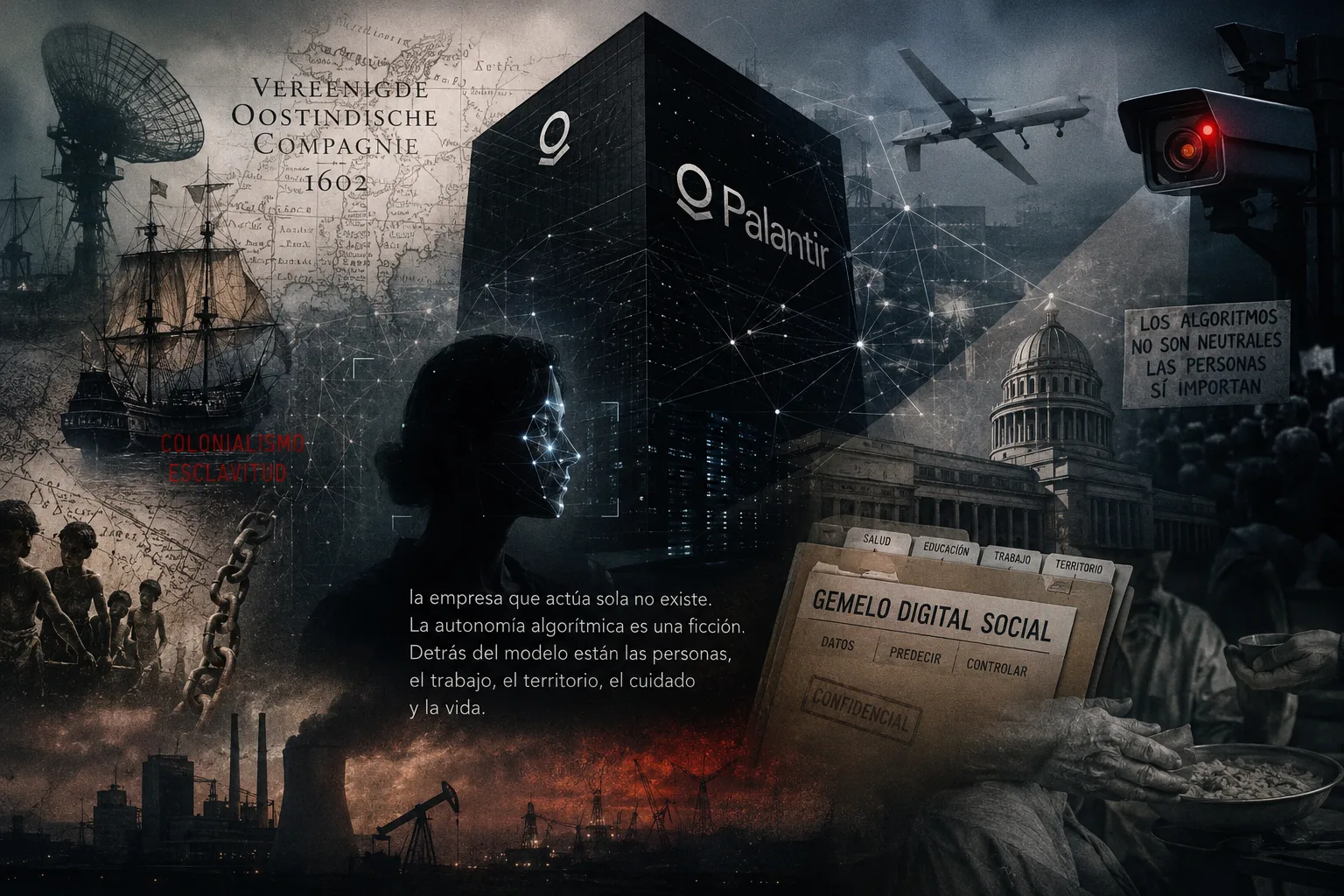
The company that acts alone does not exist. Nor does the model that decides with no world around it, nor the algorithmic corporation that operates outside any human, material and legal network. What does exist is an increasingly powerful fiction. Certain technical assemblages are beginning to present themselves as autonomous subjects, with the capacity to act, contract, calculate, monitor, select targets or be sanctioned as if they were a person.
In a few weeks of 2026, that fiction has taken several forms. Palantir has defended a technological republic where hard power is built with software and Silicon Valley pays its moral debt through military capability. The United States has restricted Fable 5 and Mythos 5, advanced models from Anthropic, as if they were strategic infrastructure. Javier Milei has proposed turning Argentina into a legal refuge for non-human corporations run by AI agents. The Argentine government has also announced a Social Digital Twin that promises to anticipate public policy through mass data processing.
Read separately, they are items of current affairs. Read together, they show a larger transformation. States are beginning to decide when AI is a weapon, when it is a company, when it approaches the category of the person and when an entire population can be turned into a predictive model. Technical autonomy appears as a solution, but also as an alibi. It serves to shift responsibilities towards opaque entities while hiding the people, the territories, the bodies, the labour and the life that sustain those systems.
The fiction of the algorithmic subject
Milei’s proposal is the point where the fiction becomes explicit. In a column published on 4 June in the Financial Times, he defended a new legal category for companies run by AI agents. He called them non-human corporations and imagined them with minimal regulation, limited liability and competitive taxation.
The chosen comparison was not innocent. Milei linked that figure with the limited liability company and with the Dutch East India Company, founded in 1602. Presented in this way, the reference looks like a story of legal innovation and commercial efficiency. Seen historically, it opens up a much darker zone.
The VOC was not just a modern company ahead of its time. It was a fundamental mechanism of European colonialism over several centuries. It combined private capital, war, commercial monopoly, territorial administration, slavery and colonial violence. Its corporate form allowed wealth to be accumulated and responsibility to be displaced while it conquered territories, imposed monopolies, exploited enslaved labour and organised enclaves such as Batavia or the Cape Colony. Modern legal personhood was not born in a neutral laboratory. It was born too in that world of ships, forts, plantations, colonial routes, enslaved people and profits protected by distance.
That is why granting legal personhood to an AI is not a technical detail. It is the decision of who can appear as a subject of law and under which historical fiction. Marcel Mauss reminded us that the category of the person is not a natural given but a social and historical construction. Western legal personhood first extended to certain humans, then to corporations and now it is proposed for non-human agents able to operate in markets, sign contracts, move assets and pursue objectives.
Yuval Noah Harari replied in the same newspaper a few days later. His warning went to the heart of the problem. Granting legal personhood to AI agents may open a master key to the financial, economic and political systems. If a corporation governed by AI causes harm, who is locked up? The prison that may deter a director of a company means nothing to a system without a body. Harari also recovered the colonial analogy of the VOC and Batavia. The risk would not be only a corporate state, but an AI state.
The counterpoint came from the law of AI. Yonathan Arbel, Simon Goldstein and Peter Salib argued that an algorithmic corporation could make those agents more visible and governable. The state could see their contracts and licences, tax them, sanction them and seize their resources if they cause harm. In their article on A-corps, the algorithmic corporation appears as a legal-fictional entity able to own property, contract and litigate, owned by humans but governed by AIs.
The disagreement is useful because it reveals the centre of the conflict. It is not only a tool that is being discussed. It is a new way of manufacturing economic subjects. The algorithmic person is not born because a machine wakes up. It is born because an institution decides to count it as someone.
Models, weapons and selected people
While Argentina rehearses a legal opening, Washington acts in the opposite direction. On 9 June, Anthropic presented Claude Fable 5 as its most capable model, within a tier it called Mythos. Three days later, the US government issued an export-control directive that, invoking national security, ordered the suspension of foreign nationals’ access to Fable 5 and Mythos 5.
The nuance matters. The order targeted foreign nationals, not everyone in the abstract. But Anthropic switched off both models globally in order to comply. The company maintained that the official concern stemmed from a narrow method for getting around its safeguards and that similar capabilities existed in other models. The Administration, by contrast, stated that a relevant vulnerability had been found and that the company refused to fix it or to withdraw the model. Beyond that dispute, the political gesture is clear. A deployed commercial model came to be treated as a sovereign border.
A model then stops being only a product. It becomes capability, risk, ammunition, infrastructure. Sovereignty is no longer decided only at borders, in laws, ports or undersea cables. It is also decided in who can access an architecture of language, computation and cybersecurity.
Palantir offers the ideology that joins those scenes. In April, the company summarised The Technological Republic, the book by Alex Karp and Nicholas Zamiska, in twenty-two points. The central argument holds that the hard power of this century will be built on software. Hence the defence of AI weapons, the critique of a Western pluralism presented as empty and the accusation against cultures described as regressive. Silicon Valley, that vision holds, owes a moral debt to the nation that made its rise possible.
The word debt is not casual. Where Mauss showed that the gift produces obligations, alliances and hierarchies, Palantir formulates a political obligation. Technology must repay the state its protection in the form of military power. The private company appears not as a mere supplier but as a civilisational actor. The West stops naming a geography and comes to draw a moral border. It distinguishes who deserves the future, who can be watched and who is left outside the legitimate technological community.
That vocabulary is not abstract. Palantir does not only sell metaphors of power. Time has documented that its products help Ukraine in tasks of military target selection, as well as demining and the investigation of war crimes. In Gaza, the controversy is even harsher. A report by the United Nations special rapporteur Francesca Albanese named Palantir among the companies that, according to her analysis, profit from the Israeli offensive. The Guardian reported that Palantir agreed a strategic partnership with Israel to assist war-related missions. The company denies any link with the Lavender and Gospel programmes, used to identify targets in Gaza, but it has defended its support for Israeli defence and national security missions in other contexts.
That is where the comfort of corporate language breaks down. Target selection, operational capability, national security or war-related missions are technical expressions for processes that can end with people dead. There may be military justification, there may be a violation of international law, there may be disputed grey zones. What there cannot be is analytical innocence. When a company offers software to shorten chains of lethal decision, technical autonomy enters the terrain of life and death.
Karl Polanyi helps to understand that twist. Modern capitalism already turned into commodities things that were not produced to be sold, such as land, labour and money. He called them fictitious commodities. Frontier models begin to look like a new compound fictitious commodity. In them are mixed language, accumulated labour, data, computation, industrial secrets, military risk, energy and geopolitical access. The novelty lies not only in the technique but in the way of treating a social capability as if it were a private thing, exportable, restrictable or weaponisable.
Autonomy hides the arrangement
The company that acts alone does not exist because no economic actor acts alone. Michel Callon and Donald MacKenzie have been showing for years that an economic actor is not an isolated individual but a sociotechnical agencement. It is an assemblage of people, devices, capital, contracts, screens, algorithms, norms and law that acts as if it were one. Autonomy is not a magical property of the system. It is the effect of an arrangement that has managed to erase its seams.
The algorithmic corporation, the frontier model and the data-integration platform have something in common. They seem to act from a single centre, but they depend on dense networks. There are people who design models, label data, moderate content, buy computation, draft contracts, negotiate regulatory exceptions, run servers, sell defence systems, process claims and obey automated decisions because an institution has already turned them into a mandate.
That is why the phrase from Margarita Trovato, of the Fundación Vía Libre, works as a summary. No technology operates in a vacuum. The vacuum is a piece of staging. Every autonomous system needs energy, servers, data, permits, interfaces, insurance, technical staff, legal frameworks and political tolerance. The decisive point is not whether there are people behind it. The decisive point is which people are seen and which are turned into infrastructure.
Here it is worth opening another plane, almost always absent from the imagination of the masculine techno-military elite that dominates this debate. Karp speaks of hard power. Thiel embodies the alliance between capital, surveillance and sovereignty. Milei promises legal freedom for non-human corporations. David Sacks appears in the dispute over Fable 5 as a voice of sovereign closure. Taken together, this public scene is populated by male figures, billionaires or close to state power, convinced that the central problem of the world is to free, arm or discipline technical systems.
Feminist economics offers a radical counterweight. It does not ask only about efficiency, competitiveness or sovereignty. It looks at what sustains life. Amaia Pérez Orozco argues that the crisis should be read from the sustainability of life and not from the centrality of markets. Susana Narotzky has worked on social reproduction, labour, care, affect, moral economy and inequality. From there, algorithmic autonomy appears less as a technological feat than as a new operation of concealment. It hides who cares, who cleans data, who sustains infrastructures, who bears the harm, who moderates violence, who loses access, who falls under suspicion and who breathes the hot air of data centres, wars and energy extractivism.
The climate crisis is almost always left out of the frame. It is an enormous omission. The IPCC has warned for years that every increment of warming intensifies multiple and concurrent risks. The World Meteorological Organization has described an Earth increasingly out of energy balance, with oceans absorbing most of the excess heat, heatwaves, floods, droughts and growing threats to health and food. Even so, the techno-political conversation is organised as if there were infinite energy, infinite territory, infinite water and infinite time.
There is not. Models require computation. Computation requires electricity, water, minerals, networks, cooling and territories. Technological war consumes materials and energy. Predictive surveillance expands infrastructures. The platforms that promise to govern societies through simulations are built on an increasingly unstable biosphere. When the techno-liberal note speaks of innovation and does not speak of climate, it is not forgetting a detail. It is denying a material condition of existence.
Feminist economics lets us say it without circling around. No economic system is viable if it destroys the conditions that make life possible. No artificial intelligence acts alone if it depends on labour, energy, care and extraction. No legal personhood of the machine should be discussed without first asking about the people and ecosystems that pay its costs.
Argentina and opacity as a form of government
The Argentine Social Digital Twin shows how that operation can land in a concrete state. On 22 May, the Ministry of Human Capital announced a virtual replica of Argentine society that would cross data from ANSES, health, education, labour and territory in order to simulate scenarios and anticipate the effect of public policies. Milei circulated it in a video generated with AI, with spelling mistakes included, and closed it with a political wink, “MAGA. VLLC!”.
What was decisive was not only what was announced, but what was omitted. There is no confirmed provider, no clear public budget, no timetable, no specific legal framework. The minister promised to work with anonymised and statistical data, but anonymisation does not by itself resolve the problem of purpose, governance and consent. Law 25,326 on the protection of personal data reminds us that data collected for one purpose cannot be freely reused for another incompatible one.
Into that void steps Peter Thiel. The Palantir co-founder had met privately with Milei weeks earlier and bought property in Buenos Aires. Moreover, digital twins are one of the technological lines associated with the kind of infrastructure that Palantir represents. Mass data integration, predictive analytics, a governmental view of territory and opaque decision platforms. But there is no confirmed contract. The announcement video showed the logos of Amazon Web Services, not of Palantir, and other companies such as Microsoft, IBM and Siemens offer similar technologies. Thiel should not appear as the awardee. He functions as a political-technical archetype of a form of power.
The Fundación Vía Libre requested information about databases, the bodies involved, the processing of sensitive data, the legal basis, the transfer between bodies, the possible integration of private databases, automated decisions, consent and providers. There were also requests for reports from Congress. The opacity is not an administrative detail. It is the political centre of the case.
A social digital twin does not reproduce a society. It produces a way of seeing it. It decides which variables matter, which harms become calculable, which bodies appear as risk, which households become a pattern, which territories are turned into a signal. The official promise speaks of anticipating policies. The danger lies in replacing social conflict with a simulation that almost no one can dispute because almost no one knows how it is made.
Here feminist economics returns with more force. A state that simulates its society can count what it already knows how to process and forget what sustains common life. It can measure incomes and not care. It can cross-reference files and not grief. It can classify households and not exhaustion. It can detect risk without listening to experience. It can optimise benefits without repairing inequalities. It can produce evidence without democracy.
What stops counting
Algorithmic autonomy does not eliminate politics. It redistributes it. Sometimes it shifts it towards a company. Sometimes towards a model. Sometimes towards a legal person without a body. Sometimes towards a state platform that promises to anticipate society from above. In every case, the risk is that responsibility becomes harder to locate.
Behind the autonomous agent is the network that sustains it. Behind the sovereign model are the people excluded from its access. Behind the non-human corporation are those who own it, train it, host it, finance it and profit from its fiction. Behind the state that anticipates are the people being counted. Behind the war assisted by software are the people turned into a target, collateral damage or operational data. Behind artificial intelligence as a promise of abundance is a climate crisis that narrows the material conditions of life.
Against the technological republic of the lords of hard power, feminist economics recalls something far more basic. Before producing legal subjects for machines, we would have to sustain lives worth living. Before imagining corporations without humanity, we would have to recognise the humanity already expelled from the balance sheet. Before turning entire societies into digital twins, we would have to listen to those who care, breathe, fall ill, migrate, work, lose, resist and sustain what is common.
Granting personhood to machines is, above all, a way of deciding which people stop counting. That decision, for now, is taken by no AI.
Sources
- Palantir and its technological manifesto. Fortune, “Palantir’s mini manifesto claims some cultures are ‘harmful’ and ‘middling’”; The Verge, “We translated the Palantir manifesto for actual human beings”.
- Palantir, war and target selection. TIME, “How Tech Giants Turned Ukraine Into an AI War Lab”; WinBuzzer, “Palantir Demos Show How the Military Could Use AI for War Plans”; report by special rapporteur Francesca Albanese, United Nations / OHCHR, “From economy of occupation to economy of genocide”.
- Anthropic, Fable 5 and Mythos 5. Anthropic, “Claude Fable 5 and Claude Mythos 5”; Axios, “Trump admin blocks foreign access to Anthropic’s most powerful AI”; TIME, “Anthropic Pulls Its Most Powerful AI Models After U.S. Bars Foreign Access”.
- Javier Milei and non-human corporations. Column by Javier Milei in the Financial Times, “Argentina invites AI to free itself”, with coverage in the Buenos Aires Herald; reply by Yuval Noah Harari in the Financial Times, reported by Futurism; Yonathan Arbel, Simon Goldstein and Peter Salib, “How to Count AIs. Individuation and Liability for AI Agents” (SSRN) and arXiv version.
- Dutch East India Company, colonialism and slavery. Britannica, “Dutch East India Company”; Iziko Museums, “Slave Lodge”.
- Argentine Social Digital Twin. Infobae, “The Ministry of Human Capital presented the Social Digital Twin”; Law 25,326 on the Protection of Personal Data; Agencia de Acceso a la Información Pública.
- Climate crisis. IPCC, AR6 Synthesis Report and Headline Statements; WMO, “State of the Global Climate” and “Earth’s climate swings increasingly out of balance”.
- Feminist economics and the sustainability of life. Amaia Pérez Orozco, “Crisis multidimensional y sostenibilidad de la vida”, Investigaciones Feministas (2011); Amaia Pérez Orozco, Subversión feminista de la economía, Traficantes de Sueños; Susana Narotzky, New Directions in Economic Anthropology, Pluto Press.
- Conceptual apparatus. Marcel Mauss, “A category of the human mind: the notion of person”, in The Category of the Person; Karl Polanyi Institute of Political Economy, on The Great Transformation; Michel Callon, “What does it mean to say that economics is performative?”; Donald MacKenzie, Material Markets, Oxford University Press.