
Political anthropology and AI
When the cockroaches answer back
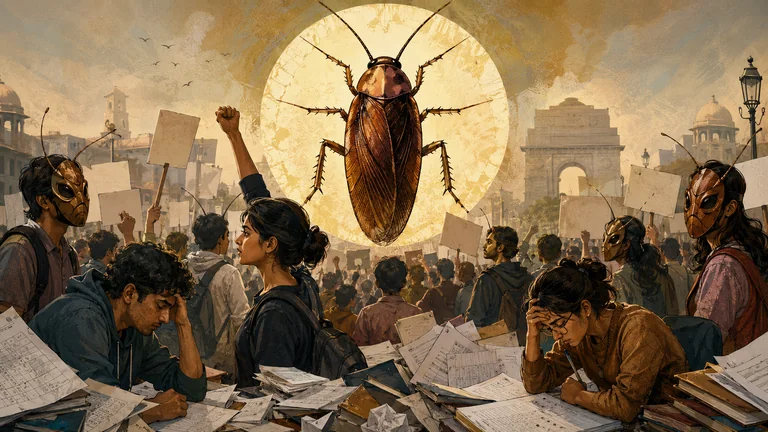
In India in 2026, a judicial slur became a political identity. The journey of the “cockroach” opens questions about classification, aspiration, embodiment, satire, power and algorithmic visibility.
In May 2026, a disparaging remark made from India’s Supreme Court turned the “cockroach” into an image of unemployed and critical young people. Less than three months later, that word had been reclaimed by a movement with millions of followers, had occupied the streets of Delhi and had become part of a political crisis that ended with the resignation of the Education Minister. The trajectory of the insult raises a broader issue. It matters who has the power to classify, who can alter those classifications, and what happens when that dispute circulates through digital platforms.
On 15 May 2026, a word left India’s Supreme Court and began to circulate through a country that would soon return it transformed. Cockroaches.
During a hearing concerning the designation of a lawyer as a Senior Advocate, Chief Justice Surya Kant criticised certain unemployed young people in the legal profession who, according to remarks reported by the press, ended up turning to journalism, social media or right-to-information activism and began to “attack the system”. He also spoke of “parasites” (Ananthakrishnan, 2026a). Precision matters. The following day, Kant said he had been misinterpreted and maintained that he was not criticising unemployed youth in general, but people who entered professions through false or fraudulent qualifications (Express News Service, 2026). We can therefore debate what he intended to say. What he could no longer control was what that word had started to do.
Bruno Latour’s legal ethnography adds a useful precision here. In La fabrique du droit, his work inside the French Conseil d’État shows that legal authority does not simply emanate from the person who holds an office. It is made through files, procedures, deliberations and acts of legal qualification that turn a case into a stabilised legal decision (Latour, 2002). Kant’s remark carried the immense symbolic weight of the Supreme Court, but it was neither a judgment nor a legal qualification. It was an intervention uttered inside the institution that escaped the procedural forms through which law ordinarily contains and transforms the matters it judges.
That distinction matters. It lets us analyse the institutional force of the expression without automatically attributing it to the Court as a collective decision. It also helps explain why its later circulation was so disruptive. A word spoken in the space of law left the file, the procedure and the deliberation behind, and began to acquire another social life.
On 16 May, Abhijeet Dipke responded from the United States with a satirical post that would eventually give shape to the Cockroach Janta Party (CJP), an obvious parody of Narendra Modi’s Bharatiya Janata Party (BJP). Dipke had previously worked in political communications and was studying for a postgraduate qualification in public relations in Boston. He returned to India on 6 June, by then one of the most visible faces of a phenomenon moving from meme to mobilisation (Agarwala, 2026). That movement matters. The campaign was born neither entirely inside nor entirely outside India, but in a connected political space where diaspora, media, social networks and national events could interact almost in real time. Dipke’s trajectory evokes the transnational landscapes and public spheres described by Arjun Appadurai. The territory of the state remains crucial, but it no longer contains the production of political imagination by itself (Appadurai, 1996).
Reuters later reported that the community associated with the movement had reached more than 22 million followers on Instagram within days and later exceeded 25 million (Agarwala, 2026). Yet a digital community does not explain a protest on its own. Humour encountered social conditions already primed by youth unemployment, suspicions of corruption, examination leaks and growing mistrust towards institutional procedures on which millions of life projects depend. Irregularities affecting entrance examinations such as NEET touched millions of applicants, while investigations and family testimonies linked the examination crisis with severe suffering among students. Causal claims connecting each death by suicide to each irregularity require caution, but the human dimension of the crisis had ceased to be a statistical abstraction (Ahmed et al., 2026).
During June and July, that distress acquired bodies and occupied places. Jantar Mantar again became a site of protest. Sonam Wangchuk began a hunger strike that lasted 26 days; Neha Bora, president of the All India Students’ Association, and other activists maintained another for 23 days (Ellis-Petersen, 2026; Sinha, 2026). Bora’s presence also exposes something hidden by the generic expression “unemployed youth”. The CJP manifesto itself demands that women hold 50 per cent of seats in Parliament and 50 per cent of positions in the Council of Ministers (Cockroach Janta Party, 2026). Gender, caste, class, place of origin and family resources shape differently who can spend years studying, who can travel to a protest, who can remain on hunger strike for weeks and what risks people assume when they occupy public space.
The metaphor, then, does not fall upon abstract bodies. Before it is an image, a cockroach is a body. So are the people marching behind cockroach masks.
Mary Douglas offers a first point of entry. In Purity and Danger, pollution and dirt do not describe hygienic conditions alone. They express classificatory systems through which beings, objects and practices are distributed between what belongs and what disrupts order by its presence (Douglas, 1966). Few creatures materialise unwanted presence more effectively than the cockroach. We do not negotiate with it or ask why it is there; we want it removed. When political conflict is articulated through the figure of a pest, the question can shift from what a person is saying to why that person is there at all.
Literature had imagined the violence contained in such a transformation long before. In Die Verwandlung, generally known in English as The Metamorphosis, Franz Kafka does not turn Gregor Samsa precisely into a cockroach. The German text calls him an Ungeziefer, vermin or a noxious creature whose classification remains deliberately indeterminate. Gregor retains consciousness, memory and affection; what changes radically is the way those around him begin to perceive him and the place they believe he is entitled to occupy. As he ceases to work and contribute financially to the household, son, brother and worker gradually disappear behind the classification of vermin (Kafka, 1915).
India in 2026 seems to reverse that metamorphosis. Here nobody wakes up transformed into an insect. An authority supplies the classification, and those who receive it do something Gregor Samsa never manages to do. They appropriate the name, leave the room and occupy public space. What matters now is the reverse movement, in which the supposed pest retains its voice and answers back.
Frantz Fanon helps us recognise the potential violence of that operation. Colonialism governs not only through law, armies or administrations; it also produces languages capable of pushing particular populations towards the animal, the irrational or the inferior and, by doing so, diminishing their status as political interlocutors (Fanon, 1961). Some Indian commentators recalled after Kant’s remarks the extreme history of the term inyenzi — cockroaches — used against the Tutsi population during the Rwandan genocide. The comparison requires an unequivocal limit. India in 2026 is not Rwanda in 1994. There is no basis for transferring intentions, social relations or historical consequences from one context to the other. The precedent works better as a warning than as an equivalence. It reminds us that animalisation can transform interlocutors into species, claims into infestations and political conflicts into problems of cleansing.
Yet the Indian cockroach of 2026 introduces something that the history of dehumanisation cannot by itself explain. Matter out of place decided to remain.
Veena Das helps us follow what happened next. Much of her anthropology observes how violence and institutions descend into the ordinary and settle into bodies, relationships, bureaucracies, silences and minor everyday practices (Das, 2007). We can follow the word in the same way, from court to headline, post, meme, mask, placard, encampment and hunger strike. The event does not remain above. It descends and, in doing so, encounters people who have spent years preparing for examinations, families that have invested money and expectation in education, and young people who have organised a substantial part of their lives around the promise that study will open the way to another future.
An examination is not merely a mechanism for measuring knowledge. It is also an institutional promise about the future.
Appadurai offers another key here. His concept of the capacity to aspire describes the unequally distributed ability to imagine plausible pathways between the present and desirable futures (Appadurai, 2004). Study, pass, gain entry, work and build a particular kind of life form a chain of expectations. When questions are leaked, an examination is cancelled or the rules appear manipulable, it is not only an administrative procedure that breaks down. The credibility of the pathway itself also deteriorates. Protest therefore stops being solely about an examination and begins to concern who retains the right to believe in the tomorrow that institutions had promised them.
Appadurai offers another move as well. In The Social Life of Things, he proposes following circulation to observe how value changes as an object moves from one context to another (Appadurai, 1986). We can perform the same exercise with a word by following it from the Supreme Court through the press, Instagram, the meme, identity, the street and political negotiation. It remains “cockroach”, but its value is no longer the same.
James C. Scott helps explain that reversal. Scott distinguishes between the public transcript performed in front of power and the hidden transcripts in which rumour, caricature, mockery and other forms of insubordination circulate with relative protection from those who dominate (Scott, 1990). The CJP introduces a variation specific to digital infrastructures. The hidden transcript barely had time to remain hidden. Its manifesto mixed political demands with a deliberately absurd aesthetic, while membership was ironically addressed to people who were unemployed, “lazy”, chronically online and professionally able to complain (Cockroach Janta Party, 2026). Mockery repeated the categories of contempt until they became ridiculous. The object of the joke ceased to be the cockroach and became the person who needed to call someone a cockroach.
Then came the masks. A mask does something a tweet cannot do because it occupies space. It turns an insult into a visible surface, forces the metaphor to acquire human dimensions and returns to power a distorted image of its own classification. Where the word sought to reduce a person to an insect, the body that publicly accepts that image demonstrates precisely that it remains a political body. It marches, goes hungry, receives water, gas or blows, gathers and speaks.
Douglas explains the insult with extraordinary precision and shows what a classificatory system places out of place. But Douglas is not enough to explain the rebellion. Here matter out of place refuses to return to its assigned box. It occupies Jantar Mantar, speaks and forces the classificatory system to respond.
On 25 July, the President of India accepted Dharmendra Pradhan’s resignation and, in the same communiqué, assigned the Education portfolio to Pralhad Joshi in addition to his existing responsibilities (President of India, 2026). The mobilisation had obtained an unusual concession from the Modi government, although it would be reductive to attribute a ministerial decision of that kind to a single cause.
It would be equally reductive to turn the episode immediately into a general explanation of “India”. The British colonial state developed powerful technologies for counting, classifying and administering populations. Caste, territory, occupation, religion and criminality were repeatedly turned into categories of political legibility. Yet the Indian Republic now has almost eight decades of history of its own. Its inequalities, institutions, elites, social movements and nationalisms cannot simply be interpreted as residues of the Raj.
Ambedkar offers a more productive caution. We do not need to claim that the “cockroach” represents a caste, nor identify the CJP with Dalit politics. We do need to remember that no classification falls upon a flat society. Dipke also comes from a Dalit family and has publicly acknowledged the intellectual influence of B. R. Ambedkar. When he returned to Delhi on 6 June, he emerged from the airport displaying one of Ambedkar’s books (Agarwala, 2026). The gesture invites us to examine the material hierarchies onto which any classification lands, including who has access to education, recognition, contacts, property or mobility, and who has to travel much narrower routes to aspire to the same future (Ambedkar, 1936). Hierarchy is not a cultural curiosity. It is political.
Vandana Shiva shifts the same question towards the concentration of knowledge and power. In Monocultures of the Mind, Shiva (1993) uses monoculture to criticise systems that destroy diversity while presenting a single form of knowledge or development as universal. There is no need to turn the CJP literally into a “political polyculture”; the metaphor would eventually make more noise than the argument. The intuition is useful. Economic power does not only concentrate resources; it can also narrow the worlds that are considered possible.
The connection also exists within the movement itself. The CJP manifesto explicitly challenges media concentration associated with the Ambani and Adani conglomerates and demands greater space for independent media (Cockroach Janta Party, 2026). Shiva therefore extends the problem towards the material conditions under which a society can imagine, know and speak to itself.
In 2026, one further actor appears, the platforms. Between a word uttered from an institution and its political reclamation sit systems that order content, relevance and attention. We do not have the internal data from Instagram or X required to claim that their algorithms caused the CJP’s expansion. To do so would confuse infrastructure with causation. We do know that the movement was inseparable from those infrastructures. It was born within them, accumulated millions of followers and saw one of its X accounts blocked in India before a court later ordered access to be restored (India Today News Desk, 2026).
Artificial intelligence and automation therefore do not need to become the main subject of this story in order already to be part of it. They appear in the production of some images and satirical pages, in digital circulation and, above all, in an anthropological problem that is becoming increasingly difficult to avoid. Visibility itself is at stake.
Law qualifies. Movements reclassify words. Platforms distribute attention.
The three operations are different, but all three produce political consequences.
Nor did the story end with Pradhan’s departure. On 10 August, thousands of applicants for public-sector jobs again mobilised in Jharkhand over fresh allegations of irregularities in recruitment examinations. Police used tear gas, water cannon and batons when part of the demonstration attempted to advance towards the state assembly (Reuters, 2026). The cycle of conflict around examinations, employment and futures remains open.
Perhaps that is ultimately the political power of the cockroach. Not its supposed indestructibility. There is no need to romanticise the insect. What matters is that a classification attempted to place certain presences outside legitimate space, and those who received the name kept the word, altered its value and returned with it to public space.
Douglas allows us to recognise the boundary, while Fanon warns about the violence of animalisation. Latour forces a distinction between the authority of a word uttered from a court and the procedural work through which law produces a decision. Ambedkar makes visible the hierarchy onto which classification lands; Das follows its effects into ordinary life and bodies; Appadurai shows what happens when the possibility of aspiration is broken and how meanings change as they circulate. Scott helps us understand how mockery can leave subordinate spaces and become public speech, while Shiva turns attention back towards the material concentration of what a society can know, imagine and say. Platforms add another uncertainty about which voices circulate and which remain invisible.
On 15 May, “cockroach” was a category pronounced from above. Less than three months later it was a meme, a mask, a hunger strike, a political identity, an organisation and a mobilisation capable of forcing power to respond.
Matter out of place had taken the floor.
In the end, what remains in dispute is the power to name itself.
Who, ultimately, has the power to name whom?
References
Agarwala, T. (2026, 23 July). How Abhijeet Dipke became the face of India’s first Gen Z protest movement, and won. Reuters. https://www.reuters.com/world/india/abhijeet-dipke-face-indias-first-gen-z-protest-movement-2026-07-23/
Ahmed, A., Sharma, S., & Khanna, S. (2026, 25 July). “The fear killed her”: How an exam scandal in India sparked a student uprising. Reuters. https://www.reuters.com/world/asia-pacific/the-fear-killed-her-how-an-exam-scandal-india-sparked-student-uprising-2026-07-25/
Ambedkar, B. R. (1936). Annihilation of caste. [Originally prepared as an undelivered speech].
Ananthakrishnan, G. (2026a, 15 May). Some jobless youth in law like cockroaches, become media, activists and attack system: CJI. The Indian Express. https://indianexpress.com/article/legal-news/cji-surya-kant-youngsters-cockroaches-media-activists-rti-lawyer-10691246/
Express News Service. (2026, 16 May). ‘Misquoted by media’: CJI Surya Kant clarifies ‘cockroaches’ remark on unemployed youth. The Indian Express. https://indianexpress.com/article/legal-news/cji-surya-kant-clarifies-cockroaches-remark-fake-degrees-row-10692979/
Appadurai, A. (1986). Introduction: Commodities and the politics of value. In A. Appadurai (Ed.), The social life of things: Commodities in cultural perspective (pp. 3–63). Cambridge University Press.
Appadurai, A. (1996). Modernity at large: Cultural dimensions of globalization. University of Minnesota Press.
Appadurai, A. (2004). The capacity to aspire: Culture and the terms of recognition. In V. Rao & M. Walton (Eds.), Culture and public action (pp. 59–84). Stanford University Press.
Cockroach Janta Party. (2026). The CJP manifesto. https://cockroachjantaparty.org/
Das, V. (2007). Life and words: Violence and the descent into the ordinary. University of California Press.
Douglas, M. (1966). Purity and danger: An analysis of concepts of pollution and taboo. Routledge & Kegan Paul.
Fanon, F. (1961). Les damnés de la terre. François Maspero.
Kafka, F. (1915). Die Verwandlung. Kurt Wolff Verlag.
Latour, B. (2002). La fabrique du droit: Une ethnographie du Conseil d’État. La Découverte.
Ellis-Petersen, H. (2026, 24 July). Indian Cockroach activist ends hunger strike after 26 days as protests spread. The Guardian. https://www.theguardian.com/world/2026/jul/24/india-cockroach-protest-sonam-wangchuk-ends-hunger-strike
India Today News Desk. (2026, 7 July). Delhi High Court orders unblocking of Cockroach Janata Party’s X account. India Today. https://www.indiatoday.in/india/story/delhi-high-court-orders-unblocking-of-cockroach-janata-partys-x-account-2942330-2026-07-07
President of India. (2026, 25 July). Press communiqué. https://www.presidentofindia.gov.in/press_releases/press-communique-35
Reuters. (2026, 10 August). Thousands of youth march to legislature in India to protest alleged job, exams wrongdoing. Reuters. https://www.reuters.com/business/media-telecom/thousands-youth-march-legislature-india-protest-alleged-job-exams-wrongdoing-2026-08-10/
Scott, J. C. (1990). Domination and the arts of resistance: Hidden transcripts. Yale University Press.
Shiva, V. (1993). Monocultures of the mind: Perspectives on biodiversity and biotechnology. Zed Books.
Sinha, J. (2026, 20 July). CJP protest: 3 students on hunger strike with Sonam Wangchuk end indefinite fast. Hindustan Times. https://www.hindustantimes.com/india-news/cjp-protest-3-students-on-hunger-strike-with-sonam-wangchuk-neha-bora-manish-kumar-and-ameen-amitoj-jantar-mantar-101784522282600.html