
Political Anthropology and AI
Open does not mean shared
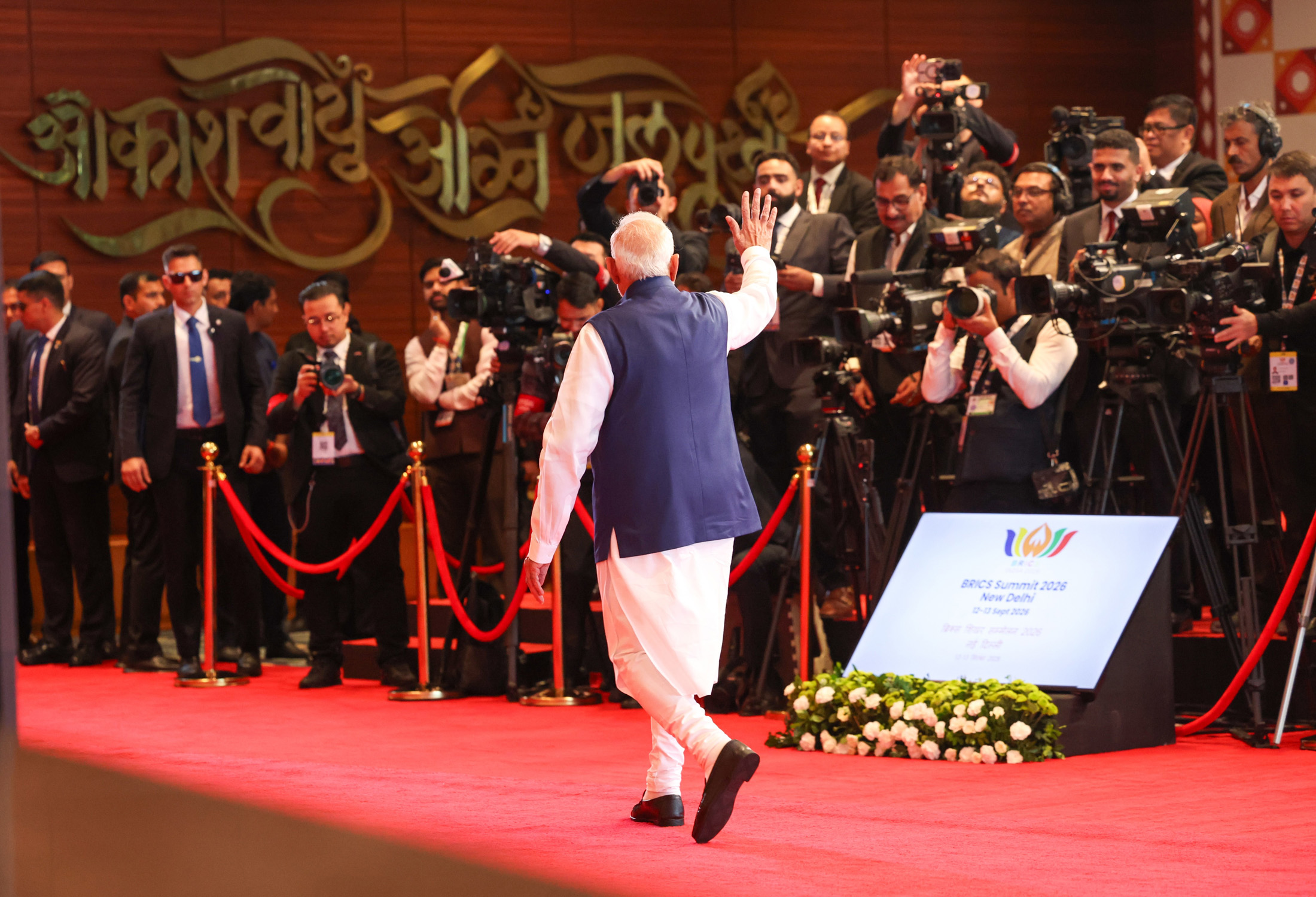
China is proposing an open artificial intelligence ecosystem around BRICS to expand the technological capacity of the Global South. The initiative promises to reduce dependencies, although infrastructure, capabilities and forms of governance remain profoundly unevenly distributed.
In New Delhi, Xi Jinping turned the word ‘open’ into a technical description and, at the same time, a political promise.
During the 18th BRICS Summit, held on 12 and 13 September, the Chinese president proposed a BRICS open-source artificial intelligence zone and an initiative for AI-driven new industrialisation. His speech called for greater cooperation in research and applications, open models, industrial chains and training, as part of a broader strategy to expand the technological capacity of the Global South. [1][2]
That proposal should be distinguished from the agreement reached by BRICS as a whole. The New Delhi Declaration does not adopt Xi’s proposed open zone as a common project. The collective commitment is broader and, at the same time, more cautious. Members agree to improve access to AI resources, promote safe, reliable and inclusive technologies, strengthen research and implement the bloc’s statement on the global governance of artificial intelligence. [3]
The distinction matters. China is proposing an architecture. For now, BRICS shares a direction.
The calendar will show how far that gap can be narrowed. China will assume the BRICS presidency in 2027 and host the next summit, giving it an especially favourable position from which to try to turn its proposals into concrete programmes, agreements or infrastructure. [1][2]
Xi linked this openness to a critique of technological decoupling and disrupted supply chains, and explicitly rejected the small yard, high fences strategy. Narendra Modi used different language to identify a related vulnerability. He warned against the ‘weaponisation’ of technology and critical minerals and defended reliable and resilient supply chains. [1][4]
Both formulations begin from a difficult fact to dispute. The most capable models, the chips used to train them, large data centres, cloud infrastructure and many of the tools needed to deploy artificial intelligence are concentrated in a small number of companies and territories. Much of the world accesses this infrastructure without having participated proportionately in setting its terms.
BRICS is attempting to intervene in that distribution. In doing so, it also makes visible the inequalities within the alternative itself.
Infrastructure for the Global South
BRICS no longer resembles the BRIC — still without South Africa — coined by Jim O’Neill in 2001. The bloc expanded in 2024 to include Egypt, Ethiopia, Iran and the United Arab Emirates, while Indonesia joined in 2025. Even its current perimeter retains a degree of institutional ambiguity. An official document from India’s BRICS presidency in September counts eleven members and includes Saudi Arabia, while Reuters continues to describe BRICS as a ten-member grouping and Riyadh attended the New Delhi summit as an invited country. [11][12][13]
The discrepancy does not alter the central argument, but it illustrates how the so-called Greater BRICS remains an architecture in formation. It brings together some of the world’s largest populations and economies alongside vast differences in income, industrial capacity, technological infrastructure and political power.
Xi places artificial intelligence within a strategy that goes far beyond distributing models. China proposes cooperation in research and applications, new industrial chains, technological training and AI-driven industrialisation. In July, Beijing also backed the establishment in Shanghai of the World Artificial Intelligence Cooperation Organization, WAICO, with 29 founding countries. Xi himself said in New Delhi that China had developed international cooperation centres for AI applications with BRICS and other organisations, and encouraged members of the bloc to participate. [1][14]
India is not among WAICO’s founding countries. The absence is significant because New Delhi held the BRICS presidency in 2026 and had organised its own AI Impact Summit only months earlier. The New Delhi Declaration explicitly recognises both that Indian summit and Shanghai’s World AI Conference. Rather than a single technological platform for the Global South, an overlapping set of spaces is beginning to emerge in which China and India cooperate while seeking to shape the rules, institutions and capabilities of AI. [3][15]
This wider scope makes it possible to see artificial intelligence less as an isolated product than as a layer of economic and political infrastructure. Open models can lower important barriers. They allow systems to be run without permanent dependence on a foreign API, adapted to particular contexts and used to develop applications for languages or needs that are unlikely ever to be priorities for the largest commercial platforms.
Yet ‘open’ does not describe a single technical condition.
A laboratory may release a model’s weights without providing the data used to train it, the full training code or enough information to reproduce the process. The Open Source Initiative adopts a more demanding definition, linking genuinely open AI to the effective ability to study, use, modify and share the system, which also requires code and sufficient information about the data used. [6]
Between a completely closed API and a reproducible technology stack lies a broad gradient of openness. Having the weights enables far more than consuming a remote service, but offers less autonomy than also having the code, information about the training process and the material capacity to reproduce or transform the system.
For countries seeking to build their own technological capacity, that distinction is substantial.
Access to a model is not the same as possessing the capabilities required to produce and sustain the infrastructure that makes it possible.
Asymmetry within the alternative
China enters this discussion with an artificial intelligence industry, computing capacity, technology manufacturers, data centres, models and platforms that most of its BRICS partners cannot reproduce.
Infrastructure may use open models while remaining deeply dependent on the country that supplies compute, chips, supply chains, training or the standards through which those models operate. Publishing weights or code does not automatically distribute those capabilities.
The work of Susan Leigh Star and Karen Ruhleder helps make this distinction particularly clear. Infrastructure does not simply exist as a set of technical objects made equally available to everyone. It is embedded in specific practices, standards and communities. What works almost invisibly for some institutions may appear to others as a sequence of requirements, dependencies and barriers. [5]
A model may be available to download while demanding a level of compute that few countries possess. It may permit modification while depending on imported chips. It may release its weights without providing everything needed to reproduce its training, and it may perform far better in languages whose corpora, digital resources and developer communities are more abundant.
The model may circulate. The capacity to make it one’s own does not necessarily circulate with it.
BRICS partly recognises this problem in its own declaration. The document does not merely call for wider access to artificial intelligence. It also refers to capacity-building, research, digital infrastructure and scientific cooperation. Elsewhere, it raises a particularly relevant concern by warning about the risks of appropriation and misrepresentation of knowledge, heritage and cultural values that are insufficiently represented in AI datasets and models. [3]
Sovereignty therefore also appears as the capacity to intervene in what systems know, represent and omit.
BRICS’ internal differences do not end with technological capacity. China and Russia participate from authoritarian systems, while India combines intense electoral competition with a documented erosion of freedoms and institutions during Narendra Modi’s governments. Brazil provides a more plural political counterweight within the bloc. [7][8]
Recognising the importance of those differences does not require turning them into a moral ranking of members. They condition what future shared governance might mean. Infrastructure can be open or nationally controlled without necessarily being transparent, democratic or subject to the same degree of accountability.
India also occupies a distinctive position. It has a vast technology sector, its own digital public infrastructure and long-standing policies of productive autonomy organised around Aatmanirbhar Bharat. It participates in BRICS while maintaining close technological and strategic ties with the United States, Europe, Japan and other partners.
In New Delhi, Modi defended resilient supply chains and rejected the use of critical technologies as instruments of pressure. India can use BRICS as an instrument of multipolarity without turning it into a substitute for its other alliances. [4]
The meeting between Modi and Xi on 12 September showed this combination of cooperation and caution. Both leaders acknowledged progress in the bilateral relationship and advocated a long-term strategic perspective, while Modi insisted that peace and stability along the border remain an essential basis for developing the relationship. [9]
Cooperation and competition belong to the same architecture.
The material limits of openness
Code and weights cover only some layers.
An artificial intelligence ecosystem needs electricity, data centres, chips, networks and skilled people. It needs data, digitised languages, evaluation systems and institutions able to deploy and oversee models. It also requires political capacity to regulate them and sufficient technical autonomy to replace components when economic or geopolitical conditions change.
The distinction between access and productive capacity offers another way to read the promises of openness.
A country can freely download a model and still need GPUs, financing, data centres or expertise supplied from elsewhere in order to adapt it to local needs. The download removes one barrier. The others remain.
Kimi K3 condenses that paradox. Although its architecture activates around 104 billion parameters per token, Moonshot recommends deploying it on configurations of 64 accelerators or more. The weights can be public while the material capacity to run them at scale remains concentrated. [18]
There is also a regulatory dimension. A state with its own infrastructure has greater room to impose conditions on data storage, auditing, transparency, safety or social impact. When essential components depend on foreign providers, some regulatory decisions can carry substantial economic and technological costs.
Regulatory capacity does not float above infrastructure either. It depends partly on it.
A third infrastructure
The international conversation about artificial intelligence is increasingly organised around two major centres of technological accumulation.
The United States concentrates many of the frontier companies, global cloud infrastructure and the design of the advanced chips used to train and run large models. Closed systems coexist there with a substantial ecosystem of open software and models.
China has built its own network of companies, public research, data centres, manufacturers, models and industrial policy. Moonshot AI’s launch of Kimi K3 — a 2.8-trillion-parameter model released with open weights — offers a concrete example of how this strategy can project technological capacity beyond the domestic market. [16]
Open-weight distribution considerably expands the possibilities for local execution and modification, although it does not automatically make the entire production chain open.
The United States and China are not sealed systems either. Their supply chains, markets, research and infrastructure remain intertwined in many ways. They are nevertheless the two main centres from which technological capacity is currently accumulated and projected.
Xi’s proposal in New Delhi seeks to open another space around BRICS and the Global South.
The contrast became especially visible during the same days as the summit. While Xi argued in New Delhi for wider diffusion of capabilities and greater cooperation in AI, Anthropic chief executive Dario Amodei called for the development of frontier models to be paced for safety reasons. Sam Altman and Elon Musk publicly backed aspects of that appeal. [10] The contrast is not simply between a China that wants to accelerate and a Silicon Valley that wants to slow down. Amodei also argues for preserving US leadership and tighter controls on Chinese access to advanced technologies, while Beijing likewise insists on AI safety and human control. [17]
What emerges is a more complex dispute over which capabilities should spread, which should be restricted and who gets to participate in making those rules.
The reach of the BRICS proposal will depend on how the capabilities sustaining that space are distributed — who can train and audit models, where data centres are located and who supplies the chips, which languages and forms of knowledge enter the corpora, who participates in setting standards and which countries succeed in building technological capacity of their own.
There is also a less visible measure of autonomy. Being able to leave an infrastructure without losing what has been built on top of it.
Sovereignty after access
For years, much digital-inclusion policy was organised around access. Connecting territories, expanding the availability of devices or reducing the cost of certain services offered relatively clear indicators of progress.
Artificial intelligence introduces dependencies across more layers.
The same model can occupy radically different material positions. Where there are data centres, specialised personnel, regulatory capacity, linguistic resources and companies able to modify it, access can become a capability of one’s own. Elsewhere, the same system may be used without control over virtually any of the layers that sustain it.
The difference becomes visible when conditions change. A company changes a licence, a provider restricts a technology, a sanction interrupts a supply chain, regulation alters a service, or a community discovers that a system represents its language, institutions or knowledge poorly.
Autonomy then appears as a property distributed across technology, institutions, knowledge and political relationships.
A more demanding technological sovereignty is measured by the capacity to train, modify, audit and host systems, to regulate them according to local priorities and, when necessary, to leave an infrastructure without losing everything built upon it.
BRICS now has an opportunity to test whether an open architecture can distribute more than software. Sharing compute, technical knowledge, standards, research and institutional capacity among profoundly unequal countries could genuinely diversify the global geography of artificial intelligence. Concentrating those layers in only a few members would widen access without changing the distribution of technological power to the same extent.
China’s proposal places the Global South before a field of possibilities that is difficult to reduce to a choice between dependence and autonomy. Infrastructure is built through degrees of dependence, negotiation, local capacity and the possibility of exit. It also embeds decisions about who can intervene in it and under what forms of control.
Open does not mean shared. Shared does not necessarily mean sovereign. The difference lies in who has the capacity to produce the infrastructure, intervene in it, subject it to oversight and retain the option of leaving it behind.
References
[1] Ministry of Foreign Affairs of the People’s Republic of China. (2026, 12 September). Jointly Shouldering the Responsibility of the Times and Striving to Be a Pioneering Force.
https://www.fmprc.gov.cn/mfa_eng/xw/zyxw/202609/t20260913_12021267.html
[2] Reuters. (2026, 13 September). Xi pushes ‘Greater BRICS’ economic ties to give bloc larger global role.
https://www.reuters.com/business/aerospace-defense/xi-pushes-greater-brics-economic-ties-give-bloc-larger-global-role-2026-09-13/
[3] BRICS / Government of India. (2026, 12 September). New Delhi Declaration: Building for Resilience, Innovation, Cooperation and Sustainability.
https://www.pmindia.gov.in/en/news_updates/brics-new-delhi-declaration-building-for-resilience-innovation-cooperation-and-sustainability-september-12-2026/
[4] The Indian Express. (2026, 13 September). PM Modi flags ‘weaponisation’ of tech; Xi announces open-source AI for BRICS.
https://indianexpress.com/article/india/pm-modi-brics-speech-critical-minerals-weaponisation-supply-chain-startups-10876019/
[5] Star, S. L., & Ruhleder, K. (1996). Steps Toward an Ecology of Infrastructure: Design and Access for Large Information Spaces. Information Systems Research, 7(1), 111–134.
https://doi.org/10.1287/isre.7.1.111
[6] Open Source Initiative. (2024). The Open Source AI Definition — 1.0.
https://opensource.org/ai/open-source-ai-definition
[7] Freedom House. (2026). India: Freedom in the World 2026.
https://freedomhouse.org/country/india/freedom-world/2026
[8] V-Dem Institute. (2026). Democracy Report 2026.
https://www.v-dem.net/publications/democracy-reports/
[9] Press Information Bureau, Government of India. (2026, 12 September). Prime Minister’s bilateral meeting with Chinese President Xi Jinping.
https://www.pib.gov.in/PressReleasePage.aspx?PRID=2309538
[10] Reuters. (2026, 12 September). Anthropic CEO urges AI companies to slow model development amid fears over misuse.
https://www.reuters.com/business/anthropic-ceo-urges-ai-companies-slow-model-development-2026-09-12/
[11] Press Information Bureau, Government of India. (2026, 10 September). BRICS: Evolution, Cooperation and India’s Leadership.
https://www.pib.gov.in/PressReleasePage.aspx?PRID=2308611
[12] Reuters. (2026, 12 September). The evolution of BRICS and its challenges today.
https://www.reuters.com/business/finance/evolution-brics-its-challenges-today-2026-09-12/
[13] Saudi Gazette / Saudi Press Agency. (2026, 12 September). Saudi foreign minister arrives in New Delhi for BRICS Summit.
https://saudigazette.com.sa/article/664515/saudi-arabia/saudi-foreign-minister-arrives-in-new-delhi-for-2026-brics-summit
[14] Reuters. (2026, 16 July). Twenty-nine countries sign agreement to establish global AI cooperation body.
https://www.reuters.com/world/china/twenty-nine-countries-sign-agreement-establish-global-ai-cooperation-body-2026-07-16/
[15] The Indian Express. (2026, 20 July). In China’s creation of new global AI body, a push for lead role in governance.
https://indianexpress.com/article/explained/explained-sci-tech/in-chinas-creation-of-new-global-ai-body-a-push-for-lead-role-in-governance-10794294/
[16] Reuters. (2026, 17 July). China’s Moonshot unveils world’s largest open AI model, closing in on US rivals.
https://www.reuters.com/world/china/chinas-moonshot-unveils-worlds-largest-open-ai-model-closing-us-rivals-2026-07-17/
[17] Reuters. (2026, 14 September). How China is preparing for the risk of AI escaping human control.
https://www.reuters.com/legal/litigation/how-china-is-preparing-risk-ai-escaping-human-control-2026-09-14/
[18] Moonshot AI. (2026, July). Kimi K3: Open Frontier Intelligence.
https://www.kimi.com/en/blog/kimi-k3