
Note
Nokia · The sisu that would not fit in an American pocket
Reading time: 33 min
From rubber boots to SMS, from T9 to Asha, and from the collapse of the mobile-phone business to AI networks. A story about Nokia, Finland and the shifting geography of technological power.
Nokia did not merely make phones. For a few years, it made a possibility: that one of the technologies reorganising the daily lives of billions of people might have its centre not in California, Seattle or New York, but in Finland, a small country that for centuries occupied an uneasy political and cultural frontier with Russia.
Before it became a rectangle we carried in our pockets, Nokia had been wood pulp, cable, rubber and boots for walking through snow and mud. Later came radio, telephony, SMS, cameras, small computers connected to the Internet and some of the best-selling phones in history. Then it fell. Or, more precisely, the Nokia we knew fell.
Because Nokia still exists. In 2026, it is no longer fighting primarily for space in our pockets but for a far less visible, and perhaps more important, layer of the technological world. It builds the networks through which our data, and increasingly artificial intelligence, travel.
Telling Nokia’s story allows us to tell something larger. How a technology becomes culture; how objects alter the ways we write, photograph, converse, trade and remember; how a machine conceived in Finland can acquire unexpected uses in Kenya, India or Brazil; and how technological power can shift from those who manufacture the object to those who control the operating system, the platform, the data, the cloud or the infrastructure.
This is not, then, a story about old phones. It is a story about where power resides when a society becomes technological.
First came the boots
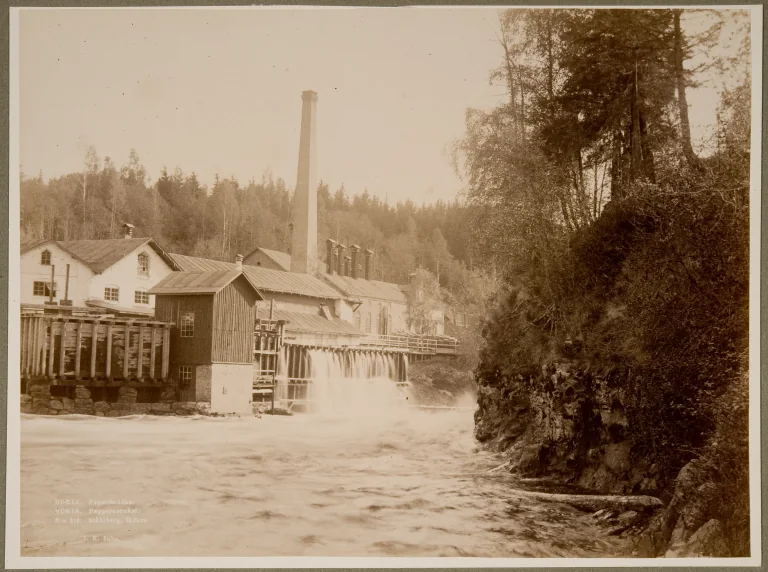
Nokia was born long before anyone could imagine a mobile phone. In 1865, engineer Fredrik Idestam opened a wood-pulp mill in Finland. That company would eventually converge with Finnish Rubber Works, a manufacturer of boots, tyres and other rubber products, and Finnish Cable Works, which produced electrical and telephone cables. From that industrial network, the modern Nokia Corporation emerged in 1967.
Seen from a Lumia 1020, the genealogy is almost disorienting. But it offers a clue. Nokia never had a single technological essence. Its historical speciality was changing form, from wood to rubber, from rubber to cable, from cable to electronics and from electronics to communication.
Behind that transformation was Finland.
Living next to Russia
Finland cannot be understood without its geography. For centuries it formed part of Sweden. In 1809 it was incorporated into the Russian Empire as an autonomous Grand Duchy. It retained its own institutions and, during that period, developed many of the structures that would later make an independent state possible.
The Russian Revolution opened the next historical rupture. Finland declared independence on 6 December 1917. The Bolshevik government led by Lenin formally recognised the separation weeks later. Independence did not usher in a peaceful history. The Finnish Civil War followed, and two decades later the Soviet invasion that began the Winter War of 1939–1940.
Decades afterwards, the relationship with Russia produced a far less traumatic scene and one almost too perfect for this story. In October 1989, Mikhail Gorbachev used a Mobira Cityman in Helsinki to call Moscow. The model, launched by Nokia-Mobira in 1987, would thereafter be associated with the Finnish nickname “Gorba”. The same historical frontier that had shaped Finland for generations was now being crossed by Finnish mobile technology.
In this landscape appears a word Finland often uses to speak about itself, sisu.
Translating it simply as resilience or perseverance is not enough. Emilia Lahti studies it as a form of fortitude that emerges especially when a person faces adversity that seems to exceed the resources they believe they possess. But the concept contains an ambiguity that is particularly useful for thinking about Nokia. Perseverance can become stubbornness. Continuing is not always the same as being right, and sometimes the capacity to endure prevents us from recognising when a strategy should be abandoned.
Sisu does not mean remaining the same forever. But neither does it guarantee knowing when to change.
Finland had anthropology too
There is a little-known intellectual resonance here. For roughly half a century, Finland developed a tradition of sociology and social anthropology around Edvard Westermarck, a foundational figure in Finnish sociology who also exercised considerable influence at the London School of Economics. His school was interested in comparison, ethnography and the processes through which social phenomena emerge and change. Otto Pipatti has recently reconstructed that tradition in The Origins of Human Social Nature: Westermarckian Sociology and Social Anthropology.
There is no genealogy leading from Westermarck to Nokia. There is something more modest, and perhaps more suggestive: a Finnish tradition of observing how social forms change, and a company that, decades later, helped change some of them.
Europe invents a common language for phones
Before Nokia there was another indispensable protagonist, the standard.
At the beginning of the 1980s, Europe was fragmented into incompatible mobile networks. GSM emerged precisely to build a common technology. On 7 September 1987, fifteen members from thirteen countries signed in Copenhagen the Memorandum of Understanding that would lead to the deployment of the new pan-European standard.
This was far more than engineering. It was technological politics. An interoperable standard created economies of scale, roaming and handsets capable of crossing national borders.
Finland found itself at the centre of that moment. On 1 July 1991, the first official GSM call was made. Finland’s then prime minister, Harri Holkeri, called Kaarina Suonio, deputy mayor of Tampere, from Helsinki using infrastructure developed by Nokia for Radiolinja’s network.
Years later, Nokia engineer Pekka Lonka said he had made a test call a few hours earlier to check that the network worked correctly. Connections had in fact been tested even before that. Ceremony and the technical work that makes it possible do not always happen at the same moment.
It was not merely a technical demonstration. A European standard was beginning to become global infrastructure. The telephone was ceasing to belong to a place and beginning to belong to a person.
Then we stopped calling and started writing
This may be one of the cultural transformations of that era we remember least clearly. Nokia did not invent SMS. The service emerged within the collective GSM ecosystem, and the first message was sent on 3 December 1992. Engineer Neil Papworth wrote it on a computer and sent it to a Vodafone phone with two words: “Merry Christmas”. Curiously, the first act of writing in SMS history still needed a machine other than the mobile phone to begin. In any case, searching for a single inventor or company oversimplifies a history made from standards, operators, manufacturers and engineers working at the same time.
But a technology does not change a society simply by existing. It has to become practice and become ordinary. Nokia contributed enormously to turning the phone from a machine that carried only voice into a writing machine as well.
The change looks small from 2026. It was not. It allowed people to write while walking, send a few words without interrupting someone with a call, say something without saying it aloud, keep a conversation, reread it and wait for a reply.
The mobile phone began to contain a new form of presence and a new relationship with time. A call required synchrony. Two people had to be available at roughly the same moment. SMS separated presence from simultaneity. It allowed us to be there for someone without being with them at that instant, to leave a sentence waiting, reply later or deliberately delay an answer.
Much of the social temporality we now associate with WhatsApp, Telegram or direct messages began to become normal on those monochrome screens.
The 3310 and mobile written conversation
In September 2000, Nokia launched the 3310. The model and its 3330 variant would eventually reach around 126 million units. But its cultural significance lies not only in Snake, its battery or its later reputation as a practically indestructible phone.
Nokia introduced the device by explicitly highlighting a chat function built on SMS. The phone could keep a conversation history, use aliases, concatenate messages and frame written exchange in a way Nokia already compared with Internet chat.
The 3310 also inherited a sonic identity that had already become part of everyday life. The Nokia Tune came from a few bars of Gran Vals by the Valencian guitarist and composer Francisco Tárrega, written in 1902 and turned by Nokia into a recognisable ringtone during the 1990s. A Finnish multinational had transformed a handful of notes from a Spanish guitar piece into one of the most recognisable sounds of mobile globalisation.
From today’s perspective, it looks elementary. From the year 2000, it was something else. WhatsApp, Telegram and iMessage did not yet exist, but something that now organises a large part of our social lives was emerging: mobile written conversation.
The technology produced new ways to flirt, end relationships, warn, lie, care, organise a family, maintain friendships and build secrets. The 160-character limit was not merely a technical constraint. It produced culture, abbreviations, emoticons, shared codes, rules of politeness and new anxieties.
How long is it reasonable to wait before replying? What does it mean when someone does not answer? Call or write? Does replying immediately show interest, or too much availability?
Questions we now transfer to contemporary platforms had an earlier life in SMS. Nokia did not invent all of that, but it helped turn it into habit.
T9, when the phone began to guess
Then something stranger happened. Nine keys had to represent an entire alphabet. The traditional solution required pressing the same key repeatedly to select a letter. T9 changed the gesture.
The technology was developed by Tegic Communications and licensed to different manufacturers. Nokia did not invent T9, but its enormous sales volumes helped turn predictive writing into an everyday experience for millions of people.
One press per letter. The system looked at the combination and searched its dictionary for the most likely word. Suddenly, the machine was taking part in writing.
It was not generative artificial intelligence or a large language model. Presenting T9 as a primitive version of ChatGPT would be an anachronism. Culturally, however, something revealing happened.
Long before a machine tried to complete our sentence, a Nokia tried to complete our word.
The kinship between T9 and a language model is not computational. It is cultural. Both place the person writing in front of a linguistic proposal produced by a machine. We can accept it, reject it or correct it. The technological difference is enormous, but the gesture feels surprisingly familiar.
T9 did not technically anticipate generative AI. It anticipated something perhaps more important for an anthropology of our relationship with it: our cultural willingness to write alongside a machine that tries to guess.
A country of five million makes phones for the world
In 1998, Nokia became the world’s largest mobile-phone manufacturer and remained the leader for more than a decade. In 2007, it reported roughly 38 per cent of the global market and around 40 per cent in the final quarter of the year.
Its weight within Finland became enormous. Around the turn of the century, Nokia generated roughly 3 to 4 per cent of Finnish GDP and around a fifth of the country’s exports. Some estimates for 2000 placed the latter figure slightly above 20 per cent.
But it would be a mistake to interpret that success as an exclusively Finnish or European story. Nokia phones were everywhere, and a growing share of its market lay outside Europe and North America. In the fourth quarter of 2007, the company recorded its strongest growth in the Middle East and Africa and in Asia-Pacific, while unit sales declined in North America.
Nokia’s world was never simply Helsinki looking towards California. It included Lagos, Nairobi, Delhi, São Paulo and Beijing.
Perhaps the device that demonstrates this best is not the 3310 but the Nokia 1100. Launched in 2003 and regarded as the best-selling phone in history, it surpassed 250 million units. It was inexpensive, had a non-slip, dust-resistant casing and a feature that can look secondary from a smartphone perspective but proved decisive in many places: a built-in torch. The 1100 reminds us that innovation does not always mean adding computing power. Sometimes it means understanding that a light in a pocket can be more valuable in daily life than a spectacular feature.
The Nokia that became something else in Kenya
Here is a story that makes it impossible to tell the history of mobile telephony only from Europe and the United States.
In March 2007, Safaricom and Vodafone launched M-Pesa in Kenya. It worked on basic 2G phones and allowed one person to send money to another. Over time, for millions of people it became a gateway to financial services that the traditional banking system had not provided.
M-Pesa was not a Nokia innovation. That is precisely why it matters.
Nokia handsets formed part of the material ecology of mass mobile telephony, especially in Africa, Asia and the Middle East. But what societies did with those devices was not decided in Helsinki. A phone designed for calls and messages could become a wallet, a transfer system, commercial infrastructure and a mechanism of financial inclusion.
Innovation no longer resided only in the laboratory that had designed the device, but also in the people who appropriated it.
Payal Arora has challenged precisely the assumption that histories of the Internet and technology can be understood by extrapolating Western experience to the rest of the planet. In The Next Billion Users, she examines how people in India, China, Brazil, the Middle East and elsewhere adopt technologies through needs, pleasures and practices that frequently contradict what designers imagined.
From Kenya, Nanjala Nyabola proposes another necessary shift. African digital life is not a delayed version of a technological history that has already happened in the West. It is a political and cultural space in its own right, shaped by local appropriation, inequality, innovation and new forms of digital colonialism.
Seen this way, Nokia’s expansion acquires another meaning. Finland made a global technology, but the world intervened in what it meant.
Where was a Nokia really made?
Technological nostalgia tends to erase another geography, that of the factory.
At the height of its expansion, Nokia’s production stretched across Brazil, China, Finland, Germany, Hungary, India, Mexico, South Korea and, later, Vietnam, alongside an extensive international supplier network.
A Nokia phone could contain components from multiple countries, be designed by internationally distributed teams and assembled thousands of kilometres from Finland. A team at ETLA, working within a collaboration with the Berkeley Roundtable on the International Economy, later estimated that Nokia captured a very significant share of the value added in its phones and that a dominant part of the value generated directly by the company was still recorded in Finland, although the distribution varied by model and production chain.
The anthropological question changes here. What matters is no longer only who invented the phone, but who assembled it, where value was generated and captured, where it was used and who ultimately decided what that technology meant.
A Nokia held in Nairobi might have been conceived in Espoo, contain components from several continents, be assembled in China or India and end up participating in an economic practice that nobody at the Finnish headquarters had imagined.
That too is part of the technological assemblage.
Before the iPad there was a Nokia Internet Tablet
Nokia did not limit itself to refining phones. In May 2005 it launched the Nokia 770 and explicitly announced a new category, the Internet Tablet.
It was a Linux-based device with an 800 × 480-pixel screen, Wi-Fi, Bluetooth, a browser, email, Internet radio and RSS. Nokia also developed the open Maemo platform around it. It was not a phone. It was a small machine conceived primarily for accessing the Internet.
The N800 and N810 followed. Five years later, Apple introduced the iPad.
Did Steve Jobs copy Nokia? We cannot sustain that claim. Tablets have many antecedents and there is not enough evidence to argue for direct copying. We can make a more revealing claim instead. Apple did not invent the idea of an Internet-connected tablet. Nokia had been selling its own interpretation of that category since 2005.
The difference was not simply who arrived at an idea first. It was who managed to turn that idea into a product, an ecosystem, a desire and a market. That difference would prove decisive.
The camera no longer needs an occasion
Nokia understood very early that the phone was ceasing to be a phone. The N90 brought Carl Zeiss optics into its mobile range. Then came the N8 and, in 2012, one of the most singular photographic experiments in the industry, the Nokia 808 PureView.
Its sensor had 41 megapixels and used pixel oversampling. It combined information from several pixels to produce lower-resolution, higher-quality images while also enabling zooming, cropping and reframing. The technology would later reappear in the Lumia range.
But reducing that story to a megapixel race would miss the point. Nokia was participating in another anthropological change. The camera stopped being an object we carried because we intended to photograph something. It became an object we carried all the time.
That changed our relationship with events. We began taking photographs not because we had prepared a camera, but because the camera was already there. It entered meals, daily travel, births, protests, violence, accidents and things we had not known in advance we would need to remember.
The problem was not making phones
And then came 2007.
The iPhone changed the definition of a smartphone. Android quickly extended an alternative model, and competition ceased to revolve mainly around radio technology, miniaturisation, battery life, durability or cameras.
The battle moved to another layer.
The platform.
And a platform was not simply an operating system. It was the app store, accounts, services, third-party development, payments, data, the cloud and the power to decide what software could circulate through that ecosystem and under what conditions.
Nokia was still particularly good at making phones when the market ceased to be merely a market for phones. Symbian, once one of its greatest strengths, progressively became an architecture that was difficult to adapt to the new paradigm.
The company did not stand still. Ovi tried to bring together a store, maps, email and other services; Maemo and later MeeGo explored another technical path; the N9 showed how far that route could go; and the Lumia family would later offer some of the best devices built around Windows Phone. The problem was not a lack of innovation. It was turning all that innovation into a coherent ecosystem attractive enough to users, developers and companies.
Here sisu returns. The same persistence that helps us cross an apparently impossible situation can make it harder to abandon what has stopped working.
To say that Nokia fell because it did not know how to innovate would almost reverse the facts. Nokia innovated extensively in photography, messaging, mobile computers, interfaces and networks. The problem was that it did not sufficiently control the new system within which those objects acquired value.
Microsoft bought the phones, not Nokia
In February 2011, Stephen Elop, a former Microsoft executive who had become Nokia’s CEO, described the situation using the famous image of a “burning platform”. A few days later, Nokia made its strategic bet on Windows Phone.
In 2013, Microsoft announced the acquisition of virtually the entire Devices & Services business. Precision matters here. Microsoft did not buy Nokia. It bought Nokia’s devices and services business. The €5.44 billion transaction was completed on 25 April 2014. Nokia Corporation continued to exist.
The outcome was disastrous for Microsoft’s phone venture. In July 2015, the company announced an impairment charge of roughly $7.6 billion related to the Nokia assets it had acquired, along with a deep restructuring of the business.
The Nokia that had conquered the pocket practically disappeared. Nokia itself did not.
An anthropologist articulated the other half of Nokia’s story
There is, however, an entire assemblage that histories of Nokia’s decline tend to leave out: where a huge part of Nokia’s user base actually lived.
While the ecosystem war was being fought between Cupertino, Mountain View and Redmond, Nokia’s everyday scale still rested on India, Africa, South-East Asia and Latin America.
And precisely in 2011, the year of the “burning platform” memo and the Windows Phone bet, Nokia presented another strategy in London. It was called Asha.
The name means “hope” in Hindi. The first family, the Asha 200, 201, 300 and 303, was unveiled at Nokia World in October 2011 and explicitly aimed at what Nokia called the next billion, the next billion people who would access the Internet through a mobile device.
The person who presented the new Asha phones on the Nokia World stage was Blanca Juti, then vice-president of marketing for Mobile Phones. Live coverage from 26 October places her taking over from Elop on stage to speak about high-growth markets, the digital divide and the new family of devices.
Juti was born in Mexico and holds Mexican and Finnish nationality. In a 2020 interview, she explained that her first degree at Cambridge was in Social Anthropology, followed by an MPhil in History and a doctorate in Literature. L’Oréal’s corporate biography also confirms that she spent five years as cultural attaché at the Mexican Embassy in Finland before joining Nokia in 1998.
Within Nokia she held roles in communications, investor relations, operations and marketing before becoming vice-president of marketing. According to the corporate biography later published by L’Oréal, she eventually became responsible for an €11 billion mobile-phone business across 150 countries.
The fact is revealing for this story. One of the world’s largest technology companies had a Mexican-Finnish anthropologist explaining who its next billion users would be.
At Nokia World, Juti centred her intervention on the digital divide and young people in fast-growing markets. Contemporary live reports record her speaking about Beijing, Delhi and São Paulo and describing people seeking an Internet connection of their own. Her discourse was not organised around processors or US market share, but around access, affordability and connectivity.
The Asha phones were not intended to compete head-on with a high-end iPhone. The first models were priced at roughly €60 to €115, ran Series 40 and offered different combinations of QWERTY keyboards, touchscreens, dual SIM, email, messaging, maps and social networks. Nokia Browser compressed traffic heavily to reduce data use and loading times. Some models offered standby times measured in weeks.
They were not simply cheap phones. They represented another hypothesis about how the planet would connect.
While one part of the Western technology conversation debated whether the future belonged to iOS, Android or Windows Phone, Nokia was still asking how the Internet would reach someone for whom the price of the handset, the cost of every megabyte, battery life, unreliable coverage or the ability to use two SIM cards were not technical details. They were the material conditions of access.
The phrase “the next billion” also deserves critical scrutiny. It compresses enormously different societies into a single future market category. India, Kenya, Indonesia, Brazil or Nigeria appear gathered under the gaze of a multinational company trying to imagine its next customers.
But that tension makes the story more complex. Nokia understood something that later accounts of its defeat tend to forget. The premium-smartphone war was never the whole history of mobile telephony.
Nokia’s loss to Apple and Google was most visible in the segment watched by much of the American and European technology press. In another geography, Nokia remained for years one of the main gateways to connectivity.
And the irony is difficult to resist. In the same year that Nokia declared its platform was burning, a Mexican anthropologist took the stage at Nokia World to explain that there were still a billion people left to connect.
One story spoke of defeat. The other spoke of expansion. Both were Nokia.
Asha did not escape the transformation reorganising the industry either. By 2013, while the company tried to maintain its position in Africa, India and other growth markets, Asian manufacturers were placing Android smartphones at prices increasingly close to those of Asha devices. The advantage of the enhanced feature phone began to disappear beside inexpensive handsets that offered access to a far larger application ecosystem.
Nokia even tried another response. In February 2014 it introduced Nokia X, a family of affordable phones based on Android and aimed, once again, at the next billion. It lasted very little time. After completing the purchase of Nokia’s mobile business, Microsoft decided in July 2014 to abandon Asha, Series 40 and Nokia X and concentrate its strategy on Windows Phone.
Asha’s disappearance did not mean the market it was trying to serve disappeared. Over the following years, low-cost Android smartphones progressively occupied that space in India, Africa, South-East Asia and Latin America.
At this point Blanca Juti’s story stops being a side episode. The same shift in power that had reached Nokia in Europe and the United States eventually reached those “next billion” too. Not necessarily through the iPhone or premium phones. It arrived through increasingly inexpensive Android smartphones.
The handset manufacturer could still be Indian, Chinese, Korean or European. But the layer organising applications, compatibility, development and services was once again converging around a platform controlled from the United States.
It simply happened a few years later and under another name.
Nokia’s story, then, does not split neatly into a Western defeat and a victory in the Global South. It is more uncomfortable than that. The shift in power from those who make the phone to those who control the layer organising the ecosystem eventually crossed both geographies.
Blanca Juti had asked, from inside Nokia, how to connect the next billion. The following decade would answer who controlled the system through which they would connect.
Geopolitics did not need a conspiracy
The temptation to turn this story into a deliberate operation is understandable, but the evidence does not support it.
There is no evidence that the United States, Microsoft or any political centre decided to destroy Nokia in order to ensure that Western technology ended up under US control. Turning the story into that conspiracy would make it weaker.
But there is another geopolitical reading we can sustain. During the GSM era, Europe controlled strategic positions across different layers of mobile telephony. It had built a common standard, had manufacturers such as Nokia and Ericsson, and possessed networks, engineering expertise, operators, intellectual property and industrial capacity.
The next generation progressively shifted the economic centre towards other layers. Apple controlled hardware, operating system and store. Google controlled Android, services, advertising, data and a decisive part of application distribution. Microsoft dominated fundamental parts of personal and business computing. Amazon would build a central position in the cloud, and Meta would end up concentrating a huge share of digital social relations.
Network effects, economies of scale, capital markets, data concentration and ecosystems strengthened by every new user all played a part. No conspiracy was required. The economic architecture itself could produce concentration.
Nokia did not fall because it was Finnish. But its fall coincided with something much larger. Technological power was shifting from the device to the platform. And many of the platforms that won that battle were American.
Nokia and the moment Europe stopped controlling the pocket
This transformation allows us to ask a different question. Which layer of a technology produces real power?
For a time, making the handset, mastering radio engineering and participating in the definition of standards had been enough. Then it stopped being enough.
Having hundreds of millions of phones in hundreds of millions of pockets mattered less than deciding which operating system they ran, where their applications were downloaded, which account they required, where their photographs were stored, who could collect their data and who took a commission from every transaction inside the ecosystem.
The loss of Nokia was therefore more than the disappearance of a European phone brand. It symbolised a shift in technological capacity. Europe continued to produce research, industry and strategic companies, but lost much of its everyday contact with the interfaces through which we were beginning to experience the digital world.
And the world was not waiting for Silicon Valley
One final correction of perspective is necessary. The global history of technology cannot be reduced to a competition between Europe and the United States either.
M-Pesa and Asha demonstrate that. The people Payal Arora calls the next billions of users are not simply late recipients of technologies invented elsewhere. They produce uses, economies, languages, desires, practices and innovations.
Low-cost mobile telephony allowed different societies to develop solutions that were not incomplete versions of the Californian smartphone. They were something else.
From Kenya, Nanjala Nyabola warns against explaining African digitalisation exclusively through categories built elsewhere. Doing so can simultaneously erase local agency and the new dependencies produced by digital infrastructure.
That forces us to broaden the question: not only where power is located, but who has the right to decide what a technology is for.
Looking at Nokia as an assemblage
At this point, the social studies of science and technology become particularly useful.
The theoretical materials that frame AIthropology draw on STS, Latour and Suchman to understand technologies as sociotechnical assemblages, relationships among objects, people, institutions, practices, discourses and infrastructures.
But Nokia forces that framework to expand geographically. Latour and Suchman help dismantle the idea of technology as an autonomous object. Arora and Nyabola help dismantle another assumption, that the meaning of a technology is necessarily decided where it was designed.
Blanca Juti introduces a third twist. Anthropology does not appear only after technology, observing it from a university. It was inside Nokia.
Inside a multinational company trying to understand what young people in India, Africa, Asia or Latin America wanted, how they accessed the Internet, how much they could pay for data, what it meant to share a phone or use two SIM cards, and what infrastructure a device needed in order to be genuinely useful.
That does not turn Asha into “applied anthropology”, nor does it allow its design to be attributed to a single person. But it breaks down an overly comfortable separation between those who study culture and those who build technology.
Nokia was never simply a Finnish factory. It was Finland and its industrial policy, GSM, the operators, T9, Snake, M-Pesa without being Nokia, Asha, a Mexican anthropologist thinking about the “next billion” from inside a Finnish company, factories in China, India, Brazil, Mexico and Hungary, Carl Zeiss cameras, Symbian, Maemo, MeeGo and Microsoft.
It was also the inability to turn some remarkable innovations into a coherent platform.
Seen this way, its fall ceases to be the simplistic morality tale of a company that “failed to innovate”. Nokia innovated extensively. What it failed to control was the new assemblage within which that innovation acquired value.
Nokia left the pocket
The story could end there, but Nokia has a habit of not ending where it should.
After selling its devices business, it concentrated much of its activity on telecommunications infrastructure. Later it acquired Alcatel-Lucent and, with it, incorporated the technological genealogy of Bell Labs.
Today Nokia develops mobile and fixed networks, IP routing, optical infrastructure, intellectual property and data-centre technology. It no longer needs to be in the pocket to participate in what happens inside it.
In October 2025, something happened that allows this story to close with an irony difficult to invent. NVIDIA announced a $1 billion investment in Nokia and an alliance to develop AI-RAN and future 6G networks.
The most revealing thing is not only the investment, but the way NVIDIA chose to title its own announcement, “Powering America’s Return to Telecommunications Leadership”.
Powering the return of the United States to telecommunications leadership.
This is corporate rhetoric, not a neutral description of the world. That is precisely why it matters. A US company presents an investment in a Finnish company as part of a national “return” to telecommunications leadership.
That does not prove that the United States destroyed Nokia. It shows something more revealing: technological infrastructure is once again being narrated explicitly as national and geopolitical power.
One last irony
During Nokia’s years at the top, a European company demonstrated that a global technology could be built from a country of only a few million people. Its phones ended up embedded in lives that Helsinki could not control either: teenage conversations, money transfers, informal economies, photographs, missed calls, family networks, businesses and local forms of relationship.
Inside Nokia itself, a Mexican anthropologist was trying to imagine how to connect those the company called “the next billion”.
Then the technological centre of gravity moved towards American platforms. And now one of the companies that best represents the new US power in artificial intelligence is investing a billion dollars in Nokia to build the next generation of networks together, while presenting the deal as part of America’s return to telecommunications leadership.
Nokia is there again, but it no longer controls the object in our hand. It builds part of the infrastructure we almost never see.
Perhaps that is a more fertile way of thinking about sisu. Not as the capacity to remain identical, nor even the capacity not to fall, but as the capacity to continue when it is no longer possible to remain what one was.
From pulp to boots, from boots to cables, from cables to GSM, from GSM to SMS, from SMS to predictive text, from voice to photography, from the camera to the small connected computer, from the phone to the network and from the network to artificial intelligence.
Nokia did not invent every one of those technologies. It helped turn them into human practices: a phone could become a writing machine, a conversation could wait for a reply, a machine could anticipate our next word and a camera could accompany us everywhere.
The rest of the world demonstrated something just as important. A technology does not belong entirely to those who design it. It can become something else as soon as someone makes it their own.
M-Pesa probably says as much about the social history of the mobile phone as the iPhone does. Asha says as much about Nokia in 2011 as the burning-platform memo. A factory in Chennai says as much about Nokia as an office in Espoo. A Mexican anthropologist thinking about connectivity in India, Africa and Latin America says as much about its history as a Finnish engineering team. And an NVIDIA announcement about the “return of America” says as much about contemporary telecommunications as a 6G specification sheet.
Because the question was never simply who invented the phone. The question was who makes the technology, who uses it, who decides what it is for, who captures its value and who ultimately controls the system within which it acquires meaning.
There was a time when much of the future fitted inside a Nokia.
Today Nokia is trying to build the network through which the next one will travel.
References
- Ali-Yrkkö, Jyrki; Rouvinen, Petri; Seppälä, Timo and Ylä-Anttila, Pekka (2011). “Who Captures Value in Global Supply Chains? Case Nokia N95 Smartphone”. Journal of Industry, Competition and Trade, 11, 263–278. ETLA. DOI 10.1007/s10842-011-0107-4. https://doi.org/10.1007/s10842-011-0107-4
- Arora, Payal (2019). The Next Billion Users: Digital Life Beyond the West. Harvard University Press.
- GSMA (2007). “Global Mobile Communication is 20 years old”, on the GSM MoU signed in Copenhagen on 7 September 1987. GSMA’s current institutional history counts fifteen members from thirteen countries. https://www.gsma.com/newsroom/press-release/global-mobile-communication-is-20-years-old/
- GSMA. “Our history”. Chronology of GSM, roaming, SMS and global expansion. https://www.gsma.com/about-us/who-we-are/our-history/
- Yle (2021). “Ensimmäinen GSM-puhelu soitettiin 30 vuotta sitten – Harri Holkerin puhelu jäi historiaan, mutta linjoilla oli muutama muukin ennen häntä”. Interview with Pekka Lonka about test calls made before Harri Holkeri’s official call. https://yle.fi/a/3-12004901
- International Monetary Fund (2001). Finland: Selected Issues. Data on Nokia’s weight in Finnish GDP, exports and the ICT sector. https://www.elibrary.imf.org/view/journals/002/2001/215/article-A001-en.xml
- Juti, Blanca (2020). Interview in Art of Humans, where she details her Cambridge studies in Social Anthropology, History and Literature and recounts her move from diplomacy to Nokia. https://www.artofhumans.com/2020/09/top-businesswoman-blanca-juti/
- L’Oréal Groupe (2021). Corporate biography of Blanca Juti. Confirms her Mexican-Finnish dual nationality, five years as a cultural attaché, joining Nokia in 1998 and later responsibility for an €11 billion mobile business across 150 countries. https://www.loreal.com/en/press-release/group/loreal-executive-committee-nomination-blanca-juti-is-appointed-chief-communications--public-affairs/
- Lahti, Emilia E. (2019). “Embodied fortitude: An introduction to the Finnish construct of sisu”. International Journal of Wellbeing, 9(1), 61–82. https://www.internationaljournalofwellbeing.org/index.php/ijow/article/view/672
- Microsoft (2014). “Microsoft officially welcomes the Nokia Devices and Services business”. https://news.microsoft.com/europe/2014/04/25/microsoft-officially-welcomes-the-nokia-devices-and-services-business/
- Microsoft (2015). “Microsoft announces restructuring of phone hardware business”, on the approximately $7.6 billion impairment charge. https://news.microsoft.com/source/2015/07/08/microsoft-announces-restructuring-of-phone-hardware-business/
- Nokia (2000). “Nokia introduces mobile chat with the Nokia 3310”. https://www.globenewswire.com/news-release/2000/09/01/1845525/0/en/Nokia-introduces-mobile-chat-with-the-Nokia-3310.html
- Nokia (2005). Launch of the Nokia 770 and the Linux-based Internet Tablet category. https://www.globenewswire.com/news-release/2005/05/25/1847897/0/en/Nokia-launches-new-Linux-based-Internet-Tablet-product-category.html
- Nokia (2008). Q4 2007 results, with an estimated 40% market share and regional device volumes. https://www.globenewswire.com/us/news-release/2008/01/24/1848828/0/en/Nokia-Q4-2007-net-sales-of-EUR-15-7-billion-EPS-of-EUR-0-47-EUR-0-47-excluding-special-items.html
- Nokia (2011). “Nokia showcases bold portfolio of new phones, services and accessories at Nokia World”. Presentation of Asha 200, 201, 300 and 303, prices, Series 40, Nokia Browser and the next billion strategy. https://www.globenewswire.com/js/news-release/2011/10/26/1857896/0/en/Nokia-showcases-bold-portfolio-of-new-phones-services-and-accessories-at-Nokia-World.html
- Nokia / Nokia Connects (2011). “Blanca Juti on future devices, the digital divide and dancing”. Contemporary Nokia source on her Nokia World presentation and her discourse around the digital divide. https://blogs.windows.com/devices/2011/12/08/blanca-juti-on-future-devices-the-digital-divide-and-dancing/
- Nokia (2012). Q4 2011 report, describing the N9 as an outcome of the MeeGo effort and Asha as part of the strategy to connect the next billion. https://www.nokia.com/system/files/files/q4-earningsrelease.pdf
- Nokia (2012). Nokia 808 PureView, 41-megapixel sensor and pixel oversampling. https://www.globenewswire.com/news-release/2012/05/02/1719020/0/en/Nokia-to-begin-rolling-out-award-winning-Nokia-808-PureView-in-May.html
- Nokia. Historical archive and corporate material on the company’s industrial origins, including Finnish Rubber Works, Finnish Cable Works and rubber products. https://www.nokia.com/about-us/news/media-library/nokia-history-photos/
- NVIDIA and Nokia (2025). “NVIDIA and Nokia to Pioneer the AI Platform for 6G — Powering America’s Return to Telecommunications Leadership”. NVIDIA Newsroom, 28 October 2025. https://nvidianews.nvidia.com/news/nvidia-nokia-ai-telecommunications
- Nyabola, Nanjala (2018). Digital Democracy, Analogue Politics: How the Internet Era is Transforming Politics in Kenya. Zed Books.
- Pipatti, Otto (2024). The Origins of Human Social Nature: Westermarckian Sociology and Social Anthropology. Palgrave Macmillan.
- Qualcomm / Tegic Communications (1999). Contemporary documentation on T9 Text Input. https://www.qualcomm.com/news/releases/1999/05/tegic-communications-licenses-text-input-software-qualcomm
- The Guardian (2011). “Nokia’s chief executive to staff: ‘we are standing on a burning platform’”. Reproduces the internal memo attributed to Stephen Elop. https://www.theguardian.com/technology/blog/2011/feb/09/nokia-burning-platform-memo-elop
- Vodafone (2017). “25 years since the world’s first text message”, on Neil Papworth, the computer-sent message and “Merry Christmas” on 3 December 1992. https://www.vodafone.com/news/newsroom/technology/25-anniversary-text-message
- Vodafone / Safaricom. Corporate history of M-Pesa and its commercial launch in Kenya in 2007.
- Mobile Phone Museum. Nokia 1100, with more than 250 million units sold, integrated torch, non-slip casing and dust-resistant design. https://www.mobilephonemuseum.com/phone-detail/1100
- Mobile Phone Museum. Nokia 2110 and the origin of the Nokia Tune in Francisco Tárrega’s Gran Vals. https://www.mobilephonemuseum.com/phone-detail/2110
- 100 Objects from Finland. “The Gorba Phone” Mobira Cityman 900, on Mikhail Gorbachev’s call from Helsinki to Moscow. https://www.100objects.fi/english/1987