
Political anthropology
Cuba and Ayiti: Genealogies of Sovereignty Under Pressure
A historical comparison of Cuba and Ayiti on sovereignty, infrastructure and the material capacities that sustain life.
Two Caribbean societies with radically different histories allow us to pose the same question. What is political sovereignty worth when the material capacity to reproduce life is eroding? Cuba is not becoming Ayiti. Ayiti is not a metaphor for Cuba’s future. Comparing them allows us, precisely, to see why their trajectories differ and what happens when the infrastructures sustaining everyday life cease to function as expected.
A blackout can contain centuries
On 18 September 2026, Cuba’s National Electricity System disconnected completely once again. The Ministry of Energy and Mines announced the total collapse of the grid and the activation of recovery protocols. During those hours, Unión Eléctrica reported faults in the 220 kV transmission network between Matanzas and Cienfuegos and, subsequently, between Matanzas and Santa Clara (Ministerio de Energía y Minas de Cuba, 2026).
Contemporary counts did not initially agree on the ordinal number of the episode. A reconstruction of the nationwide disconnections recorded during 2026 places it as the eighth general collapse of the year, although the Ministry’s initial statement did not number it. It is a small distinction, but an important one when a figure acquires political meaning. The number alone does not explain the blackout.
Before an electricity grid disconnects, there is already a material history. Ageing thermal power stations, breakdowns, maintenance difficulties, shortages of fuel, financial restrictions, the loss of suppliers, investment decisions, and an economy that for decades has had to reorganise its external dependencies. When the grid disappears, other infrastructures also become visible.
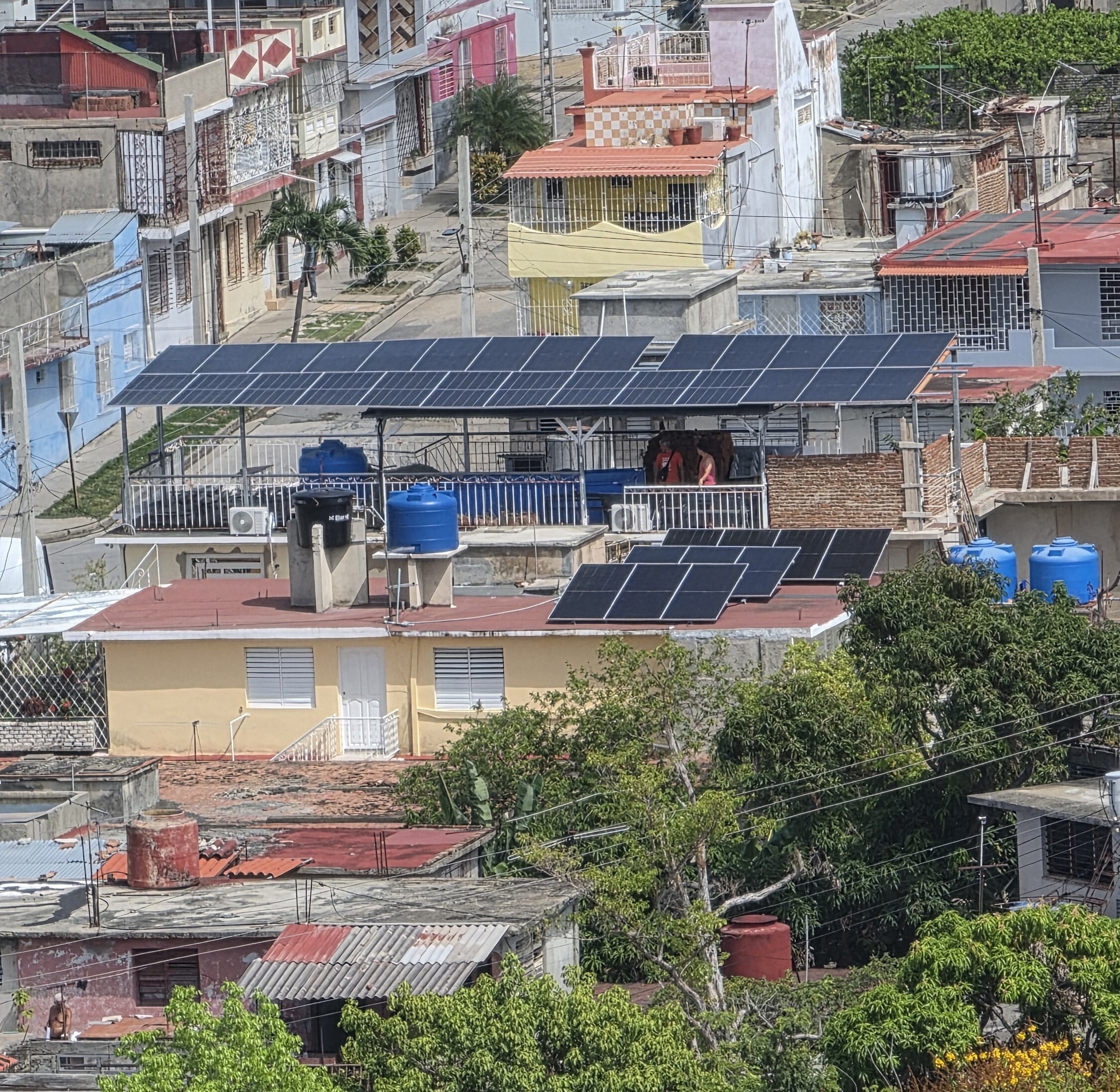
A battery. A photovoltaic panel. A generator. A charged phone. An MSME able to import fuel. A person living abroad who sends money, medicines or a spare part. Diego de la Serna’s chronicle, which prompted this essay, described precisely that shift towards tank containers, private distribution circuits, fuel transported in containers and household electricity-generation solutions (De la Serna, 2026).
Infrastructure therefore ceases to mean only what the state builds. It also includes what households, family networks and small businesses improvise so that life can continue.
Cuba and Ayiti show, from radically different histories, that political sovereignty is never merely juridical. It also depends on the material capacity to reproduce life.
Ayiti — the Kreyòl name of the country known in English as Haiti — has already appeared in an earlier AIthropology analysis as a particularly fertile case for thinking about the relationships between history, foreign intervention, power and institutional capacity. Returning to Ayiti requires methodological caution.
We are not establishing an equivalence between the two countries or a hierarchy of suffering. Nor are we claiming that Cuba is following a Haitian trajectory.
Cuba retains a state with nationwide territorial reach, a centralised administration and public systems that for decades produced comparatively strong health and educational outcomes in the region. Ayiti has followed an institutional trajectory marked by occupations, political ruptures, extreme inequality and, in the present, a security crisis that severely limits state capacity in parts of the territory.
The comparison operates at another level. What matters is observing what happens when formal sovereignty comes into tension with the material capacities that make life under it possible. Before going further, it is useful to measure part of this historical difference.
Two trajectories of human development
The United Nations Development Programme’s Human Development Report 2025 uses 2023 data for its Human Development Index. The HDI combines longevity, education and income. By itself, it does not measure political freedoms, institutional quality, inequality, security or state capacity and should not be treated as a total explanation of a society (United Nations Development Programme [UNDP], 2025).
Table 1
Selected human-development indicators, 2023
| UNDP indicator | Cuba | Ayiti/Haiti |
|---|---|---|
| HDI, 2023 | 0.762 | 0.554 |
| HDI rank | 97 | 166 |
| Life expectancy at birth | 78.1 years | 64.9 years |
| Expected years of schooling | 13.9 | 10.9 |
| Mean years of schooling | 10.6 | 5.4 |
| GNI per capita, 2021 PPP | US$8,415 | US$2,935 |
| Inequality-adjusted HDI | No comparable published figure | 0.337 |
| Loss due to inequality | No comparable published figure | 39.2% |
| Gender Inequality Index | 0.296 | 0.618 |
Note. Author’s compilation based on UNDP (2025). Indicators refer primarily to 2023.
In 2023, the estimated gap in life expectancy was 13.2 years. Cuba’s mean years of schooling were nearly double those of Ayiti, while gross national income per capita in purchasing-power-parity terms was almost three times as high.
UNDP does not publish a comparable inequality-adjusted HDI for Cuba in this edition. That absence should remain an absence. Filling it through extrapolation would manufacture precision where none exists.
Something similar applies to the Multidimensional Poverty Index. The 2025 edition gives Cuba a value of 0.003 and an incidence of 0.7%, but relies on a 2019 survey. For Ayiti it reports an MPI of 0.200 and an incidence of 41.3%, based on 2016–2017 data (UNDP & Oxford Poverty and Human Development Initiative, 2025). These figures reveal very different accumulated conditions, but they are not a comparable snapshot of the two countries in 2026.
The point relevant to this essay lies elsewhere.
Cuba and Ayiti arrived at their present crises after accumulating profoundly different human capabilities.
Those differences also have a history.
Infant mortality allows us to follow one of those trajectories over almost four decades. To avoid mixing national methodologies, we use a single harmonised series: the World Development Indicators, sourced from the United Nations Inter-agency Group for Child Mortality Estimation — UN IGME — which brings together UNICEF, WHO, the World Bank and the UN Population Division (World Bank, n.d.-a, n.d.-b).
The rate records deaths before the age of one per 1,000 live births.
Table 2
Infant mortality in Cuba and Ayiti, selected years
| Year | Cuba | Ayiti/Haiti |
|---|---|---|
| 1985 | 14.1 | 113.6 |
| 1990 | 10.8 | 98.6 |
| 2000 | 6.8 | 71.1 |
| 2010 | 4.9 | 79.3 |
| 2020 | 5.7 | 43.6 |
| 2024 | 6.8 | 39.0 |
Note. World Development Indicators series, indicator SP.DYN.IMRT.IN, based on UN IGME. Latest common year available: 2024 (World Bank, n.d.-a, n.d.-b).
Between 1985 and 2024, the estimated rate fell by approximately 52% in Cuba and 66% in Ayiti. These percentages are calculations derived from the official series, not indicators published by the World Bank. The trajectory also resists an overly simple reading.
Ayiti shows an exceptionally visible anomaly in 2010. The rate rises from 56.8 in 2009 to 79.3 in the year of the earthquake, before falling back to 54.4 in 2011. This does not, by itself, establish the earthquake as the sole causal explanation for the entire variation, but it shows how sharply an extreme shock can become inscribed in a demographic indicator.
Cuba presents a different signal, less abrupt but relevant to this essay. The international estimate reached 4.8 deaths per 1,000 live births between 2011 and 2015. It has since risen steadily to 6.8 in 2024, an increase of roughly 42% from that low point. The rate remains far below Ayiti’s. But its direction has changed.
That change matters because it allows us to view the Cuban crisis as more than a decline in consumption, GDP or electricity availability. Some of the social capabilities accumulated over decades may also deteriorate. A human-development achievement is not an irreversible possession.
Cuba’s crisis: economy, sanctions and everyday life
The Cuban economy provides other signals. ECLAC estimates that real GDP contracted by 3.8% in 2025 and projects a further 10.3% contraction in 2026. It also records a sharp contraction in tourism and severe constraints involving foreign currency, energy and imports (Romero, 2026).
Between January and June 2026, Cuba received 387,591 international visitors, 60.7% fewer than during the same period a year earlier. Official year-on-year inflation reached 20.70% in July, while the latest available annual average state-sector wage, for 2025, stood at 6,930 Cuban pesos per month (Romero, 2026).
The 2024–2025 sugar harvest produced fewer than 150,000 tonnes, placing output at its lowest level in more than a century according to the figures examined by ECLAC (Romero, 2026). Sugar is not just another sector in Cuba’s genealogy.
It is landscape, labour, slavery, territorial organisation, world trade and external dependency. For centuries it structured the island’s insertion into the global economy. Its contemporary contraction therefore carries a meaning that extends beyond sectoral accounting. Nor can the crisis be reduced to a single cause.
There are domestic problems involving productivity, investment, management, incentives, agriculture, currency and infrastructure. Cuban institutions themselves acknowledged in June 2026 that the scale of the difficulties required significant changes. The programme presented to the National Assembly brought together 176 transformations organised across 23 areas, drawn from 390 proposals and 69 additional recommendations. It includes changes affecting state enterprises, private activity, ownership and management of assets, agriculture, energy policy, municipal autonomy and social protection (Díaz Ballaga & Antón, 2026).
The breadth of the programme supports a descriptive conclusion. Cuban authorities themselves consider that the economy’s internal functioning requires substantial modification. Domestic decisions, however, do not exhaust the genealogy.
Following the war of 1898, the United States occupied Cuba until 1902. The new republic was constrained by the Platt Amendment, which established US powers of intervention. That framework was removed by the 1934 Treaty of Relations, although the agreement concerning the Guantánamo naval base remained in force (U.S. Department of State, Office of the Historian, n.d.-a).
After the 1959 Revolution, the relationship changed again. The United States broke diplomatic relations in 1961 and established a broad trade embargo in 1962. Decades of regulations, exceptions, relaxations and new restrictions subsequently produced a wider legal architecture, including the 1996 Helms-Burton Act. A new layer appeared in 2026.
On 29 January, Executive Order 14380 declared a national emergency with respect to Cuba and created a mechanism for imposing additional tariffs on imports from countries supplying oil to the island (The White House, 2026a).
On 1 May, Executive Order 14404 expanded US sanctions authorities. The political and security characterisations contained in that order belong to the US Government and should be understood as such, rather than as neutral descriptions adopted by this essay (The White House, 2026b).
On 7 May, the Office of Foreign Assets Control brought GAESA within the measures derived from that new framework. On 11 June, OFAC added Unión Cuba-Petróleo, CUPET, to its list of blocked persons and entities (Office of Foreign Assets Control [OFAC], 2026a, 2026b). These measures operate on top of a much older sanctions architecture. There is also a diplomatic indicator of how persistent the dispute has been.
From 1992 to the closing date of this article, the United Nations General Assembly has adopted 33 resolutions under the agenda item Necessity of ending the economic, commercial and financial embargo imposed by the United States of America against Cuba. The institutional precision matters.
This does not mean that “the UN” as a whole has issued 33 legally binding rulings against the United States. They are General Assembly resolutions and they are not legally binding.
The first was A/RES/47/19, adopted in 1992 (United Nations General Assembly, 1992). The series continued annually through 2019. After the interruption during the pandemic, the Assembly voted on the issue again on 23 June 2021 through resolution A/RES/75/289. On 11 May 2022, during its seventy-sixth session, it decided to include the item on the agenda of the following session (A/DEC/76/563); the Assembly voted on the issue again on 3 November 2022 through resolution A/RES/77/7 (United Nations General Assembly, 2021, 2022a, 2022b).
The most recent resolution available as of September 2026 is A/RES/80/4, adopted on 29 October 2025 by 165 votes in favour, 7 against and 12 abstentions (United Nations General Assembly, 2025).
The significance of that series is primarily diplomatic and political. It does not repeal US legislation or settle the debate over its effects. It does show that international opposition to the embargo has been remarkably persistent.
An explanation of Cuba’s crisis based solely on sanctions would erase internal decisions, institutional rigidities and productive problems. An explanation based solely on the functioning of the Cuban economy would erase an external architecture that affects finance, energy, trade and relations with third countries.
Both narratives contain facts. The problem begins when either claims to contain them all.
Economics does not exhaust Cuba’s present either.
The protests that began on 11 July 2021 showed that material hardship could also become political and social conflict. Special Procedures of the UN Human Rights Council transmitted allegations to the Cuban Government concerning arbitrary detention, temporary disappearance, excessive use of force, communication restrictions and possible infringements of the freedoms of expression and assembly (Office of the United Nations High Commissioner for Human Rights [OHCHR], 2021).
The document is a communication of allegations, not a judicial ruling. The Cuban state has rejected a number of characterisations of both the protests and its response, and has defended the legality of the measures taken.
Preserving that distinction is particularly important in an analysis seeking to avoid closed explanations.
Ayiti and another genealogy of sovereignty
Ayiti offers a profoundly different trajectory. The Haitian Revolution culminated in 1804 with the creation of an independent state born from a revolution against colonial slavery. External recognition did not follow immediately.
In 1825, France made recognition conditional upon an indemnity initially set at 150 million francs, an obligation that constrained Haitian finances for decades. Historical US diplomatic records document the debt and its subsequent renegotiations (U.S. Department of State, 1873). The United States formally recognised Haiti in 1862.
Between 1915 and 1934, US forces occupied the country. The State Department’s own institutional history situates that intervention within a combination of US strategic, financial and political interests in the Caribbean (U.S. Department of State, Office of the Historian, n.d.-b). There is no mechanical line running from 1825 to 2026. Genealogy does not work like that.
It allows us to observe how debt, foreign intervention, inequality, national institutions, economic elites, disasters and political conflict accumulated at different historical moments. The present was not written in advance. Nor did it begin yesterday. In Ayiti, the contemporary crisis operates on a different scale from Cuba’s.
The International Organization for Migration’s Displacement Tracking Matrix counted 1,466,862 internally displaced people in May 2026. Eighty-four per cent were living outside formal displacement sites, mainly with host households or in rented accommodation (International Organization for Migration [IOM], 2026). That 84% deserves anthropological attention. A huge share of displacement does not end in a camp.
It ends in somebody else’s home. Humanitarian infrastructure can also be a room, a mattress, a kitchen and a household absorbing additional people. In April 2026, the World Food Programme estimated that 5.8 million people, around 52% of the population, were facing acute food insecurity at crisis level or worse. More than 1.8 million were facing emergency levels of food insecurity (World Food Programme [WFP], 2026).
The United Nations’ 2026 Humanitarian Response Plan estimated that 6.4 million people required assistance and aimed to reach 4.2 million, with a funding requirement of approximately US$880 million (United Nations in Haiti, 2025). Violence adds another dimension.
The United Nations Integrated Office in Haiti documented 1,408 people killed and 656 injured between April and June 2026. Its report distinguishes violence attributed to armed groups, security-force operations, self-defence groups and other people involved (United Nations Integrated Office in Haiti [BINUH], 2026). That precision prevents “gangs” from becoming a total explanation of Haitian society.
At this point, the difference matters as much as the comparison. Cuba retains a nationwide state apparatus, administrative institutions and public-service systems. The crisis is expressed through the deterioration of some of those capacities and increasing difficulty in maintaining certain services and infrastructures.
In Ayiti, state authority is directly contested in parts of the territory and the security crisis constrains basic administrative, economic and mobility functions. To speak of a “Haitianisation” of Cuba would erase that distinction. What matters is that material sovereignty can deteriorate in different ways. A state can retain territorial control while losing economic and infrastructural capacity.
Another can experience material deterioration, mass displacement and an effective loss of authority in particular areas at the same time. In both cases, people, households and social networks appear absorbing the impact.
Everyday life as infrastructure
When infrastructure fails, the need it once met does not disappear. It changes location. Electricity the grid no longer delivers becomes a battery, a solar panel, fuel, a generator or foregone consumption. Medicine unavailable through ordinary channels must be found elsewhere.
Food that cannot be bought with wages requires savings, alternative markets, family networks or outside assistance. Interrupted mobility becomes hours. Someone must absorb those hours. The household then becomes a shock absorber.
An infrastructure crisis can be transformed, almost silently, into domestic labour, informal networks, care work and family dependency. But that transfer is not socially neutral either.
Households with access to foreign currency, relatives abroad, solar panels, transport or the ability to store food possess resources unavailable to others. Adaptation can reduce harm. It can also redistribute it. This is where contemporary Cuban anthropology becomes particularly useful.
Ruth Behar, born in Havana and Professor of Anthropology at the University of Michigan, has spent decades working on home, displacement, migration, return, memory and diaspora. Her work allows Cuba to be understood not only as a national territory but also as a network of relationships crossing borders.
In The Portable Island, the volume she edited with Lucía M. Suárez, the image of a “portable island” brings together Cuban voices reflecting on what happens when belonging, home and social life move with those who emigrate (Behar & Suárez, 2008).
In Bridges to Cuba/Puentes a Cuba, Behar also examines artistic, academic and family connections maintained between people living inside and outside the island, including during decades of highly restrictive political relations between Cuba and the United States (Behar, 2015). Behar does not call a remittance or a battery “infrastructure”. That analytical extension is ours.
But her work allows us to move beyond an excessively territorial image of Cuban society. A person may physically leave the island while continuing to participate in the daily reproduction of a household that remains there. Migration does not necessarily break national society apart. It can also stretch it. From this perspective, a remittance ceases to be merely a balance-of-payments figure.
Seen from macroeconomics, it is a monetary transfer. Seen from a kitchen, it is food. From a blackout, a battery. From a pharmacy, medicine. From a bedroom, the month’s rent. Diaspora can therefore function as transnational infrastructure for social reproduction. Something similar happens in Ayiti, albeit within a different migratory and political history. The important point is not to romanticise this capacity.
A society partly sustained through external ties distributes the ability to withstand crisis unevenly. Not every household has relatives abroad, and not every diaspora has the same economic capacity. Adaptation does not eliminate precarity. Sometimes it merely privatises it.
Memory and material sovereignty
Michel-Rolph Trouillot offers a different tool. In Silencing the Past, Trouillot proposed understanding power as something that intervenes at different moments in the production of history — in the creation of sources, their preservation, the construction of narratives and what later acquires historical significance (Trouillot, 1995). Silence is not only the deletion of a document.
It can also be produced when an explanation renders everything outside it irrelevant. Applied to Cuba, two particularly closed narratives emerge. One attributes the crisis to the US embargo and sanctions.
The other presents contemporary deterioration as self-sufficient proof of the failure of Cuba’s economic and political system. The first can silence internal decisions, economic-policy mistakes, institutional restrictions or productivity problems.
The second can silence the history of US intervention, sanctions, economic asymmetry and external dependencies that constrain the available options. Recognising both dimensions does not require dividing responsibility in half. Genealogy is not a balance sheet. Trouillot becomes even more necessary when we turn to Ayiti.
Terms such as “failed state”, “gang violence” or “ungovernability” may describe observable dimensions of the present. Turned into total explanations, they risk presenting institutional fragility as an almost natural attribute of Haitian society.
Trouillot showed precisely how the Haitian Revolution could be rendered a “non-event” within intellectual categories unable to conceive of a revolution led by enslaved people. Silence did not arrive after history. It formed part of its production. Fernando Ortiz provides another scale.
His concept of transculturation, developed in Contrapunteo cubano del tabaco y el azúcar, sought to describe processes in which cultural contacts simultaneously generate losses, appropriations and new forms (Ortiz, 1940). Ortiz does not explain why a thermal power station fails.
He helps us look at a society historically accustomed to recomposing materials, practices and relationships drawn from different worlds. Cuba in 2026 contains state planning, public enterprises, business conglomerates linked to the Armed Forces, private MSMEs, regulated and informal markets, pesos and foreign currencies, renewable technologies, remittances and transnational family networks.
We do not need to name that mixture as a new system. It is enough to observe that everyday life crosses several systems of provision at the same time. Trouillot helps us ask what disappears from our narratives. Behar helps us follow the household when it crosses borders.
Ortiz reminds us that societies do not simply receive external forces. They transform them and are transformed by them. This is where the comparison finds its purpose.
Human-development indicators show that Cuba accumulated health and educational capabilities far greater than Ayiti’s. The infant-mortality series confirms that this divergence did not appear yesterday. But it also shows something else. Accumulated capabilities can deteriorate. A relatively high HDI does not produce electricity. High life expectancy does not repair a power station.
Decades of schooling do not automatically generate fuel, foreign currency or investment. At the same time, Ayiti’s low indicators do not describe a national essence. They are the provisional outcome of a history in which fiscal capacity, inequality, debt, institutions, foreign intervention, violence and disasters have interacted over two centuries. Perhaps, then, we should adjust the question.
Instead of asking only whether a state is sovereign, we can ask what infrastructures that sovereignty rests upon. Who produces energy? Who guarantees food? Who makes mobility possible? Who finds medicines? Who sustains care? Who finances everyday life? Who can migrate, and who can send resources back? Sovereignty then ceases to appear as an abstract property. It becomes a material relationship.
The present has a genealogy
Cuba and Ayiti do not offer a general theory of Caribbean failure. Ayiti is not Cuba’s future. Nor does Cuba retrospectively explain Ayiti. The two societies allow us to observe something more complex. Institutional capabilities can be built over decades and deteriorate later. External interventions can produce lasting effects without explaining everything that follows.
Domestic decisions matter without making the international conditions in which they are taken disappear. Families can keep life going when infrastructure fails, but that capacity may conceal an enormous transfer of costs towards households.
Human-development indicators can record genuine achievements without guaranteeing that they are irreversible.
Cuba and Ayiti show, from radically different histories, that political sovereignty is never merely juridical. It also depends on the material capacity to reproduce life.
A genealogy does not absolve responsibility.
It prevents the present from appearing to have been born yesterday.
That is why a blackout can reveal more than the absence of electricity. A battery connected to a solar panel brings together state infrastructure, global technology, markets, energy policy, household income and diaspora.
In Ayiti, a displaced family finding shelter in another family’s home makes something similar visible. A function we might expect to find in an institution has been transferred to a social relationship. Society continues to function. But somebody is materially paying for that continuity. Perhaps that produces a more useful question than an abstract celebration of resilience. Not how much a society can endure.
But who is absorbing the cost of keeping it going. Because societies, like archaeological sites, accumulate layers. And sometimes all it takes is for the lights to go out to see them.
Methodological note. The comparison between Cuba and Ayiti is used as an analytical instrument, not as a historical equivalence, prediction or hierarchy of suffering. Economic, health, humanitarian and human-development figures have been checked primarily against official national sources, intergovernmental organisations and primary governmental documentation. Political claims appearing in official Cuban or US documents are attributed to the institutions making them and are not automatically adopted as analytical descriptions. CTXT is used only for journalistic scenes and observations, not to establish the main comparative statistical series.
Data from the Human Development Report 2025 refer primarily to 2023. Infant-mortality figures come from one harmonised international series and run to 2024, the latest common year available. The percentage reductions in infant mortality and the percentage Cuban increase from the 2011–2015 low are author calculations based on the World Bank/UN IGME series. UN General Assembly resolutions concerning the embargo on Cuba are not legally binding. The total of 33 refers to resolutions adopted between 1992 and 2025, taking into account the pandemic-related disruption to the calendar and the formal deferral during the seventy-sixth session.
References
Behar, R. (2015). Bridges to Cuba/Puentes a Cuba. University of Michigan Press. https://doi.org/10.3998/mpub.8818436
Behar, R., & Suárez, L. M. (Eds.). (2008). The portable island: Cubans at home in the world. Palgrave Macmillan. https://doi.org/10.1057/9780230616158
De la Serna, D. (2026). Cuba: radiografía de una devastación programada. CTXT. https://ctxt.es/es/20260901/Politica/55260/diego-de-la-serna-cuba-devastacion-gasolina-eeuu-asedio.htm
Díaz Ballaga, W., & Antón, S. (2026, June 18). Presentan transformaciones económicas y sociales ante el Parlamento cubano. Granma. https://www.granma.cu/cuba/2026-06-18/comenzo-la-tercera-sesion-extraordinaria-de-la-asamblea-nacional-del-poder-popular
International Organization for Migration. (2026). Haiti — Information sheet on the displacement situation: Round 13, May 2026. Displacement Tracking Matrix. https://dtm.iom.int/reports/haiti-information-sheet-displacement-situation-round-13-may-2026
Ministry of Energy and Mines of Cuba [@EnergiaMinasCub]. (2026, September 18). Se ha producido una desconexión total del Sistema Eléctrico. Ya comienzan a activarse los protocolos para la recuperación [Post on X]. X. https://x.com/EnergiaMinasCub
Office of Foreign Assets Control. (2026a, May 7). Counter terrorism and Iran-related designations; Cuba designation and designations updates; issuance of Cuba-related general license and frequently asked questions. U.S. Department of the Treasury. https://ofac.treasury.gov/recent-actions/20260507
Office of Foreign Assets Control. (2026b, June 11). Cuba designation; Russia-related designations removals and designation update; issuance of amended Russia-related general licenses and frequently asked questions. U.S. Department of the Treasury. https://ofac.treasury.gov/recent-actions/20260611
Office of the United Nations High Commissioner for Human Rights. (2021, August 3). Communication CUB 3/2021. Special Procedures of the Human Rights Council. https://spcommreports.ohchr.org/TMResultsBase/DownLoadPublicCommunicationFile?gId=26561
Ortiz, F. (1940). Contrapunteo cubano del tabaco y el azúcar. Jesús Montero.
Romero, I. (2026). Evolución macroeconómica de Cuba en 2025 y perspectivas para 2026 (LC/MEX/TS.2026/15). Comisión Económica para América Latina y el Caribe. https://www.cepal.org/es/publicaciones/90285-evolucion-macroeconomica-cuba-2025-perspectivas-2026
The White House. (2026a, January 29). Addressing threats to the United States by the Government of Cuba. https://www.whitehouse.gov/presidential-actions/2026/01/addressing-threats-to-the-united-states-by-the-government-of-cuba/
The White House. (2026b, May 1). Imposing sanctions on those responsible for repression in Cuba and for threats to United States national security and foreign policy. https://www.whitehouse.gov/presidential-actions/2026/05/imposing-sanctions-on-those-responsible-for-repression-in-cuba-and-for-threats-to-united-states-national-security-and-foreign-policy/
Trouillot, M.-R. (1995). Silencing the past: Power and the production of history. Beacon Press.
United Nations Development Programme. (2025). Human development report 2025: A matter of choice: People and possibilities in the age of AI. https://hdr.undp.org/content/human-development-report-2025
United Nations Development Programme, & Oxford Poverty and Human Development Initiative. (2025). Global Multidimensional Poverty Index 2025. https://hdr.undp.org/content/2025-global-multidimensional-poverty-index-mpi
United Nations General Assembly. (1992). Necessity of ending the economic, commercial and financial embargo imposed by the United States of America against Cuba (A/RES/47/19). United Nations Digital Library. https://digitallibrary.un.org/record/158766
United Nations General Assembly. (2021). Necessity of ending the economic, commercial and financial embargo imposed by the United States of America against Cuba (A/RES/75/289). United Nations Digital Library. https://digitallibrary.un.org/record/3930692
United Nations General Assembly. (2022a). Necessity of ending the economic, commercial and financial embargo imposed by the United States of America against Cuba (A/DEC/76/563). United Nations Digital Library. https://digitallibrary.un.org/record/3977763
United Nations General Assembly. (2022b). Necessity of ending the economic, commercial and financial embargo imposed by the United States of America against Cuba (A/RES/77/7). United Nations Digital Library. https://digitallibrary.un.org/record/3993964
United Nations General Assembly. (2025). Necessity of ending the economic, commercial and financial embargo imposed by the United States of America against Cuba (A/RES/80/4). United Nations Digital Library. https://digitallibrary.un.org/record/4092314
United Nations in Haiti. (2025, December 18). Launch of the 2026 Humanitarian Response Plan in Haiti to assist 4.2 million people. United Nations. https://haiti.un.org/en/307360-launch-2026-humanitarian-response-plan-haiti-assist-42-million-people
United Nations Integrated Office in Haiti. (2026, August 25). Haiti: At least 1,408 people killed and 656 injured during the second quarter of 2026. United Nations. https://binuh.unmissions.org/en/node/136551
U.S. Department of State. (1873). Haiti (Foreign relations of the United States, 1873, Document 205). https://history.state.gov/historicaldocuments/frus1873p1v1/d205
U.S. Department of State, Office of the Historian. (n.d.-a). A guide to the United States’ history of recognition, diplomatic, and consular relations, by country, since 1776: Cuba. https://history.state.gov/countries/cuba
U.S. Department of State, Office of the Historian. (n.d.-b). U.S. invasion and occupation of Haiti, 1915–34. https://history.state.gov/milestones/1914-1920/haiti
World Bank. (n.d.-a). Mortality rate, infant (per 1,000 live births) – Cuba [Data set]. World Development Indicators. Retrieved September 28, 2026, from https://data.worldbank.org/indicator/SP.DYN.IMRT.IN?locations=CU
World Bank. (n.d.-b). Mortality rate, infant (per 1,000 live births) – Haiti [Data set]. World Development Indicators. Retrieved September 28, 2026, from https://data.worldbank.org/indicator/SP.DYN.IMRT.IN?locations=HT
World Food Programme. (2026, April 17). WFP urges support to protect gains in fight against entrenched food insecurity in Haiti. https://www.wfp.org/news/wfp-urges-support-protect-gains-fight-against-entrenched-food-insecurity-haiti