
Linguistic anthropology and AI
A language is not an event
Reading time: 10 min
As UNESCO debates AI and living heritage, Indigenous voices from Mexico defend the collective right to decide which technologies to use for their languages.
On 15 October, UNESCO is devoting a session of its TechCul Dialogues to artificial intelligence and intangible cultural heritage. The event acknowledges the risk of fixing in place, or appropriating, practices that remain alive through the people who sustain them. From Mexico, the work of Yásnaya Elena Aguilar Gil and experiences of Indigenous digital activism broaden this discussion to linguistic rights and technological autonomy. Deciding whether a language should be incorporated into an AI model, and on what terms, is also part of that language’s future.
The session on 15 October, from 9.00 to 11.00 am Spanish peninsular time, is part of a series organised by UNESCO’s Regional Office for East Asia on AI and culture in East and South-East Asia. It is moderated by Harriet Deacon of the University of Hull, and three of the four speakers are affiliated with Chinese universities. The announcement poses five questions. It examines how AI-assisted documentation can be reconciled with the living character of heritage, how the people who hold this knowledge took part in designing and governing the applications, and which data-protection and cultural protocols were adopted to prevent appropriation or loss of context. It also asks whether the applications contributed to revitalisation and community empowerment, and what technical, ethical and institutional limitations remain.
These questions matter. By raising them, UNESCO acknowledges constraints that enthusiasm for digitising living culture can overlook. Even so, they arise from experiences in which an application has already been developed. The possibility of deciding beforehand whether such a technology ought to be developed deserves an equally prominent place in the discussion.
A language is not an event
Yásnaya Elena Aguilar Gil, an Ayuujk linguist from Ayutla Mixe and a member of the COLMIX collective, offers a productive provocation through which to read the session. In a keynote lecture for FAIR, the feminist AI research network, she argued that language should not be treated as culture in the narrow sense of an artistic expression, the sense that places it within ministries of culture alongside dance, music and textiles.
This does not diminish the importance of those practices. A dance takes place at a particular moment. A language has no moment of its own. It runs through waking, argument, silent thought and even dreams. Aguilar Gil therefore speaks of languages as cognitive territories, and of the systematic violation of linguistic rights as a form of dispossession from those territories.
The distinction has consequences for AI. The heritage framework approaches practices as things to be documented, safeguarded and passed on. A language can enter that framework as an object of preservation. Yet what keeps it alive is everyday life in which it is spoken, at school, in hospital, in court or at home, rather than an archive.
Aguilar Gil also describes how states have carved out limited technological niches for Indigenous languages. Storytelling apps are encouraged, while systems for healthcare, justice or public administration are not. She borrows a term attributed to a fellow linguist for this phenomenon, glottowashing, the appearance of accommodating linguistic diversity without actually doing so.
On 6 October, Aguilar Gil clarified her position in a column for El País. In a non-capitalist world, she writes, where digital technologies were conceived as collective goods with free and fair access, the inclusion of Indigenous languages in AI would not even be disputed, because all languages have an equal right to be used in every sphere. She thereby places linguistic revitalisation within the economic relations that shape technological development. In her view, what is at stake is whether ‘we repurpose our languages to serve as vehicles for the capitalist system’. Without making this explicit, she warns, those who question AI as a tool for revitalisation risk being dismissed as technophobes. She leaves open a difficult question: how can anti-capitalist revitalisation be pursued without falling into a paralysing purism?
A machine speaking a language does not revitalise it
On 17 September, a report by Arlette Xitlali Morales Diego for Animal Político brought together speakers and specialists in several of Mexico’s languages to consider this debate. Kiado Cruz, a Zapotec communicator and researcher from Yagavila, recounted how an AI assistant apologised for not understanding him when he addressed it in his language. Ximena Gutiérrez, a computational linguist and researcher at UNAM’s Centre for Interdisciplinary Research in the Sciences and Humanities (CEIICH), explained that systems struggle to learn what is scarcely represented in their training data, and that computers alone cannot resolve the problem.
The most pointed warning came from Marco Martínez, an Ayuujk activist associated with Rising Voices and COLMIX. According to the report, Martínez argues that the debate often drifts towards the mistaken belief that a language is automatically revitalised once an AI system learns it. That belief draws attention away from what sustains a language: language planning and transmission between generations. His formulation is unequivocal: ‘There is no point in the language being there if the code does not belong to us.’
In the same report, Aguilar Gil considered the promise of a linguistically diverse digital world to have been broken. She asked whether AI is necessary at all, given its consumption of water, energy and minerals. It is for communities themselves, she maintained, to answer that question.
Community deliberation before the model
This insistence on who gets to decide has an intellectual history. From the Mixe and Sierra Juárez regions of Oaxaca, Floriberto Díaz and Jaime Martínez Luna developed the concept of comunalidad, a shared way of life encompassing territory, assemblies, community service, collective labour and festivities. The communal does not begin with a resource to be managed jointly. It begins with a community that makes decisions about its territory.
Aguilar Gil extends this thinking to technology. From tequio, collective and reciprocal work for the common good, she derives tequiología, an approach to technology grounded in reciprocity and outside the logic of patents. She recalls that the milpa, a traditional agricultural system, is also a technology, and that nobody pays a licence fee to cultivate one. She also invokes Sumak Kawsay as one of the ways different languages articulate Buen Vivir, or living well, in contrast to prevailing notions of progress.
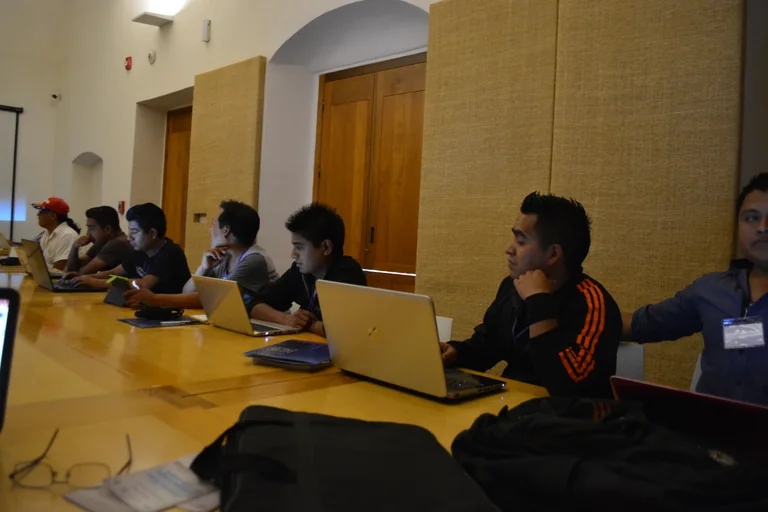
Rising Voices has put this approach into practice. Between April and May 2026, it organised a programme on AI, accountability and Indigenous self-determination in Chiapas. From 5 to 7 May, in San Cristóbal de las Casas, fifteen digital activists speaking Tsotsil, Tseltal and Ch’ol discussed whether, and how, they wanted to engage with AI. Understanding how these systems work was the starting point, while a recurring concern was the lack of information about what happens to the data they collect.
On 3 October, the organisation opened a similar call for speakers of Indigenous languages in Oaxaca. The programme is facilitated by Kiado Cruz, Ximena Gutiérrez and Tajëëw Díaz Robles, who is Mixe from Tlahuitoltepec and a member of COLMIX. Its announcement begins by explaining what the programme will not do: ‘We will not teach you to use AI tools to create content in Indigenous languages.’ Applications close on 20 October.
The sequence matters. Information and collective deliberation come first. A tool may follow, if that is what the community decides.
What global ethics left out
On 6 October, the journal AI and Ethics published an article by Dorine Eva van Norren, a Leiden University researcher associated with the University of Pretoria’s decoloniality research group, comparing UNESCO’s Recommendation on the Ethics of Artificial Intelligence with principles of Buen Vivir. Her reconstruction of the drafting process reveals a significant detail. The initial draft included a value described as ‘living in harmony and peace’, which several member states challenged over the ambiguity of harmony and its possible implications for human rights. It was eventually reformulated as ‘living in peaceful, just and interconnected societies’. The reference to harmony with nature disappeared from that principle, although the Recommendation retains environmental commitments elsewhere.
The Recommendation also encourages states, where appropriate, to consider using AI to preserve Indigenous languages and knowledge through participatory approaches, and recognises Indigenous peoples’ self-governance over data. Van Norren observes that Indigenous peoples appear in the text as distinct communities in need of protection, while their values scarcely inform the principles intended to apply to everyone.
Read from Oaxaca, the discussion shifts further. The Recommendation envisages AI as a possible means of preservation. The reflections emerging from COLMIX and Rising Voices add a collective right to deliberate over whether it is desirable and under what conditions.
Consent also requires work
In the 14 October Radar, The rest of the delegation, we discussed a finding by Samuel Oluwatobi Atiku concerning systems that draft notes during medical consultations. His analysis of regulatory documents argues that consent and the ability to refuse these tools require adequately resourced alternatives. Formal refusal can hardly be an effective choice when the means to sustain it are absent.
The scale is different, but the mechanism is similar. For a community to refuse the inclusion of its language in an AI model, or to accept on its own terms, it needs conditions resembling those that Rising Voices seeks to strengthen: information, time, spaces for deliberation and a workable alternative. Without these, community consent risks being reduced to a procedural formality.
The five questions at the 15 October session remain necessary. Communities’ experiences add another, preceding the design of any application. Who decides that a language needs a machine, and what means do they have to reject it? Aguilar Gil ends her lecture without a single answer. She proposes multiple tequiologías, diverse technological traditions and futures that need not be measured against a single notion of progress.
Sources
- Aguilar Gil, Yásnaya Elena. (1 November 2022). La lengua como territorio cognitivo y su relación con concepciones tecnológicas. Keynote lecture at the First Regional Meeting of FAIR’s LAC Hub, published in Inteligencia Artificial Feminista. Hacia una agenda de investigación para América Latina y el Caribe. CC BY-SA 4.0. https://feministai.pubpub.org/pub/5gmo1xhx/release/2
- Gil, Yásnaya Elena A. (6 October 2026). Inteligencia artificial y lenguas indígenas. Pujx. El País México. https://elpais.com/mexico/opinion/2026-10-06/inteligencia-artificial-y-lenguas-indigenas-pujx.html (archived copy at https://archive.ph/UX9KC)
- Morales Diego, Arlette Xitlali. (17 September 2026). «Discúlpame, no te entiendo»: cuando la IA intenta hablar lenguas originarias. Animal Político. https://grupoanimal.mx/sociedad/ia-intenta-hablar-lenguas-originarias
- Rising Voices. (23 July 2026). Who decides if and how AI is used? Self-determination should be the priority, say Mayan activists from Chiapas. https://rising.globalvoices.org/blog/2026/07/23/who-decides-if-and-how-ai-is-used-self-determination-should-be-the-priority-say-mayan-activists-from-chiapas/
- Martínez, Marco. (3 October 2026). [Convocatoria Oaxaca] Inteligencia artificial, responsabilidad y la autodeterminación para pueblos indígenas. Rising Voices. https://rising.globalvoices.org/es/2026/10/03/convocatoria-oaxaca-inteligencia-artificial-responsabilidad-y-la-autodeterminacion-para-pueblos-indigenas/
- UNESCO Regional Office for East Asia. (9 October 2026). Mark Your Calendar | TechCul Dialogues — Webinar 2: Intangible Cultural Heritage. https://www.unesco.org/en/articles/mark-your-calendar-techcul-dialogues-webinar-2-intangible-cultural-heritage
- van Norren, Dorine Eva. (2026). A pluralistic view on AI ethics: perspectives from Buen Vivir. AI and Ethics, 6, 580. https://doi.org/10.1007/s43681-026-01403-w
- Díaz, Floriberto. (2007). Escrito. Comunalidad, energía viva del pensamiento mixe. UNAM. https://www.libros.unam.mx/gd-floriberto-diaz-escrito-comunalidad-energia-viva-del-pensamiento-mixe-ayuujktsen-9786070262081-libro.html
- Martínez Luna, Jaime. (2010). Eso que llaman comunalidad. Oaxaca. https://books.google.com/books/about/Eso_que_llaman_comunalidad.html?id=1v9ZMwEACAAJ
- Atiku, Samuel Oluwatobi. (2026). Regulating the drafting fiction: A qualitative content analysis of official guidance and regulator documents on AI scribe adoption and use in healthcare. PLOS Digital Health, 5(10), e0001776. https://doi.org/10.1371/journal.pdig.0001776