
Visual anthropology and AI
Niu Lai and the trace of the hand
Reading time: 14 min
A Chinese film made without artificial intelligence went from ridicule to a cultural phenomenon. Between internet 抽象, 手搓 and the desire for 活人感, what happens when imperfection begins to function as a trace of humanity.
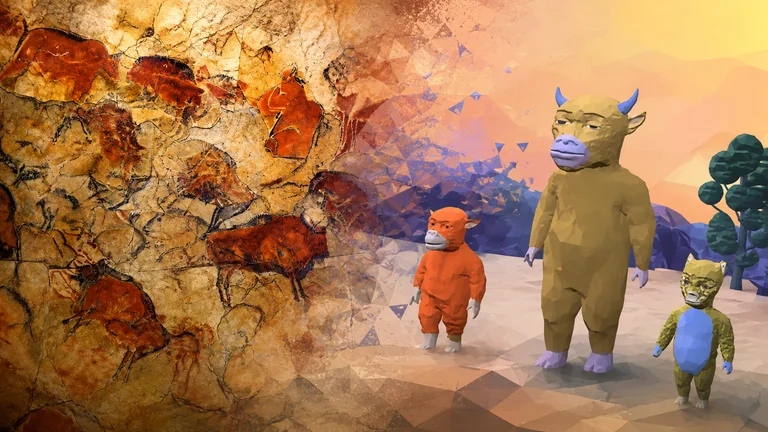
The poster promised a different film. Ink, mountains, empty space and an ox beneath a red cloak. Then the screen lit up and showed rudimentary 3D models, stiff movements, flat textures and characters that occasionally seemed to forget the laws of physics.
Niu Lai (牛来, roughly “the ox is coming”) opened in China on 5 August 2026 with virtually no promotion. Xin Yumeng and his mother, Sun Lifang, had spent five years making it far from any large studio. Xin Yumeng handled directing, production, modelling, animation, editing and voices. Sun Lifang contributed to the script and dubbing and composed the closing song. This was not the story of one person making a film while his mother lent a hand. It was a two-person family workshop.
Over its first nine days, Niu Lai took 7,169 yuan from only 236 admissions, according to Maoyan data later reported by China News Service. It seemed destined to vanish from cinemas. Then its flaws began to circulate. Clips recorded during screenings, screenshots of characters passing through one another, odd movements and improbable dialogue. Ridicule became curiosity. Between 14 and 15 August, its daily screenings rose from 21 to 359. The Beijing News even found people who had driven thirty kilometres to see it and be able to say they had witnessed the moment.
Five days later, Reuters was describing a nationwide phenomenon of memes, merchandise, costumes and packed screenings. By 20 August, the film had grossed the equivalent of more than four million US dollars, remarkable for a family production of this kind. Reuters also reported that part of the conversation was becoming a joyful rejection of both slick marketing and AI-generated content.
The explanation was tempting. In a visual environment saturated with AI-generated imagery, audiences were rewarding an imperfect film because its flaws proved that people stood behind it. There is something true in that reading. But in China the story had begun with another word.
抽象 and the pleasure of breaking the script
The Beijing News described Niu Lai as breaking out through 抽象 (chōuxiàng). The literal translation is “abstract”, but here it has little to do with Western abstract art. In Chinese internet language, 抽象 has come to name a form of humour rooted in the baffling, illogical, excessive or radically out of register.
Its recent digital genealogy is commonly traced to the Douyu streaming ecosystem and to the culture around 抽象工作室 and the 6324 community from around 2015. Huxiu documented in 2018 how that small world of livestreaming, in-jokes and collective meme-making helped spread an “abstract” culture far beyond the studio that gave it its name.
Something can be 抽象 when it violates expectations so flagrantly that the rupture itself becomes a source of collective pleasure. It is not simply bad or strange. The short circuit is the point.
Niu Lai seems almost accidentally designed for this world. A commercially released film comes with certain agreements, including fluid animation, visual continuity, synchronisation and some consistency between the promotional promise and what eventually appears on screen. Niu Lai breaks one agreement after another. The further it moved away from what a cinema release was supposedly meant to be, the more people wanted to see for themselves how far it went.
At first, they were not necessarily going to defend human labour against AI. They were going because it was 抽象. The transformation came later.
手搓, made by hand and persistence
As the circumstances of the production became known, the same flaws began to mean something different. Around Niu Lai, the expression 纯手搓 (chún shǒucuō) began to circulate, roughly “made entirely by hand” or “made through sheer manual effort”.
手搓 (shǒuchuō) comes from the gesture of making something with one’s hands, but in Chinese technological language it can also describe digital objects made in a highly manual way, without large infrastructures or automation. The expression did not begin with Niu Lai. Only weeks before the film opened, the newspaper of the China Writers Association published a reflection on the renewed cultural value of 手搓 in opposition to standardisation and algorithmic production. Irregularity was presented not as an automatic virtue but as a possible trace of decisions, improvisations and human processes. China Writers Network.
In Niu Lai, the term is unusually apt. In an interview conducted before the viral explosion, Xin Yumeng explained that the budget made professional equipment unaffordable and that some hardware was bought through the second-hand platform Xianyu. Components failed and several motherboards burned out during the long production process. A full transcript of the interview was published on 18 August by Tonghuashun Finance.
The technically poor result was not deliberately sought as an aesthetic style. It is the visible mark of the conditions in which the film was made. A stiff movement remains a stiff movement and a character passing through another character remains an error, but such failures no longer tell us only what went wrong. They begin to tell us how the film was made. Five years, two people, self-teaching, limited tools, repetition, correction and time.
Imperfection begins to function as a trace.
活人感, the feeling of a living person
Another Chinese expression helps to explain that shift. 活人感 (huórén gǎn) can be rendered approximately as “the feeling of a living person”. It is used to describe content and presences that retain spontaneity, particularity, recognisable emotion and traces of lived experience in contrast with a digital culture that feels increasingly scripted, filtered and standardised.
With Niu Lai, this connection is not simply an interpretation imposed from outside. On 18 August 2026, only days into the viral explosion, 古珍晶 of the School of Digital Media at Shenzhen Polytechnic University published “‘活人感’如何实现电影艺术疗愈?——以新大众文艺视域下的动画电影《牛来》为例” in 文化软实力研究, an early academic analysis devoted precisely to this dimension of the phenomenon.
The article makes an important distinction. 活人感 is not synonymous with roughness or amateurism. It emerges when audiences perceive concrete subjects, lived experience, traces of life and creative motivations that are not entirely instrumental. 古珍晶 describes how attention shifted from assessing the film alone towards the people who created it and their life experience.
That allows the phenomenon to be stated more precisely. People who initially arrived because of the film’s strangeness began to learn about a mother and son working for five years. Judgement shifted partly from the outcome to the process. The film stopped being only a collection of defective images and became a story of labour as well.
The point is not that “bad looks human”. It is that a history of work becomes perceptible in the image again.
A film that had to be seen together
A viral film does not become a phenomenon simply because many people watch it. How they watch it matters too. Clips from Niu Lai were freely available online, yet thousands of people began travelling to cinemas to experience it collectively.
In a full auditorium, odd pauses provoke shared laughter, mistakes prompt comments and people who know the memes anticipate particular scenes. Afterwards, photographs and videos return to the platforms and feed new layers of participation. Anthropology has used the concept of communitas, associated with Victor Turner, to describe especially intense moments of collective connection in which ordinary social relationships are temporarily altered.
There is no need to turn a screening of Niu Lai into a ritual to notice something similar. The audience does not simply contemplate the film. It socially performs it. Cinemas improvised hand-made posters because promotional material was scarce. Costumes, memes and derivative objects appeared. The film began to exist as much in what audiences did with it as in the digital file projected on the screen.
Seeing Niu Lai made it possible to say something very simple. I was there too.
Technique has a body too
This way of reading traces is not unique to digital culture. Marcel Mauss showed that techniques are bound to bodies that learn, repeat and transmit ways of doing. Tim Ingold later emphasised that making involves continually responding to materials, tools, difficulties and possibilities. Alfred Gell, meanwhile, proposed attending to the relations of agency we infer from objects.
Together, these approaches help explain why a flaw can cease to be mere noise. The polygons of Niu Lai do not literally contain the hands that produced them, but the film’s reception shows that audiences can read in them a history of decisions, limitations and persistence.
A hand on the rock
Long before cinema, pixels or generative models existed, other images preserved a far more direct relationship between representation and presence. The comparison with Palaeolithic caves becomes useful precisely if we avoid a trap. The art of Altamira, Chauvet or Lascaux is not clumsy art. Many animal images display extraordinary knowledge of movement and form, while the reliefs, cracks and volumes of rock surfaces were incorporated into images in technically sophisticated ways.
The connection with Niu Lai does not lie in comparing two kinds of imperfection. It lies in the trace.
Negative hand stencils appear in many Palaeolithic caves. A palm is held against the rock and pigment is projected around it. When the hand is removed, its contour remains. We do not know with certainty what those images meant, and archaeological interpretations have varied widely. But one thing is far less disputable. A hand was there.
In semiotic terms, this is an index through contact. The image maintains a physical relation to the body involved in its production. Niu Lai belongs to a different material regime. Between the bodies of Xin Yumeng and Sun Lifang and what appears on screen lie computers, keyboards, software, three-dimensional meshes, rendering, digital files and an entire cinema infrastructure.
Its errors are not physical imprints. They operate instead as indices of process. They allow us to reconstruct a chain of actions, constraints, learning and decisions.
The Palaeolithic hand was physically on the rock. The hand behind Niu Lai has to be inferred.
María Isabel Rodríguez López’s materials on Upper Palaeolithic art are useful here because they keep this comparison grounded in material and technical questions, particularly the relationship with rock surfaces, three-dimensionality and competing interpretations.
When perfection stops telling us how something was made
For a long time, a significant part of the technological development of images involved eliminating irregularities such as noise, grain, jumps, seams, lighting errors and unconvincing movement. Achieving a technically immaculate result required resources, specialist knowledge and considerable time. Image quality therefore supplied indirect information about the process behind it.
Generative AI is changing that relationship. An extraordinarily complex image can now appear in seconds. That does not mean there is no human intervention, nor that AI necessarily produces better images. It means something more specific. Looking only at the output, it is increasingly difficult to reconstruct how it was made.
The image loses some of its ability to tell us its own history. Niu Lai does the opposite. Its technical precariousness allows us to imagine the tools, the learning curve, the time invested and the persistence. Its defects become a kind of visible metadata.
The technically poor result was not sought as a style. It is the visible mark of the conditions in which it was made.
Authenticity can also be learned
A comfortable ending would nevertheless be misleading. Anthropology has spent decades observing what happens when something becomes recognised as authentic. Dean MacCannell showed how the search for authenticity can generate staged authenticity. Davydd Greenwood observed how a cultural practice may change when it becomes a commodity for people wishing to consume precisely its “authentic” character.
Niu Lai is already inside that paradox. Improvised posters were endearing because there was no professional campaign. They then became part of the appeal. Merchandise, imitations and speculation around the film’s name appeared. Reuters even documented stock-market movements connected with enthusiasm around the symbol of the bull.
Spontaneity began to become a style. This matters because the same thing can happen to the signs through which we believe we recognise human presence. If an irregularity acquires value because it looks authentic, there will be incentives to manufacture irregularities, including artificially.
When the machine learns to leave traces
Niu Lai does not show that human art has defeated artificial intelligence, nor that people prefer technically worse work. It shows something more provisional. At a time when visual perfection is becoming abundant, some traces of process are acquiring new value.
A pause, a seam, a domestic voice, a polygon that does not quite fit. “This looks as though someone made it.”
But that association only works while such signs remain difficult to counterfeit. Generative models can already produce photographic grain, blur, apparent brushstrokes, accidental movement and an entire visual repertoire of imperfection. They can also learn the conventions of 抽象, simulate a 手搓 aesthetic and generate content designed to produce 活人感.
The question will then cease to be whether we can distinguish a perfect image from an imperfect one. It will become something else.
How will we recognise human presence when its traces can be produced without that presence?
The trace of the hand
Palaeolithic hand stencils possess something our digital images have lost. They do not need to look human. A body was there and the rock preserves part of that relationship.
Niu Lai occupies a much more ambiguous position. Its humanity is not guaranteed by physical contact with the support. We reconstruct it through its defects, but also through testimony, biography, time spent working and knowledge of the people who participated in making it. That may be the most interesting aspect of this strange phenomenon.
Not that Niu Lai is our new Altamira, nor that rudimentary animation can be equated with a Palaeolithic image. Rather, the two place us at opposite ends of the same question. In the cave, presence became attached to the support. In a generative image, the support guarantees almost nothing. Between them sits Niu Lai, a digital film whose seams still allow us to imagine a path back towards the people who made it.
For decades we asked technology to erase the marks of process. Now that it can erase them too well, we have begun to look for them.
What must an image preserve for us to recognise that someone passed through it?
Anthropological and archaeological references
- Gell, A. (1998). Art and Agency. An Anthropological Theory. Oxford University Press. Oxford Academic
- Greenwood, D. J. (1977/2012). “Culture by the Pound. An Anthropological Perspective on Tourism as Cultural Commoditization”. In V. L. Smith (Ed.), Hosts and Guests. The Anthropology of Tourism. University of Pennsylvania Press. DOI
- Ingold, T. (2013). Making. Anthropology, Archaeology, Art and Architecture. Routledge. Routledge
- MacCannell, D. (1973). “Staged Authenticity. Arrangements of Social Space in Tourist Settings”. American Journal of Sociology, 79(3), 589–603. DOI
- Mauss, M. (1936). “Les techniques du corps”. Journal de Psychologie, 32, 271–293. Full text, UQAM
- Rodríguez López, M. I. El arte del Paleolítico Superior I y II. Liceus. Volume I · Author publication record, UCM
- Turner, V. (1969). The Ritual Process. Structure and Anti-Structure. Aldine. Routledge edition
Sources on Niu Lai and Chinese digital culture
- 古珍晶. (2026). “‘活人感’如何实现电影艺术疗愈?——以新大众文艺视域下的动画电影《牛来》为例”. 文化软实力研究, published 18 August 2026. CNKI
- Teng, Chao. (15 August 2026). “《牛来》靠‘抽象’出圈:有观众驱车30公里只为见证‘历史’”. The Beijing News. Article
- Reuters. (20 August 2026). “How a low-budget fever dream sparked a Chinese box office revolt”. Article
- China News Service. (22 August 2026). “《牛来》有情绪”. Reproduced by Sina Finance. Article
- Xin Yumeng. Interview on the production of Niu Lai, reproduced by Tonghuashun Finance on 18 August 2026. Transcript
- China Writers Network. (29 July 2026). “亲手‘搓’出的作品更珍贵”. Article
- Huxiu. (2018). “孙笑川,狗粉丝与这个时代的孤独狂欢”. Article