
Political Ecology and AI
‘Where applicable’: Territories, regions and donations at COP17 in Yerevan
Reading time: 16 min
The COP17 biodiversity summit begins the first global review of the Kunming–Montreal Framework. Three phrases under negotiation in Yerevan reveal who defines a territory, who counts as a region and who pays for genetic data, including data used by artificial intelligence.
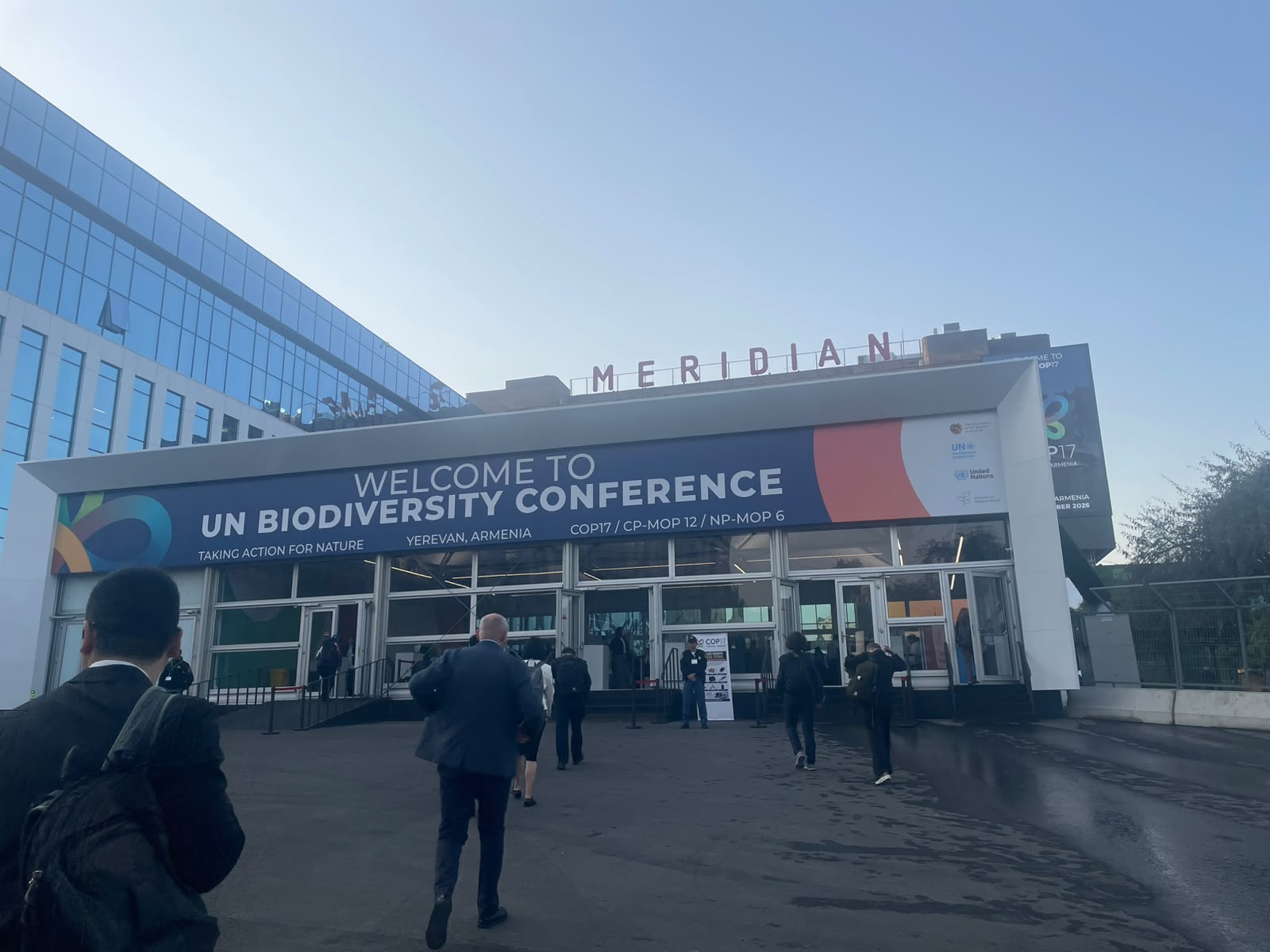
The seventeenth Conference of the Parties to the Convention on Biological Diversity (COP17), taking place in Yerevan, formally opened on 19 October and will run until 30 October. It hosts the first global review of collective progress in implementing the Kunming–Montreal Global Biodiversity Framework, adopted in 2022 with 23 targets for 2030. The diagnosis arrived before the delegations. According to the review presented on 15 October, nearly 90% of Parties have set national targets, yet fewer than half of the national targets that could be assessed are on track.
On the first day of negotiations, the contact group on protected areas could not agree whether the programme of work should recognise Indigenous and traditional territories ‘where applicable’. This was reported by the Earth Negotiations Bulletin, which follows the proceedings in the negotiating rooms day by day. The phrase comes directly from Target 3 of the Framework, concerning the protection and conservation of 30% of land and sea areas. Those two words encapsulate a central issue for political ecology: who has the authority to define a territory.
This article follows that phrase and two others circulating in Yerevan. All three are grounded in developments documented during the sessions of 19 and 20 October; none depends on the eventual outcome of the conference.
A review with the accounts still open
The Framework itself places the biodiversity finance gap at US$700 billion a year, and Goal D commits to closing it progressively. It addresses that gap through two complementary commitments: increasing the resources directed towards biodiversity and reducing economic incentives that contribute to its destruction. Target 19 calls for the mobilisation of US$200 billion annually from all sources by 2030, while Target 18 calls for a reduction of at least US$500 billion a year in incentives harmful to nature. Target 19 also contains a more specific milestone: US$20 billion a year in international public finance for developing countries by 2025, rising to US$30 billion by 2030.
The available figures convey the scale of the problem. According to an OECD estimate, based on its own methodology, total global biodiversity finance — domestic and international, public and private — amounted to between US$74.9 billion and US$92.4 billion annually over 2023–2025. The international public component was around US$16.1 billion a year, of which only US$7.9 billion in 2023 and US$8.5 billion in 2024 had biodiversity as a specific objective. An assessment published by the Convention’s Secretariat on 10 September concluded that the 2025 milestone was unlikely to have been met. These measurements use different methods and should not simply be subtracted from one another, although the order of magnitude is clear.
The opening statements exposed the disagreement. Senegal, speaking for the African Group, called on developed countries to honour their financial commitments and on the conference to explain how the necessary levels of funding would be reached. Jamaica, on behalf of the Latin American and Caribbean Group, drew attention to Target 19 and the systemic obstacles holding back implementation. Ireland, speaking for the European Union, advocated mobilising finance from all sources and broadening the contributor base. The EU negotiating position adopted on 12 October also proposes exploring ‘high-integrity’ nature credits. Ecologistas en Acción, which is following the summit from Yerevan, regards these credits as a false solution and warns of the growing corporate presence within the Convention. On 20 October, the contact group on resource mobilisation showed broad support for four criteria governing the financial mechanism, including its operation under the authority of the Conference of the Parties and democratic, transparent governance. Views continued to diverge on who should broaden the contributor base.
Gian Carlo Delgado Ramos, a researcher at the National Autonomous University of Mexico, defines political ecology as a field concerned with the causes of socio-environmental conflicts, paying particular attention to social metabolism — who appropriates energy and materials, and who consumes them. From this perspective, the debate over who pays in Yerevan is preceded by a further question about who benefits from activities that transform ecosystems and who bears their costs.
Who gets to name a territory
In 2001, Astrid Ulloa, a professor in the Department of Geography at the National University of Colombia, was already identifying lines of inquiry open to anthropology in the study of nature. These included the effects of the Convention itself and of the creation of protected areas on particular groups, as well as the shift from protected areas conceived as spaces of preservation to spaces of negotiation. In the same article, she drew on the typology developed by the Icelandic anthropologist Gísli Pálsson, which describes a relationship with the environment termed ‘paternalistic protection’, in which some human beings act on nature’s behalf.
The phrase ‘where applicable’ leaves open who decides when it applies, and it needs to be read carefully. The qualification concerns the recognition of Indigenous and traditional territories within systems of protected areas. Target 3 also requires, without that qualification, that the rights of Indigenous peoples and local communities be recognised and respected, including their rights over traditional territories. In its statement to COP17, the ICCA Consortium, which brings together Indigenous peoples, communities caring for their territories and allied organisations, called on Parties to ‘separately identify, recognize, and report Indigenous and Traditional Territories’, so that those territories are not absorbed into the overall count of protected hectares.
Virunga National Park in the Democratic Republic of the Congo, established in 1925 under Belgian colonial rule, offers a way to think through these questions. There, conservation operates as a political technology that delineates a particular ‘nature’ and reorganises who may live within it. Comparative evidence supports the concerns raised by Indigenous organisations. An international team led by Neil Dawson reviewed 648 empirical studies in research published in One Earth in 2024. Among the subset of 170 studies providing data on outcomes, governance arrangements in which Indigenous peoples and local communities are equal partners or hold primary control were associated with better ecological outcomes.
Who counts as a region
The second formulation arises in the group negotiating the operating arrangements of the new subsidiary body on Article 8(j), devoted to traditional knowledge and Indigenous peoples and local communities. Its co-chairs are Jennifer Tauli Corpuz of the International Indigenous Forum on Biodiversity and Sikeade Egbuwalo of Nigeria. On 19 October, delegates discussed whether the Indigenous co-chair of the body should be selected according to the United Nations’ five regional groups or the seven sociocultural regions used by the UN Permanent Forum on Indigenous Issues. A decision was deferred. An information note from the Convention identifies other outstanding questions, including whether Indigenous nominations require endorsement by Parties and whether their representatives should serve as ‘Friends of the Bureau’, in an advisory capacity.
The UN’s five regional groups bring states together. The seven sociocultural regions were defined to organise Indigenous representation in the Permanent Forum. Choosing between them means deciding which map determines the distribution of voice. In its opening statement, the International Indigenous Forum called for the body’s procedures to respect Indigenous governance structures and for direct access to funding to be simplified. Ana Di Pangracio, deputy director of Argentina’s Fundación Ambiente y Recursos Naturales and a spokesperson for the Women’s Caucus, summed up the stakes at a press briefing on 20 October. For her, finance is about the amount available, access to it, who decides how it is allocated and who ultimately benefits.
Donation or obligation
The third formulation requires some explanation. When genetic material from a plant, fungus or microorganism is sequenced, the resulting information may be deposited in scientific databases, many of them open and accessible internationally. Researchers and companies can use it for research and biotechnology applications without needing to access the original organism again. This is what the Convention refers to as digital sequence information (DSI). The Nagoya Protocol largely organised access and benefit-sharing around genetic resources and mutually agreed terms between providers and users. The international circulation of DSI has exposed the difficulty of applying that model to uses that can multiply without further transfers of the original biological material, although some countries have introduced national measures to regulate them.
To address these difficulties, COP16 in Cali established a multilateral mechanism and a fund in 2024. Decision 16/2 calls on companies using such data to contribute if they exceed at least two of three thresholds, calculated as an average over the preceding three years: US$20 million in assets, US$50 million in sales and US$5 million in profits. It sets indicative contribution rates of 1% of profits or 0.1% of revenue, leaving COP17 to settle the final thresholds and rates. At international level, contributions remain voluntary. The decision also envisages at least half of the funds addressing needs identified by Indigenous peoples and local communities themselves, subject to significant qualifications. That provision applies where appropriate and subject to national circumstances and legislation; funds may be channelled through government authorities or institutions identified by those peoples and communities.
The Cali Fund was launched on 25 February 2025 with an expectation of raising around US$1 billion annually. Its first contribution arrived nine months later, on 19 November 2025, when TierraViva AI, a small British artificial intelligence company, paid US$1,000. The biotechnology company Prozomix contributed US$5,000 in July 2026. On 15 October, four days before the conference, the Fund announced a third contribution, from the Belgian environmental DNA company E-BIOM, alongside its commitment to contribute 0.1% of its services from 2027.
The Fund’s announcement did not specify the amount received from E-BIOM. According to AFP, it was US$1,085, bringing the amount paid in by the three companies to US$7,085, the same figure reported by CaliWatch, a monitoring platform established by the Plant-for-the-Planet foundation. Two other companies have pledged a further US$3,571, which has not yet been received. The distinction between pledges and actual payments is crucial to evaluating a mechanism intended to share the commercial benefits derived from biodiversity. The absence of an amount in the Fund’s own announcement also means that readers must piece the figure together from other sources.
In August, more than 70 developing countries signed a declaration opposing a memorandum between UN bodies that presents contributions to the Fund as voluntary donations. David Castro Garro, director of Genetic Resources and Biosafety at Peru’s Ministry of the Environment, told Dialogue Earth that donations and royalties are different things, and that benefit-sharing is both an obligation and a right of countries. The debate has continued on much the same terms in Yerevan. On 19 October, Egypt, speaking for the African Group, argued that the Fund should not depend solely on discretionary contributions. The European Union called for legal certainty and more predictable contributions, while Colombia proposed provisionally adopting the distribution formula, with Brazil’s support. The following day, Cameroon and Ethiopia called on developed countries to introduce mandatory national measures requiring their companies to contribute; Guatemala and Ecuador insisted that contributions should not be treated as philanthropic donations. Many delegations called for the mechanism to remain under the authority of the Conference of the Parties and requested an independent review of the memorandum with the United Nations office responsible for trust funds. The presidency established a dedicated group for this purpose. The International Indigenous Forum called for respect for free, prior and informed consent.
Latin American anthropology provides a history through which to read this conflict. Delgado Ramos draws on the work of the Mexican economist Ana Esther Ceceña on bioprospecting as a form of hegemony, while Ulloa had already identified biopiracy as a subject of anthropological inquiry a quarter of a century ago. Today, the resource at the centre of the dispute travels as information.
When nature becomes information
Ulloa also discusses the three regimes of nature proposed by Arturo Escobar: the organic, the capitalist and technonature, the last of which is associated with biotechnology and technoscience. Digital sequence information belongs within this third regime, and artificial intelligence intensifies it.
The Cali decision explicitly acknowledges that relationship. Among the sectors that may benefit directly or indirectly from these data, it lists related information, scientific and technical services, ‘including artificial intelligence’. Entities managing databases, tools and models that depend on DSI are asked to identify the country of origin of genetic resources where known and to indicate whether traditional knowledge was used. They are also asked to take several sets of principles into account. The FAIR principles seek to make data findable, accessible, interoperable and reusable. The CARE principles, developed by the Global Indigenous Data Alliance, add collective benefit, authority to control, responsibility and ethics. The list also includes TRUST, designed for digital repositories, and UNESCO’s Recommendation on Open Science. The presence of both FAIR and CARE in the same decision captures the tension between scientific openness and data sovereignty.
June Rubis, a researcher at Macquarie University and co-founder of the Building Initiatives in Indigenous Heritage initiative in Sarawak, wrote in September that future value might increasingly reside in datasets, models and combinations of information rather than individual sequences. This is a forward-looking warning. The Cali decision does not establish individual compensation for every sequence used to train a model, nor does it automatically confer rights over the model’s outputs. It does, however, explicitly include AI-related services among the sectors that may benefit from DSI and fall within the multilateral benefit-sharing mechanism. We found no interventions focused specifically on artificial intelligence in the negotiating bulletins for the first two days. Rubis offers a further reminder worth retaining: databases contain only biodiversity that has already been sampled, while living biodiversity holds variation yet to appear in any record.
For a laboratory that studies artificial intelligence as a cultural object, this poses a concrete question. If a model trained on genetic sequences generates value, someone will have to determine where the ‘use’ that triggers benefit-sharing begins and ends, and which map of territories and regions governs the distribution of those benefits.
The host country
Armenia arrives at COP17 with a contradiction of its own, one worth describing without generalisation. On 10 October, nine days before the opening, Prime Minister Nikol Pashinyan presided over a ceremony marking the start of operations at the Amulsar gold mine, where the first gold was extracted and smelted. According to a statement from his office, Pashinyan said the environmental issues had been resolved and noted that the state owns 12.5% of the project. Two days later, a statement bearing 70 signatures from organisations and individuals, led by Transparency International Anticorruption Center, called for mining to be suspended and a new environmental impact assessment to be carried out. The signatories maintain that the government has not implemented the recommendations of the Bern Convention and warn of risks to the Arpa and Vorotan rivers, Lake Sevan and the waters of Jermuk.
The conference venue has its own history. In September, the Armenian outlet Hetq documented how soil excavated during construction work at Meridian Expo had been dumped on the slopes of the Hrazdan River gorge, leaving trees broken or leaning. The environmental inspectorate closed the case after finding no measurable damage.
What to watch until 30 October
The conference has only just begun, and the negotiating texts remain full of square brackets, marking language on which no consensus has yet been reached. Three questions can help us read the outcome without predicting it. First, whether the qualification ‘where applicable’ remains in the new programme of work on protected areas, and how it shapes recognition of Indigenous and traditional territories. Second, which regional map organises Indigenous representation in the Article 8(j) body, and whether that representation carries decision-making or merely advisory powers. Third, whether contributions to the Cali Fund remain voluntary or become more predictable, and how transparently receipts are reported.
All three issues share a political dimension. The global review has documented delays in implementing the Kunming–Montreal Framework. Negotiations in Yerevan will now determine which institutions recognise territories, how representation is distributed and under what conditions the economic benefits derived from biodiversity are shared.
Written on 21 October 2026, using information from the negotiating sessions of 19 and 20 October. The positions described concern ongoing negotiations and do not anticipate decisions to be taken later in the conference.
Sources
- Earth Negotiations Bulletin (IISD), daily report for 19 October 2026, covering opening statements and contact groups.
- Earth Negotiations Bulletin (IISD), daily report for 20 October 2026, on digital sequence information and resource mobilisation.
- UN News, presentation of the global review report, 17 October 2026.
- Convention on Biological Diversity, Goals of the Global Biodiversity Framework and Target 3.
- Convention on Biological Diversity, Decision 16/2 on digital sequence information (official PDF).
- Convention on Biological Diversity, information note CBD/COP/17/INF/20 on the Article 8(j) body (PDF).
- Carbon Brief, developed countries’ finance for nature, 15 October 2026.
- Council of the European Union, COP17 negotiating position, 12 October 2026 (summary published by Lovguiden).
- Ecologistas en Acción, ‘Los gobiernos de todo el mundo se someten a examen en la COP17 de Biodiversidad’, 15 October 2026.
- ICCA Consortium, statement to COP17, 18 October 2026.
- Armenpress, Women’s Caucus press briefing, 20 October 2026.
- Mactilda Mbenywe, Mongabay, the Cali Fund and its first contributions, 1 September 2026.
- Cali Fund, announcement of E-BIOM’s contribution, 15 October 2026.
- Cali Fund, newsletter of 15 October 2026, reporting E-BIOM’s commitment from 2027.
- AFP, the Cali Fund and the US$7,085 received, 21 October 2026 (published by Dawn).
- CaliWatch (Plant-for-the-Planet), Cali Fund contributions tracker.
- Fermín Koop, Dialogue Earth, the impasse over nature’s digital data, 16 October 2026 (republished by Eco-Business).
- June Rubis, ICCA Consortium, provider-country confidence in the multilateral mechanism, 22 September 2026.
- University of Auckland, CARE Principles for Indigenous Data Governance.
- Office of the Prime Minister of Armenia, start of operations at Amulsar, 10 October 2026.
- Transparency International Armenia, civil society statement on Amulsar, 12 October 2026.
- Hetq, COP17 venue works in the Hrazdan gorge, 12 September 2026.
- Neil M. Dawson and co-authors, ‘Is it just conservation? A typology of Indigenous peoples’ and local communities’ roles in conserving biodiversity’, One Earth, 7(6), 2024.
- Astrid Ulloa, ‘Transformaciones en las investigaciones antropológicas sobre naturaleza, ecología y medio ambiente’, Revista Colombiana de Antropología, 37, 2001.
- Gian Carlo Delgado Ramos, ‘¿Por qué es importante la ecología política?’, Nueva Sociedad, 244, 2013.