
Anthropology and artificial intelligence
Artificial Intelligence Takes Root in Latin American Social Sciences
COMECSO’s national conference on artificial intelligence and the social sciences points to a Latin American agenda that studies AI as a social fact, from power and inequality to work, gender and the classification of knowledge.
Over four days, COMECSO’s National Conference on Artificial Intelligence and the Social Sciences brought together research on power, education, gender, work, youth and knowledge. The programme confirms a Latin American agenda that treats AI as a social phenomenon rather than as mere technological innovation.
Between 28 September and 1 October, the Mexican Council of Social Sciences (COMECSO) held its Jornadas Nacionales de Inteligencia Artificial y Ciencias Sociales online. The conference was convened by the working group Horizontes de investigación sobre la Inteligencia Artificial desde las Ciencias Sociales (Research horizons on artificial intelligence from the social sciences), coordinated by Juan Pablo Duque Parra, of the Centre for Interdisciplinary Research in Sciences and Humanities (CEIICH) at the National Autonomous University of Mexico (UNAM), and by Jacqueline Torres Ruiz and Khemvirg Puente Martínez, of the Faculty of Political and Social Sciences (FCPyS) at the same university. Ricardo Arechavala Vargas, of the University of Guadalajara, and Danay Quintana Nedelcu, of FLACSO Mexico, joined them as guest coordinators. [1][2]
The group was not starting from scratch. Its first meeting, from 13 to 17 October 2025, opened with the question ‘What is artificial intelligence?’, addressed by Ximena Gutiérrez and Pablo Pruneda, and closed with a lecture by Francisco Tirado, of the Universitat Autònoma de Barcelona, on the existential territory of artificial intelligence. In between, Oscar G. Hernández presented ‘Redes, actores y algoritmos: hacia una antropología de la inteligencia artificial’ (Networks, actors and algorithms: towards an anthropology of artificial intelligence). [1]
A year on, the work is organised differently. In 2025, several of the eight thematic strands dealt with the methodological appropriation of AI in the social sciences, its applications to social problems and its uses. In 2026, the five strands were arranged around fields of social life such as democracy and the public sphere, youth, gender, education and work. The change suggests a shift in emphasis, from what can be done with AI to what AI does in social life. [1][2]
The programme brought together work from universities, research centres and public institutions in Mexico, Colombia and Chile, a paper from the Attorney General’s Office of the Republic of Cuba and another co-authored from the Universitat Oberta de Catalunya and UNAM. It also included two keynote lectures and two book presentations. [1]
The call for papers started from a deliberate definition. Artificial intelligence, the text stated, ‘should not be understood solely as a technical system or as a subdiscipline of computer science’. COMECSO described it as a sociotechnical paradigm that is transforming many processes of everyday life, and noted that the social sciences are being ‘increasingly called upon’ to reflect on its social, cultural, political and legal implications, in the context of Mexico, Latin America and Ibero-America. [2]
Power, regulation and the public sphere
The strand on democracy, power and the public sphere, coordinated by Khemvirg Puente, accounted for a large part of the programme. Fernando Barrientos Del Monte, of the University of Guanajuato, asked ‘Who controls AI?’ and focused on states, companies and capital. Elsa Martínez Flores, of the Autonomous University of Tlaxcala, analysed the shift ‘from the network society to the predictable society’ and the dispute over digital rights. Johanna Mildred Pinto García, of UNAM, set out the legal and philosophical foundations of the right to algorithmic explanation as a democratic guarantee for Ibero-American constitutionalism. Ana Cristina González Rincón, of the Universidad Autónoma Metropolitana, examined the Chapultepec Principles and the construction of a regulatory model for AI in Mexico. [1]
The strand covered very different scales, from penal institutions to mental privacy. From Cuba, Laura Sabina Paz, of the Attorney General’s Office of the Republic, analysed the limitations of using AI in the Cuban prison system from the perspective of science, technology and society studies. Antonio Montero Balderas, of UNAM’s Faculty of Higher Studies Acatlán, addressed mental privacy, cognitive inferences and new forms of instrumentalising the person. There was also work on algorithmic governmentality, techno-feudalism and necropolitics, political trust in the face of algorithmic governance and the use of predictive AI in municipal planning. [1]
On the final day, Jesús Ignacio Rivera Cano, of the Hospital Mental de Antioquia in Colombia, presented a critical analysis of how Anthropic, the company that develops the Claude models, has appropriated the concepts of wellbeing and character, and of the implications for the mental health of the people who use them. [1]
Images, discourses and audiences
The cultural dimension was also present. Carolina Martirena Vimercatti, of the Universitat Oberta de Catalunya, and Elizabeth Rodríguez Rendón, of UNAM’s University Programme for Studies on Democracy, Justice and Society (PUEDJS), presented a visual and technopolitical analysis of generative AI, synthetic images and ethnonationalism in current deportation processes in the United States. David Cuenca Orozco and Fernando López Solís, of UNAM, compared technoscientific imaginaries of AI in two elite discourses, that of the people who run the large technology companies and that of Pope Leo XIV, whose encyclical Magnifica Humanitas we read in May. Alejandro Monsalve Quintero and Adriana Medina Vidal brought applied anthropology to digital advertising with a paper on cultural audiences, actionability and AI. [1]
Inequalities in the classroom
The education sessions, coordinated by Danay Quintana Nedelcu, showed a recurring concern with the inequalities that accompany the adoption of these technologies. Cira Tecali Cárdenas Barón, of the University of Colima, studied how epistemic inequalities take shape in the appropriation of AI among upper-secondary students at private schools in Mexico’s part-attendance (semiescolarizado) system. Andrés Melida Martínez, of the Autonomous University of the State of Hidalgo, analysed access to and use of AI in secondary schools in Pachuca. From Colombia, Katherine Julieth Quintero Martínez, of the National Open and Distance University (UNAD), compared the social appropriation of AI in community settings in Fontibón, a locality of Bogotá. [1]
Other papers dealt with the incorporation of AI into curricula, such as Gabriela Barajas Martínez’s proposal for the undergraduate degree in Sociology at UAM’s Azcapotzalco campus, and with the transformation of teaching work in Mexico and Colombia. [1]
Bias, gender and age
In the strand on bias and gender, coordinated by Jacqueline Torres Ruiz, Laura Victoria Rodríguez Zaragoza, of the University of Guadalajara, analysed gender digital divides in the transition towards AI in Mexico. Suhey Ayala Ramírez and Víctor Manuel Castillo Girón, of the same university, proposed questioning the illusion of these systems’ neutrality so as not to replicate gender bias. Javiera Rosell, Vicente Martínez and Damián Grunder, of the University of Chile, presented a scoping review to conceptualise digital ageism. Erika Stephania Onofre Pérez, of the Autonomous University of the State of Hidalgo, studied the influence of AI on the construction of gender identities in adolescents. Torres Ruiz herself examined media representations of people living on the streets in the algorithmic news ecosystem from a gender and age perspective. [1]
Youth and psychosocial processes
The strand on youth and psychosocial processes, coordinated by Juan Pablo Duque Parra, closed the programme. Tifanny Andrea Aponte Mora, of UNAD, reviewed the state of the art on youth subjectivity in the age of algorithmic governmentality. Magdalena Moreno Ortiz and Luis César Frías Leal, of the National Institute of Fine Arts and Literature (INBAL), presented a study of digital objects, the body and the everyday experiences of INBAL students in Monterrey. [1]
Work, knowledge and dispossession
The strand on work and organisations, coordinated by Ricardo Arechavala Vargas, brought together some of the most suggestive conceptual proposals. Elkin Fabián Martínez and Ricardo Pérez Peña presented ‘El cercamiento del pensamiento: IA, despojo cognitivo y la renovada acumulación originaria’ (The enclosure of thought: AI, cognitive dispossession and renewed primitive accumulation). Its title alone carries two classic categories of political economy, enclosure and primitive accumulation, into the realm of thought. [1]
Lorena Litai Ramos Luna, an associate professor in the Department of Economics at the Universidad Autónoma Metropolitana, Iztapalapa campus, proposed ‘algorithmic orchestration’ as an analytical category for studying contemporary organisations. Mónica Ramírez Mata, Nancy Elizabeth Licea Silva and Arechavala himself asked ‘Who is in charge?’ in the production of knowledge mediated by generative AI, in a block of sessions that also looked at its effects on university laboratories, on decision-making and on small and medium-sized enterprises. [1][3]
Who classifies maize
The same strand featured the paper that speaks most directly to anthropology. Arturo Sánchez Porras and Aline Romero-Natale presented ‘Clasificar para conservar: IA, maíz nativo y organización del conocimiento agrobiocultural en México’ (Classifying to conserve: AI, native maize and the organisation of agro-biocultural knowledge in Mexico). [1]
They are not speaking from the outside. Together with Otilio Arturo Acevedo Sandoval and Edlin J. Guerra-Castro, from UNAM’s National School of Higher Studies (ENES) in Mérida and the Autonomous University of the State of Hidalgo, in 2025 they published imanr, an R package that automates the classification of the racial complexes of Mexican native maize. The tool applies boosted ensemble methods to morphological and geographical variables from a national database, reports ‘up to 90% in balanced accuracy’ and includes a graphical user interface for non-specialist users. The article presents it as a more efficient alternative to traditional methods, which, in its authors’ words, ‘rely on subjective expert judgement and require extended evaluation times’. Its stated aim is to help conserve a genetic diversity of great cultural, agricultural and environmental importance. [4]
The title of the paper already names the problem that matters to anthropology, the organisation of agro-biocultural knowledge. Classifying to conserve means deciding which categories are used to order a diversity that was not born in a laboratory. As Rocío Fernández Suárez, Luis A. Morales Chávez and Amanda Gálvez Mariscal point out, that diversity ‘is the product of millennia-old agricultural practices linked to the traditional knowledge of the Indigenous peoples of Mexico’, who have been its principal custodians and improvers. [5]
When classification is automated, the model’s accuracy matters as much as the knowledge it organises, the categories it uses and the place it leaves for the campesino and Indigenous knowledge that produced what is to be conserved. AI appears here at once as a conservation tool and as a technology of classification. Both dimensions deserve study.
Two keynotes and two books
The programme opened on 28 September with the keynote lecture ‘Algoritmos y pensamiento crítico para la era de la IA’ (Algorithms and critical thinking for the age of AI) by Santiago Jiménez Londoño, who holds a doctorate in philosophy from the Universidad Pontificia Bolivariana and teaches at the School of Applied Sciences and Engineering of Universidad EAFIT in Medellín. [1][6] Jiménez Londoño is the author of Algoritmos deshumanizantes: IA y la pérdida de la noción de individuo (Dehumanising algorithms: AI and the loss of the notion of the individual, Aún Humanos, 2025). [6][7] In a column published in April in El Mostrador, he summarised the book’s thesis. The deepest risk of artificial intelligence, he wrote, ‘lies not in its technical failures, but in the silent erosion of what makes us subjects’. That erosion reaches the capacity to decide and to dissent, and leaves people exposed to being reduced to data patterns. [8]
The final day included the keynote lecture ‘La IA y el reto de su regulación’ (AI and the challenge of its regulation) by Pablo Pruneda Gross, general coordinator of the Coordinating Council for Artificial Intelligence (CCOIA), which UNAM set up in May 2026. At UNAM’s Institute for Legal Research (IIJ), he also coordinates the Law and Artificial Intelligence research line. Pruneda had taken part in the group’s first meeting as well. [1][9]
Two book presentations completed the programme. Mauricio Padrón Innamorato and Agustín Morales Mena, of the IIJ, presented El derecho a la no discriminación (algorítmica) (The right to (algorithmic) non-discrimination, IIJ-UNAM, 2026), which they edited. Djamel Eddine Toudert, a research professor in the Department of Urban and Environmental Studies at El Colegio de la Frontera Norte, presented Inteligencia artificial y planeación urbana del sur global (Artificial intelligence and urban planning in the Global South, El Colef, 2026). [1][10]
A map for anthropology
Beyond each individual study, the interest of the conference lies in the map it draws as a whole. AI appears at once as economic infrastructure, political apparatus, cultural mediation, educational technology, scientific tool and a space in which new forms of classification and inequality are produced.
Yesterday, in mapping who is thinking about AI through the social sciences in Spain, we concluded that, in the cases examined, using AI to study society carries more weight than studying AI itself as a social fact. COMECSO’s programme is organised mainly around the second direction. The two maps also touch. The Universitat Oberta de Catalunya, which appeared yesterday among the partner institutions of the European project WHAT-IF, is present at this conference through Carolina Martirena Vimercatti. And COMECSO itself is preparing an Ibero-American Social Sciences Week for 2027, the year it turns fifty, which will open its meeting space to institutions from other countries. [11]
That framework is particularly relevant for anthropology. Artificial intelligence systems do not operate outside the societies that produce them. They incorporate categories, hierarchies, imaginaries and particular ways of understanding people and their relationships. At the same time, their adoption changes everyday practices, professions, institutions and ways of producing knowledge.
COMECSO’s conference thus shows a field of research gaining a density of its own in Latin America. Against a public conversation often dominated by technical capabilities, investment and new products, the social sciences are building another archive of questions about who designs these systems, what knowledge they are built on, which power relations they reproduce and what transformations they bring about when they come into contact with specific social contexts.
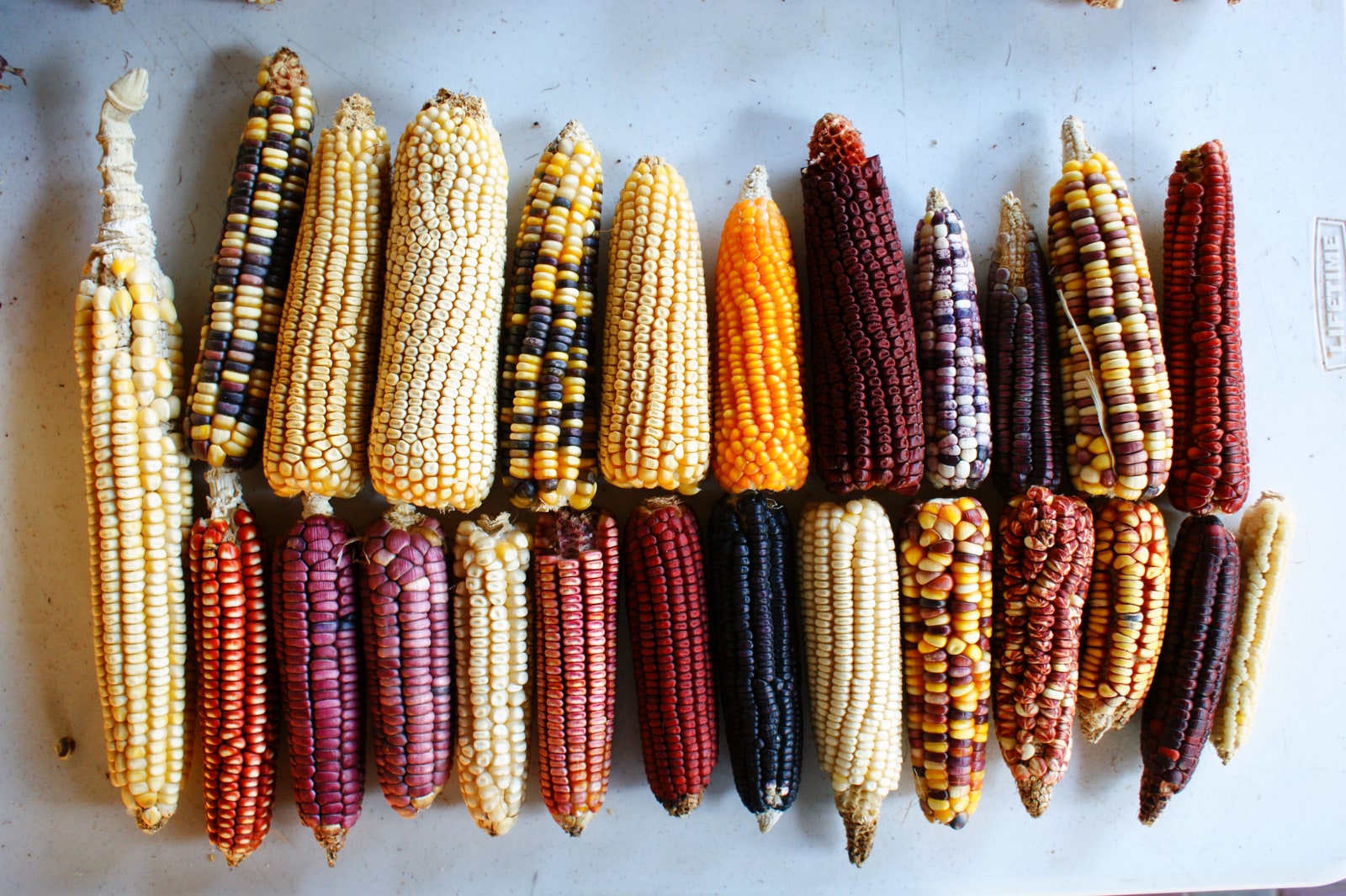
Native maize is a reminder that one of the oldest questions remains open. Who classifies, and with which categories.
Image credit: Feria de Productores, CC BY 2.0. Proportionally resized, without cropping.

References
Quotations from Spanish-language sources and the English glosses of Spanish titles are our own translations.
[1] Consejo Mexicano de Ciencias Sociales (COMECSO). Horizontes de investigación sobre la Inteligencia Artificial desde las Ciencias Sociales. Programme of the first meeting (13–17 October 2025) and of the national conference (28 September–1 October 2026). Accessed 4 October 2026. In Spanish.
https://www.comecso.com/grupos-de-trabajo/inteligencia-artificial
[2] Consejo Mexicano de Ciencias Sociales (COMECSO). Jornadas nacionales de inteligencia artificial y ciencias sociales. Call for papers, 1 July 2026. In Spanish.
https://www.comecso.com/grupos-de-trabajo/inteligencia-artificial/jornadas-nacionales
[3] Universidad Autónoma Metropolitana. Dra. Lorena Litai Ramos Luna. Academic staff directory. In Spanish.
https://investigacion.uam.mx/index.php/listado-catalogo/82259
[4] Sánchez-Porras, A., Romero-Natale, A., Acevedo-Sandoval, O. A. and Guerra-Castro, E. J. (2025). imanr: An R tool for the identification of Mexican native maize complexes. One Ecosystem, 10, e149055.
https://doi.org/10.3897/oneeco.10.e149055
[5] Fernández Suárez, R., Morales Chávez, L. A. and Gálvez Mariscal, A. (2013). Importancia de los maíces nativos de México en la dieta nacional: Una revisión indispensable. Revista Fitotecnia Mexicana, 36 (suppl. 3-a). In Spanish.
https://www.scielo.org.mx/scielo.php?script=sci_arttext&pid=S0187-73802013000500004
[6] Al Poniente. El colombiano Santiago Jiménez Londoño presenta «Algoritmos Deshumanizantes» en la FIL Guayaquil 2026. 15 September 2026. In Spanish.
https://alponiente.com/el-colombiano-santiago-jimenez-londono-presenta-algoritmos-deshumanizantes-en-la-fil-guayaquil-2026/
[7] Jiménez Londoño, S. (2025). Algoritmos deshumanizantes: IA y la pérdida de la noción de individuo. Medellín, Aún Humanos. In Spanish.
[8] Jiménez Londoño, S. Regular lo desconocido: la trampa de legislar la IA. El Mostrador, 30 April 2026. In Spanish.
https://www.elmostrador.cl/noticias/opinion/columnas/2026/04/30/regular-lo-desconocido-la-trampa-de-legislar-la-ia/
[9] Gaceta UNAM. Instala la UNAM el Consejo Coordinador de Inteligencia Artificial. 21 May 2026. In Spanish.
https://www.gaceta.unam.mx/ccoia-unam-organo-articulador-de-alto-nivel-para-atender-los-retos-de-la-ia-pruneda-gross/
[10] El Colegio de la Frontera Norte. Djamel Eddine Toudert. Institutional profile. In Spanish.
https://www.colef.mx/integrante/etoudert/
[11] Consejo Mexicano de Ciencias Sociales (COMECSO). Comunicado sobre la Semana Nacional de Ciencias Sociales 2026. 19 August 2026. In Spanish.
https://www.comecso.com/noticias/comunicado-sobre-la-semana-nacional-de-ciencias-sociales-2026