
Technology and current affairs
A revolution (in this too): weather forecasting
A note on Aardvark Weather and the impact of artificial intelligence on weather forecasting.
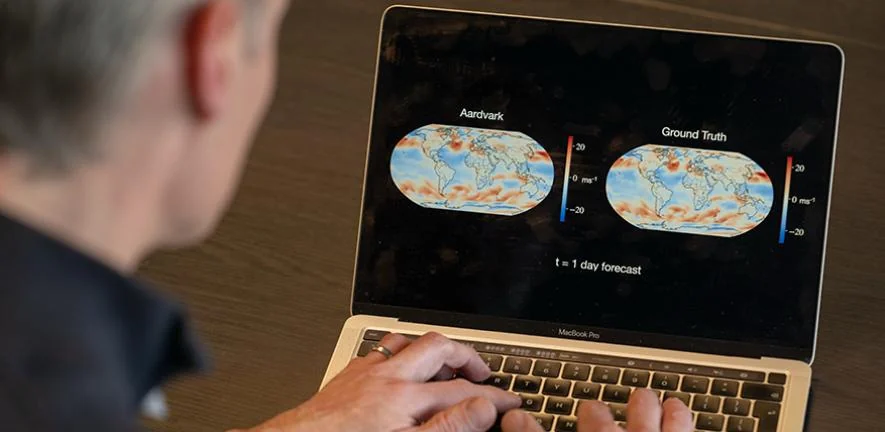
The way we forecast the weather is undergoing a radical transformation thanks to advances in artificial intelligence. Recently, a team of researchers presented Aardvark Weather, an end-to-end weather forecasting system that promises to replace traditional methods based on complex physical simulations.
What is Aardvark Weather?
Aardvark Weather is an AI model that learns to predict the future state of the atmosphere directly from observational data, without depending on the traditional chain of numerical weather prediction. The system is made up of three core modules:
- Encoder: it processes observations from various sources, such as satellites, in-situ stations and radiosondes, in order to estimate the initial state of the atmosphere. It uses deep-learning techniques, including SetConv layers and Vision Transformers, to handle irregular and missing data.
- Processor: from the initial state, it generates global forecasts autoregressively, using transformers that predict conditions over horizons from 24 hours to 10 days.
- Decoder: it transforms these global forecasts into localised predictions for key variables, such as temperature at 2 metres and wind speed at 10 metres.
Aardvark Weather’s approach makes it possible to reduce significantly both data requirements and computing costs, achieving results competitive with, or even superior to, traditional operational systems such as HRES and GFS.
Why does it matter?
Speed and efficiency
Aardvark Weather is able to generate global-scale forecasts in just seconds, using only a fraction of the data and resources demanded by conventional methods. This opens the door to a democratisation of meteorology, since institutions with limited resources could gain access to high-quality forecasts without the need for supercomputers.
Competitive accuracy
The study’s results show that, in many cases, Aardvark Weather achieves an accuracy comparable to that of traditional operational models. The ability to tune the model to optimise its performance for specific variables or regions represents a significant advance, especially for areas that are less well served by technological infrastructure.
Impact across sectors
Fast, accurate weather forecasting is crucial for sectors such as agriculture, energy, transport and emergency management. With the deployment of Aardvark Weather, preparedness for extreme weather events could be improved, operational costs reduced and, ultimately, lives saved.
The University of Cambridge has highlighted how this fully AI-driven system could start a revolution in weather forecasting, allowing even those with fewer technological resources to access accurate forecasts in real time. The Guardian has also emphasised the transformative potential of Aardvark Weather, underlining that removing the dependence on traditional models opens up new possibilities for forecasts that are faster, more efficient and more adaptable.
The development of Aardvark Weather marks a milestone in the integration of artificial intelligence into meteorology. This system not only promises to revolutionise the way we understand and forecast the weather, but also lays the groundwork for personalised, scalable models adaptable to different contexts and regions. The era of AI applied to meteorology is here, and its potential to transform critical sectors and improve quality of life is immense.
Sources and related reading
- End-to-end data-driven weather prediction — Nature (2025)
- Fully AI-driven weather prediction system could start revolution in forecasting — University of Cambridge (2025)
- Project Aardvark: reimagining AI weather prediction — The Alan Turing Institute (2025)
- End-to-end data-driven weather prediction — ResearchGate (2025)
- Application of machine learning techniques to weather forecasting — Dialnet (2019)