
AI governance and ethics
Not too late again: AI, data and public ethics
The opening in Valencia of the UN's AI Governance Lab, read through anthropology: data, consent, algorithmic harm and public ethics.
The prior digital debt
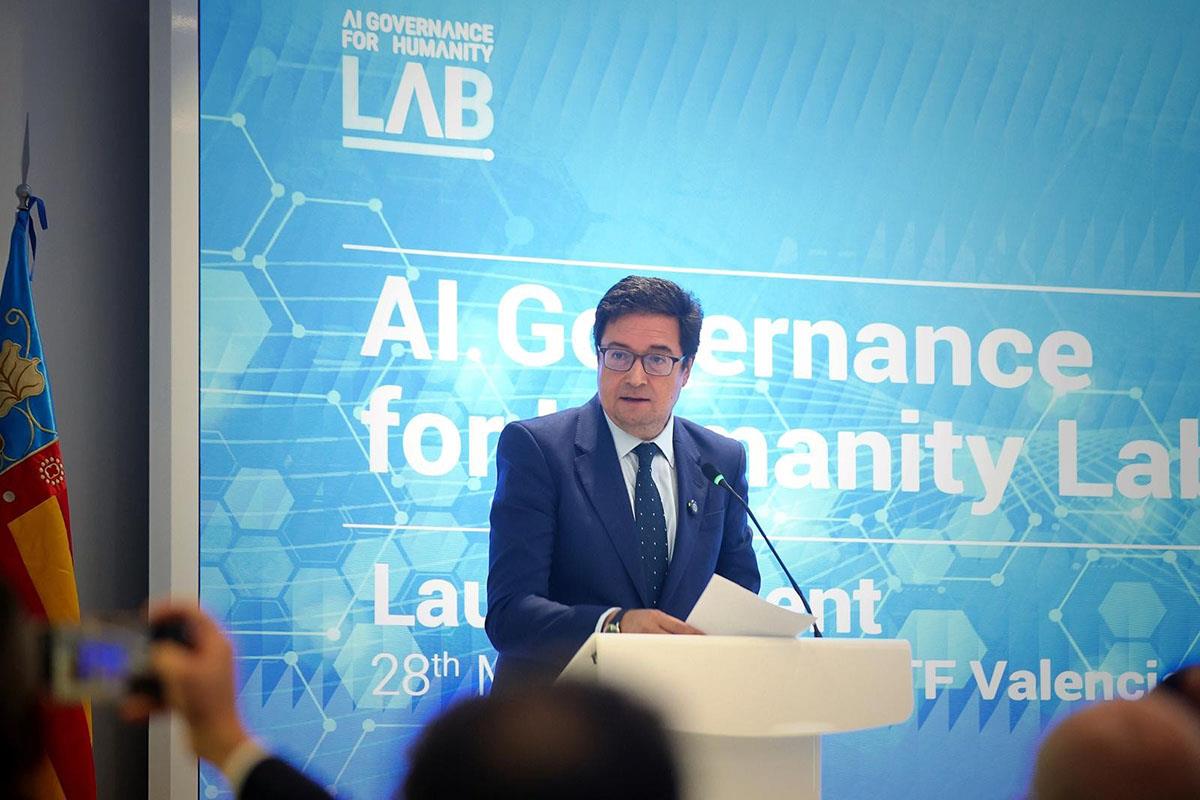
The inauguration in Valencia of the United Nations AI Governance Lab for Humanity can be read as just another institutional news item. A minister, an international body, a new space for coordination, a promise of multilateral cooperation. But that would be too poor a reading. What is at stake is not only the creation of another expert forum on artificial intelligence, but the possibility of not repeating with AI the same mistake that marked much of contemporary digitalisation.
For decades, digital life has been built on a massive and barely visible surrender of personal data. The platform economy turned human experience into raw material for the prediction, classification and monetisation of behaviour. Couldry and Mejias have described this process as data colonialism, a form of appropriation of social life through digital infrastructures that present data extraction as innovation, efficiency or mere convenience. Zuboff, from another critical tradition, framed it as surveillance capitalism, an economic regime based on transforming human experience into behavioural data destined for prediction markets (Couldry & Mejias, 2019a, 2019b; Zuboff, 2019).
First came proprietary operating systems and closed environments. Then came the social web, mobile phones turned into permanent sensors, behavioural advertising, data brokers and terms of use that turned consent into an automatic gesture. The datafication of health, movement, consumption and everyday relationships shows that we are not talking only about web browsing, but about a growing conversion of social life into data that can be processed, compared and traded (Ruckenstein & Schüll, 2017). Accept, continue, allow, sync, share location, improve the experience. Everyday life became wrapped in a technical architecture that most people do not understand, cannot audit and can barely abandon.
That is why, when Óscar López, Spain’s Minister for Digital Transformation and the Civil Service, states that we must act now so that AI governance does not become a mere wish, the phrase should not be interpreted only as a warning about the future. It also points to an accumulated debt. Artificial intelligence does not arrive in a virgin world. It arrives upon platforms that had already normalised tracking, data extraction, algorithmic opacity and the asymmetry between users, companies and states. The novelty of AI does not consist solely in producing texts, images, diagnoses or automated decisions. It consists in accelerating and amplifying a form of power that was already installed.
The new AI Governance Lab for Humanity, based in Quart de Poblet, will report to the United Nations Office for Digital and Emerging Technologies. Its task will be to coordinate knowledge, assess risks, foster multilateral cooperation, support the Global Digital Compact and advance interoperability between governance frameworks. At the presentation, the Spanish Government situated it within an agenda that includes the Charter of Digital Rights, the Digital Rights Observatory, the Spanish Agency for the Supervision of AI, the European AI Regulation and the future Spanish law on the good use and governance of AI (La Moncloa, 2026; Radio Valencia, 2026).
A contested human artefact
It is worth insisting on something that is sometimes lost between technical fascination and fear. AI is not a natural force or an intelligence fallen from the sky. It is a complex technological artefact made by humanity. It is composed of mathematical models, data, servers, energy, human labour, supply chains, business decisions, public investment, military infrastructures, programming languages, legal frameworks and cultural imaginaries. That is why it cannot be treated as though it had a destiny of its own. AI does not happen outside society. It is society organised in technical form.
This idea is not merely rhetorical. From the social studies of technology, Winner showed that artefacts can embody forms of power, authority and social order. From the anthropology of algorithms, Seaver proposed studying algorithmic systems as culture, attending not only to their code but to the people, institutions, practices and beliefs that produce them. From that view, AI is not a neutral tool placed upon the world, but a social and technical assemblage that classifies, hierarchises and acts within concrete relations of power (Seaver, 2017; Winner, 1980).
The language used in Valencia is not trivial. AI, López said, must serve peace and people. He also set this orientation against the Palantir Manifesto and the rise of technofascism. There the real political conflict appears. On one side, a vision of AI as an infrastructure of strategic superiority, security, surveillance, defence and corporate power. On the other, a still-fragile aspiration. To subject artificial intelligence to rights, public oversight, democratic deliberation and global justice.
The Palantir case is especially significant because the company itself and its intellectual milieu have defended a much closer relationship between Silicon Valley, the state and military power. In The Technological Republic, Karp and Zamiska criticise a technology centred on consumption and entertainment, and call for the industry to be oriented towards national, strategic and defence ends. Critical readings of the Palantir manifesto have pointed precisely to that shift towards an AI understood as an instrument of geopolitical domination, surveillance and armed power (Karp & Zamiska, 2025; El País, 2026).
The question is whether the democratic aspiration will be strong enough. The experience of the digital economy invites caution. Many of the large platforms grew under a mixture of enthusiasm for innovation, state dependence, regulatory weakness and tolerance towards business models based on extracting, cross-referencing and monetising personal information. There is no need to imagine a perfect conspiracy. It is enough to observe how it became natural for behavioural data to be turned into commercial raw material, for privacy to be moved to secondary menus and for transparency to be reduced to legal documents that almost no one reads.
From the standpoint of anthropological ethics, this history raises an uncomfortable question. Can we call consent an acceptance that is not understood, not negotiated and cannot be refused without being shut out of basic services of social life? In codes of ethics for research with people, informed consent is not a ticked box but a relationship. It involves explaining aims, methods, risks, sponsors, uses of the information and the right to withdraw. In ethnographic practice, moreover, it is usually understood as a continuous process, not an isolated signature. Applied to the digital world, this framework exposes the ethical poverty of consent reduced to a click (American Anthropological Association, 2012; Molina et al., 2018).
AI intensifies that problem. Models do not only process personal data in a narrow sense. They incorporate texts, images, voices, gestures, mobility patterns, consumption histories, social interactions and behavioural traces. What from a technical view appears as data, from an anthropological view may be a social relation, a memory, a vulnerability, a body, an identity, a community. The question is no longer only whether the data were collected legally. It is whether their use respects the dignity of people and the social contexts from which they come.
Governing harm before normalising it
Here another central principle appears. Do no harm. In anthropology, this obligation is not limited to avoiding immediate physical harm. It includes protecting dignity, safety, privacy, material wellbeing and the unforeseen consequences of a piece of research or intervention. Transferred to AI, it forces us to think about less visible but deeply real harms. Exclusion from services, unjust classification, workplace surveillance, biases in public decisions, exploitation of images, exposure of minors, the automation of suspicion, biometric discrimination or the technological dependence of countries and communities that take no part in designing the systems that affect them (American Anthropological Association, 2012; Benjamin, 2019; Eubanks, 2018).
The case of Gaza forces this discussion to its moral extreme. There, AI appears not as a neutral tool of administrative efficiency, but as part of a military campaign denounced by human rights organisations as genocidal, a designation Israel rejects. Investigations into systems such as Lavender or Where’s Daddy have pointed to the use of algorithmic tools to identify targets and accelerate attacks in a context of mass devastation of the Palestinian population. The Israeli army has denied that AI automatically identified targets and has described these systems as auxiliary tools for analysts, but the controversy shows precisely the underlying ethical problem. When the lethal decision is accelerated through opaque systems, responsibility becomes harder to locate and easier to dilute (Abraham, 2024; Amnesty International, 2024; Associated Press, 2024; McKernan & Davies, 2024; Reuters, 2024).
If AI governance cannot respond to that use, then its ethical language risks being reduced to decorative rhetoric for times of peace. The question is not only whether a military AI makes mistakes. The question is what kind of political world is produced by an infrastructure capable of classifying populations, prioritising targets and accelerating chains of death under an appearance of technical calculation.
The ethical governance of AI cannot limit itself to gathering experts either. If it genuinely wants to be for humanity, it must ask who is sitting at the table and who is left out. The populations affected by algorithmic systems, the workers made precarious by automation, teachers, healthcare workers, migrants, artists, public employees, minors, people under surveillance and countries of the Global South cannot be treated merely as passive recipients of decisions taken by states, companies and technical panels. Public ethics begins when those affected cease to be objects of protection and become interlocutors.
Applied anthropology offers a valuable orientation here. It is not only a matter of producing knowledge about others, but of working with others, involving the affected groups, recognising conflicts of interest, translating technical knowledge into public languages and sustaining participatory processes. Pérez Lizaur holds that applied anthropology must combine theory, rigorous methodology, the design of solutions and the humility to work in interdisciplinary teams with the active participation of affected groups. Giménez Romero, for his part, reminds us that publicly oriented anthropology requires translating complexity for wider audiences without giving up rigour (Giménez Romero, 2011; Pérez Lizaur, 2007).
The risk, however, is that ethics functions as legitimation. The history of major technological and development interventions shows that words such as participation, consent, inclusion or responsibility can become formal procedures that protect institutions more than the affected communities. The same can happen with AI. A lab, a panel, a guideline or a code do not by themselves guarantee democratic governance. Their value will depend on whether they can discomfort powerful actors, publish warnings, demand transparency, acknowledge harms and open up real spaces for public dispute.
In that sense, the United Nations initiative and Spain’s role are important precisely because they arrive late to part of the story. Not entirely too late, but after a long stage in which the digital ecosystem learned to live off opacity. Generative AI, the automation of decisions and the global data infrastructure mean that this opacity is no longer only a problem of individual privacy. It is a problem of democracy.
Not arriving too late again means accepting that innovation cannot keep advancing as a permanent exception. It means that science and democracy must come together, yes, but also that citizens need a real capacity to understand, discuss and limit the systems that order their lives. It means that digital rights cannot remain promises, nor ethics ornamental language, nor governance technological diplomacy.
The underlying question is not whether artificial intelligence will have values. It will always have them, even if it does not declare them. The question is who will have the power to define them, who will pay for their harms and who will be able to say no.
References
- Abraham, Y. (2024, 3 April). Lavender: The AI machine directing Israel’s bombing spree in Gaza. +972 Magazine. https://www.972mag.com/lavender-ai-israeli-army-gaza/
- American Anthropological Association. (2012). Principles of professional responsibility.
- Amnesty International. (2024, 5 December). Israel/Occupied Palestinian Territory: ‘You Feel Like You Are Subhuman’: Israel’s genocide against Palestinians in Gaza. https://www.amnesty.org/en/documents/mde15/8668/2024/en/
- Associated Press. (2024, 5 December). Amnesty International says Israel is committing genocide in Gaza. Israel rejects the allegations. https://apnews.com/article/israel-palestinians-hamas-war-rights-amnesty-genocide-19aa8fb76f7271942e73d5d7a42434e0
- Benjamin, R. (2019). Race after technology: Abolitionist tools for the New Jim Code. Polity.
- Couldry, N., & Mejias, U. A. (2019a). Data colonialism: Rethinking big data’s relation to the contemporary subject. Television & New Media, 20(4), 336–349. https://doi.org/10.1177/1527476418796632
- Couldry, N., & Mejias, U. A. (2019b). The costs of connection: How data is colonizing human life and appropriating it for capitalism. Stanford University Press.
- El País. (2026, 3 May). Luchas de poder, avaricia, guerra y ‘tecnofascismo’: La IA se quita la careta. https://elpais.com/tecnologia/2026-05-03/luchas-de-poder-avaricia-guerra-y-tecnofascismo-la-ia-se-quita-la-careta.html
- Eubanks, V. (2018). Automating inequality: How high-tech tools profile, police, and punish the poor. St. Martin’s Press.
- Giménez Romero, C. (2011). Hacia una nueva etapa de práctica profesional en Antropología: Retos y propuestas. In P. Tomé Martín & L. Díaz Viana (Coords.), Lugares, tiempos, memorias. La antropología ibérica en el siglo XXI (pp. 127–148). León: FAAEE y Asociación de Antropología de Castilla y León «Michael Kenny».
- Karp, A. C., & Zamiska, N. W. (2025). The technological republic: Hard power, soft belief, and the future of the West. Crown Currency.
- La Moncloa. (2026, 28 May). Óscar López anima a actuar ahora para que la gobernanza de la IA no se convierta en un mero deseo. https://www.lamoncloa.gob.es/serviciosdeprensa/notasprensa/transformacion-digital-y-funcion-publica/Paginas/2026/280526-laboratorio-gobernanza-ia-onu.aspx
- McKernan, B., & Davies, H. (2024, 3 April). The machine did it coldly: Israel used AI to identify 37,000 Hamas targets. The Guardian. https://www.theguardian.com/world/2024/apr/03/israel-gaza-ai-database-hamas-airstrikes
- Molina, J. L., Santaló, J., Darbra, S., Martínez, V., Pont, I., & Gamper, D. (2018). El consentimiento informado en investigaciones sobre poblaciones vulnerables y culturalmente diversas. Universitat Autònoma de Barcelona.
- Pérez Lizaur, M. (2007). Las perspectivas y retos de la Antropología Aplicada en el siglo XXI. Revista Mad, 17, 1–9. https://www.redalyc.org/articulo.oa?id=311224745002
- Radio Valencia. (2026, 28 May). Óscar López inaugura en València el Laboratorio de Gobernanza de IA para la Humanidad de la ONU. Cadena SER. https://cadenaser.com/comunitat-valenciana/2026/05/28/oscar-lopez-inaugura-en-valencia-el-laboratorio-de-gobernanza-de-ia-para-la-humanidad-de-la-onu-debe-servir-a-la-paz-radio-valencia/
- Reuters. (2024, 4 April). U.S. looking at report that Israel used AI to identify bombing targets in Gaza. https://www.reuters.com/world/middle-east/us-looking-report-that-israel-used-ai-identify-bombing-targets-gaza-2024-04-04/
- Ruckenstein, M., & Schüll, N. D. (2017). The datafication of health. Annual Review of Anthropology, 46, 261–278. https://doi.org/10.1146/annurev-anthro-102116-041244
- Seaver, N. (2017). Algorithms as culture: Some tactics for the ethnography of algorithmic systems. Big Data & Society, 4(2), 1–12. https://doi.org/10.1177/2053951717738104
- Winner, L. (1980). Do artifacts have politics? Daedalus, 109(1), 121–136.
- Zuboff, S. (2019). The age of surveillance capitalism: The fight for a human future at the new frontier of power. PublicAffairs.