
Indigenous thought and decolonisation
Four ways of remapping Abya Yala
A note on Ollantay Itzamná, Davi Kopenawa Yanomami, Silvia Rivera Cusicanqui and Gladys Tzul Tzul, read from Abya Yala and against the colonial map, including the one now learned by artificial intelligence.
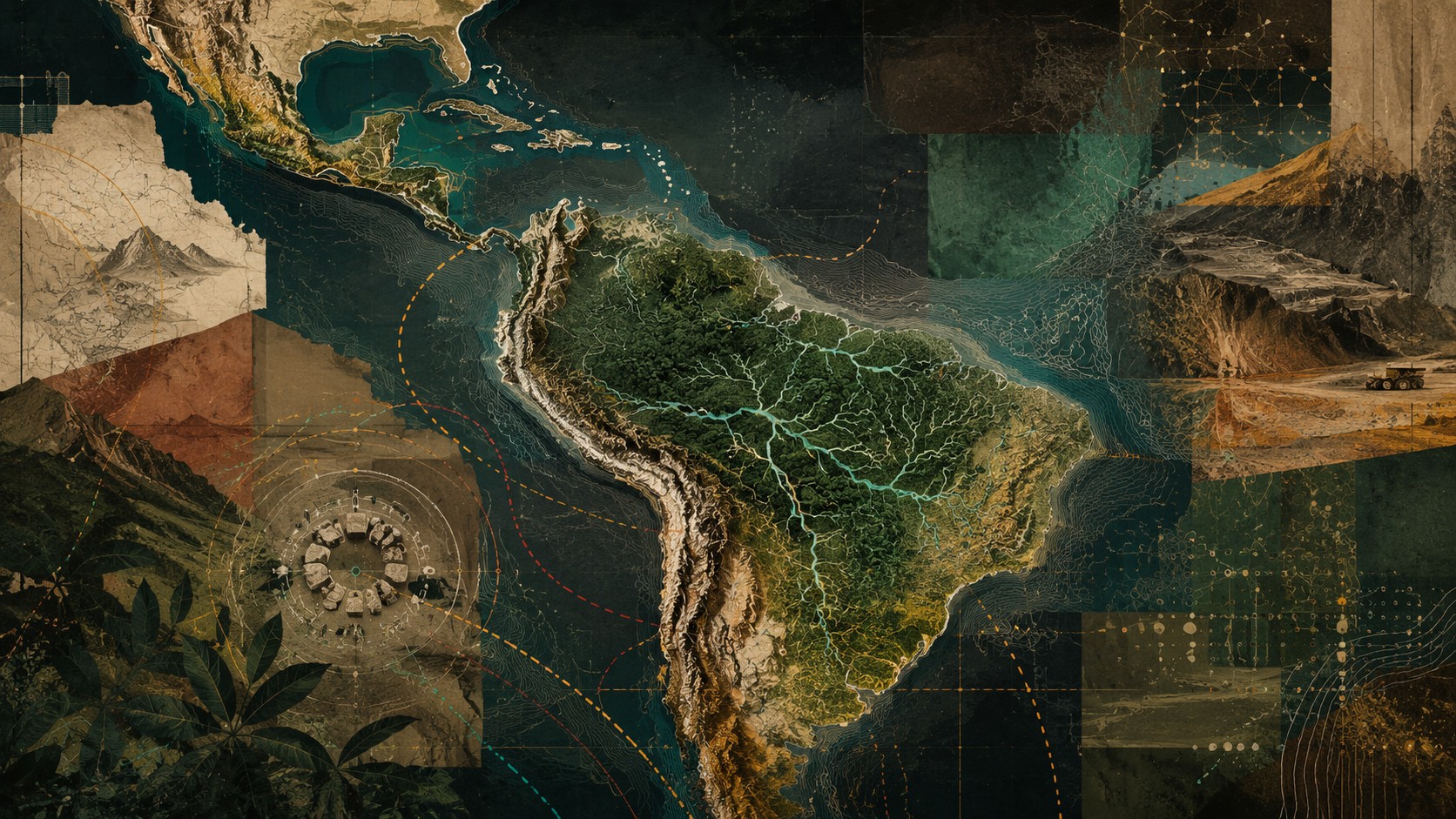
To think from Abya Yala is not a matter of gathering up “Indigenous worldviews” as though they were variations on a single essence. Nor is it a matter of swapping one continental label for another while leaving the inherited mental map intact. Abya Yala, a term of Guna origin now used by Indigenous movements, communities and institutions to name the continent from a historical and political position, does not function here as a total identity. It functions as a dispute over the place from which one speaks.
The trouble with the map is that it rarely looks like trouble. It presents itself as a neutral surface. It draws borders, routes, resources, capitals, regions, parks, extraction zones, security zones. But it also decides what counts as territory, who may name it, which lives appear as part of the landscape and which are reduced to obstacle, folklore or ethnographic datum. The map did not merely accompany the conquest. It was one of its weapons.
This note proposes reading four voices from Abya Yala not as a homogeneous chorus but as four distinct operations of remapping. Ollantay Itzamná redraws the continental map from a migrant Quechua position in Guatemala. Davi Kopenawa Yanomami contests the extractive map of Amazonia from shamanic speech and from a text mediated by an ethnographic pact. Silvia Rivera Cusicanqui remakes the temporal map through long memory, short memory and ch’ixi logic. Gladys Tzul Tzul shifts the political map of the state towards communal forms of government, kinship and the reproduction of life.
The point is not to say that they “share” a single vision. The point is to listen to how, from concrete locations, they put pressure on the colonial division between territory and resource, word and theory, community and state, memory and archive.
Abya Yala is not a backdrop
Using Abya Yala calls for caution. The term should not become a pretty word for saying “Latin America” with a different gloss. Its force comes precisely from unsettling the colonial name of the continent and from recalling that all geography is also a politics of the word.
The starting point, then, is not a closed definition but a question. What comes into view when the map stops being organised around capitals, states, development projects and extraction corridors? What appears when one looks from living territories, from languages, from communal authorities, from the memories that do not quite fit the national calendar?
The colonial map does not only occupy land. It orders time. It turns some histories into the origin of the nation and others into a superseded past. It turns some forms of knowledge into theory and others into belief. It turns some forms of government into institutions and others into custom. To remap Abya Yala means to contest those hierarchies.
Ollantay Itzamná and the map that crosses the Andes and Mesoamerica
Ollantay Itzamná is often filed away as a Guatemalan Maya, and that classification says more about the classifier than about him. In his public bylines he appears as Quechua, a lawyer and Peruvian; Prensa Latina presents him as a Quechua researcher, lawyer and anthropologist, as well as a human rights activist. That self-ascription matters more than the temptation to assign him an identity by country or by the topics he writes about.
Itzamná writes from Guatemala and about Guatemala, but not as someone who ought to be classified by the context in which he writes. His figure makes it possible to think of Abya Yala as a network of internal circulation. The Andes and Mesoamerica do not appear as sealed ethnic compartments but as fields of political resonance. Migration, solidarity between peoples and the defence of Mother Earth do not dissolve differences, yet they do prevent the continent from being read as an inventory of fixed identities.
His very author’s name condenses that circulation. Ollantay points to the Andean and Quechua world; Itzamná, to the Maya world. The combination is not a confusion to be resolved from outside. It is part of his place of enunciation. The interesting thing is not to classify him better but to listen to what that migrant hybridity allows us to think.
In his texts, Itzamná insists on categories such as comunalidad, buen vivir, sovereignty and decoloniality. His writing pushes against turning Abya Yala into a closed unity or a purely ethnic map. The continent cannot be recomposed if it erases Blackness, migrations, conflictive mixtures and difficult alliances.
His remapping, then, is not territorial in the narrow sense. It is a map of bonds. Against the colonial map, which classifies, separates and administers populations, Itzamná proposes a political geography of peoples in relation. Not out of abstract harmony, but because life, as he insists in his texts, depends on cooperation, reciprocity and common defence.
Davi Kopenawa and the map the commodity cannot read
Davi Kopenawa Yanomami does not speak of the forest as an “environment”. Nor as a set of natural resources. That vocabulary already carries with it the map of the commodity. In the Yanomami word, urihi a is not the scenic backdrop of human life. It is living forest-land, a weave of beings, forces, relations, illnesses, spirits, memories and threats.
Kopenawa’s force lies in the fact that his critique does not simply translate Amazonia into the language of global conservation. His word dismantles the separation between nature and culture. The xapiri are not a symbolic layer added to a material forest. They are agents of a world in which health, speech, dreaming, hunting, illness and the sky sustain one another. When Kopenawa warns of the falling sky, he is not producing an ecological metaphor for urban audiences. He is formulating a cosmopolitics.
The book The Falling Sky must be handled with particular care. It is not a simple autobiography nor an unmediated Indigenous voice. It was born first in French as La chute du ciel. Paroles d’un chaman yanomami, published by Plon in 2010. The English translation, The Falling Sky, appeared with Harvard University Press in 2013. The Portuguese version, A queda do céu, was translated by Beatriz Perrone-Moisés and published by Companhia das Letras. In Spanish, Capitán Swing published La caída del cielo in 2024.
More importantly still, the text was composed in collaboration with Bruce Albert over decades of relationship, recordings, translations, transcriptions and editing. That fact does not diminish Kopenawa’s authority. It makes it more interesting. The book is an ethnographic and political pact. Its question is not only what Kopenawa says, but how a Yanomami word travels towards the world of those who fell trees, extract, buy, legislate and translate.
Here lies a key point for anthropology. Mediation is not a flaw to be concealed. It is part of the scene. Who speaks when an oral voice becomes a book? Who organises the archive? What is gained and what is lost when a Yanomami cosmopolitics enters the global publishing circuits? Kopenawa does not need to appear as a “pure” voice. His power lies precisely in forcing anthropology to look at its own devices of listening.
His remapping is that of the forest against the extractive map. Where the state, mining and the economy see subsoil, concession, frontier or reserve, Kopenawa names a living territory that cannot be separated from its visible and invisible beings. He does not defend nature. He defends a world.
Silvia Rivera Cusicanqui and the map of ch’ixi time
Silvia Rivera Cusicanqui should not enter this note simply as “the Aymara thinker”. That label flattens exactly what her work has problematised. It is better to present her as a Bolivian thinker of ch’ixi genealogies, formed in a tension between worlds, memories and languages that do not merge into a reconciled identity.
The ch’ixi is not mestizaje understood as a happy synthesis. Nor is it restored Indigenous purity. It is conflictive coexistence. Something that is and is not at the same time. A stained, speckled surface where opposing elements live together without dissolving. This is why Rivera Cusicanqui is so useful for avoiding two traps. The first is the essentialism that imagines the Indigenous as continuity without fractures. The second is the state multiculturalism that celebrates diversity while keeping colonial hierarchies intact.
Her remapping operation is temporal. Against the linear time of progress, Rivera Cusicanqui proposes reading superimposed memories. Long memory is not archival nostalgia. It is the memory of the 1781 uprisings, when Túpac Amaru besieged the colonial order from Cusco and Túpac Katari laid siege to La Paz for months. Both were quartered, and the colonial power scattered the pieces of their bodies across the rebel villages as a deterrent. The quartering was also a cartographic act, a map of terror drawn with bodies. The oral tradition replied by placing in Katari’s mouth a promise that still circulates, «I will return and I will be millions». Short memory, by contrast, is that of the popular, peasant, urban and trade-union struggles of the last century. The present is not a stage that supersedes the past. It is a zone of friction where the pasts keep acting, and where what was dismembered insists on coming back together.
That gaze makes it possible to distrust the grand narratives of modernisation. It also makes it possible to distrust state celebrations of plurinationality when they turn into institutional décor. Rivera Cusicanqui does not let the state capture the word decolonisation easily. Her critique is uncomfortable because it is not content with changing symbols. It asks about practices, about bodies, about the everyday economy, about forms of authority, about the image, about language and about the coloniality that persists within those who claim to fight it.
Her map does not draw new borders. It draws temporal layers. It shows that Abya Yala is neither behind modernity nor outside it. It is crossing it, staining it, resisting it and using it in contradictory ways. That is the force of the ch’ixi. It offers no clean way out. It offers a way of thinking without erasing the tension.
Gladys Tzul Tzul and the map of communal authority
Gladys Tzul Tzul shifts the question towards government. A Maya K’iche’ from Totonicapán, a sociologist and a public intellectual, she has studied systems of Indigenous communal government, women, kinship webs and the tense relations with the Guatemalan state. Her work keeps the note from being shut inside the territory-spirituality axis, because it brings the problem of authority forcefully into view.
In Tzul Tzul, territory is not only memory or landscape. It is also the capacity to decide, the sustaining of life, communal labour, justice, kinship, offices, assemblies, markets, the defence of water, the defence of the forest and the collective response to violence. Her thought shows that communal life is not a premodern relic. It is a situated political technology, with internal conflicts, hierarchies, negotiations and its own forms of legitimacy.
This matters because the colonial map does not only draw lands. It also draws who may govern. The state recognises municipalities, courts, ministries, private property and individual citizenship. Communal forms often appear as custom, backwardness, informality or legal folklore. Tzul Tzul inverts that reading. Where the state sees an institutional deficit, she analyses systems of government. Where liberalism sees a closed community, she studies the reproduction of life, authority and conflict.
Her work on communal women also avoids another simplification. It is not a matter of adding “Indigenous women” as a thematic quota to a map that has already been drawn. It is a matter of looking at how women sustain, contest and transform communal life. The reproduction of life is not a minor domestic sphere. It is political infrastructure.
If Itzamná opens a continental map, Kopenawa contests the extractive map and Rivera Cusicanqui remakes the map of time, Tzul Tzul remakes the map of authority. Her question is concrete. Who governs when life is organised beyond the state, yet not outside conflict?
Against pan-indigenism
The easiest temptation would be to close this note by saying that these four voices share territory, spirituality, memory and reciprocity. It would be comfortable, but it would be a bad reading. Itzamná writes from a migrant Quechua position in Guatemala. Kopenawa speaks from Yanomami experience, from shamanism and from a long ethnographic mediation. Rivera Cusicanqui thinks from sociology, oral history, the image and ch’ixi critique. Tzul Tzul analyses Maya K’iche’ communal government, women and the state.
There is no common Indigenous essence that makes them interchangeable. There are tensions, possible alliances and irreducible differences. Kopenawa’s word does not work like Rivera Cusicanqui’s. Tzul Tzul’s critique of the state is not the same as Itzamná’s. Spirituality does not occupy the same place in each case. Nor does community.
The anti-Eurocentric gesture does not consist in idealising those differences or in turning them into a transparent continental unity. It consists in letting them modify the question. Not asking only what they say about “nature”, “identity” or “tradition”. Asking which maps they disobey.
Four remappings
Itzamná disobeys the map of fixed identities. His Quechua position in Guatemala makes visible an Abya Yala made of circulation, translation, solidarity and dispute. His insistence on a plurinational Abya Yala keeps the continent from closing around a single image of the originary.
Kopenawa disobeys the map of the commodity. Where extractivism sees gold, timber, soil, subsoil and frontier, he speaks of urihi a, xapiri, illness, dreaming and the falling sky. His word does not “represent” the forest. It takes part in a world in which the forest is alive and cannot be separated from those who sustain it and are sustained by it.
Rivera Cusicanqui disobeys the map of linear time. The ch’ixi shows that coloniality is not a superseded past but a tension that runs through bodies, images, memories and practices. Her critique unsettles classical colonialism as much as its progressive, state or academic versions.
Tzul Tzul disobeys the map of state authority. Her work on Indigenous communal government shows that politics neither begins nor ends in the institutions recognised by the state. Communal life is neither remnant nor backwardness. It is a form of government that organises territory, care, justice and the reproduction of life.
The fifth map
There is a fifth map being drawn right now, and it is worth naming before closing. Artificial intelligence systems do not arrive after colonial cartography; they are trained on it. A dataset is a map. It decides which languages exist and which are noise, which forms of knowledge are knowledge and which are folklore, which territories are pixels of biomass and which are worlds. The large models learn from an archive in which the languages of Abya Yala barely register, and they hand that archive back as though it were the whole world. The old division between theory and belief does not disappear in the machine. It is automated.
Extractivism has not gone away either. It has changed layer. The lithium of the Andean salt flats feeds the batteries; the water and energy of concrete territories cool the data centres; word, image and attention are mined as gold once was. The “commodity people” of whom Kopenawa speaks did not need to know language models in order to describe their logic.
None of these four voices has written, as far as we know, about artificial intelligence. We will not make them speak about what they did not speak of; that ventriloquism would be another colonial map. Yet their categories interrogate the technology better than many manifestos do. What does a classifier do with an identity that is Quechua, Peruvian and Guatemalan all at once, like Itzamná’s? What does a model see in Amazonia — carbon stock, risk, frontier — and what can it not see, if urihi a does not fit its ontology? What does the ch’ixi do to systems that demand one label per box, with no stain and no overlap? And what does Tzul Tzul’s comunalidad do to an AI governance imagined only for individuals, companies and states, where communal authority over one’s own data is not even an available category?
The question, then, is not what artificial intelligence can do for the peoples of Abya Yala. It is who draws the map the machine learns from, and whether that map can be disobeyed like the other four.
Remapping
Four ways of remapping Abya Yala, and a fifth map in dispute. The point is not to replace one total map with another, but to open cracks in colonial cartography. Where the map said resource, living territory appears. Where it said population, peoples with a word of their own appear. Where it said past, active memories appear. Where it said custom, systems of government appear. Where it said nature, beings, bonds and obligations appear. And where the colonial map drew a deterrent, a memory returns that is counted in millions.
The map was never only an image. It is a dispute over what may be seen, named, defended and cared for. These four voices do not ask permission to enter it. They have been inside for centuries.
Sources
- Ollantay Itzamná, author page at Prensa Latina: https://firmas.prensa-latina.cu/author/ollantay/
- Ollantay Itzamná, his own site Susurros del silencio: https://ollantayitzamna.com/
- Ollantay Itzamná, “Sobre Ollantay” page: https://ollantayitzamna.com/?page_id=1
- Davi Kopenawa Yanomami, biographical chronology at Survival (Spain): https://www.survival.es/articulos/3643-cronologia-davi-kopenawa
- Davi Kopenawa and Bruce Albert, Capitán Swing interview for the Spanish edition of The Falling Sky: https://capitanswing.com/prensa/davi-kopenawa-aun-sufrimos-las-enfermedades-que-trajeron-los-mineros/
- Davi Kopenawa and Bruce Albert, The Falling Sky, JSTOR / Harvard University Press, 2013: https://www.jstor.org/stable/j.ctt6wppk9
- Davi Kopenawa e Bruce Albert, A queda do céu, trecho oficial de Companhia das Letras: https://www.companhiadasletras.com.br/trechos/12959.pdf
- Silvia Rivera Cusicanqui, Un mundo ch’ixi es posible, Tinta Limón: https://tintalimon.com.ar/libro/un-mundo-ch-ixi-es-posible/
- Silvia Rivera Cusicanqui, general profile and bibliography: https://es.wikipedia.org/wiki/Silvia_Rivera_Cusicanqui
- Gladys Tzul Tzul, Sistemas de gobierno comunal indígena, Traficantes de Sueños listing: https://traficantes.net/libros/sistemas-de-gobierno-comunal-ind%C3%ADgena
- Gladys Tzul Tzul, bibliographic review at Dialnet: https://dialnet.unirioja.es/servlet/articulo?codigo=7960984
- Gladys Tzul Tzul, interview “En Guatemala la tierra es indígena”, CLACSO, 2019: https://www.clacso.org/en-guatemala-la-tierra-es-indigena/
- Gladys Tzul Tzul, audiovisual record of the interview at CLACSO TV: https://clacso.tv/pelicula/gladys-tzul-tzul-en-guatemala-la-tierra-es-indigena/