
Political anthropology
War Does Not End Where the Bomb Falls
Reading time: 16 min
Ukraine, Iran and an anthropology of peace in the age of algorithmic war.
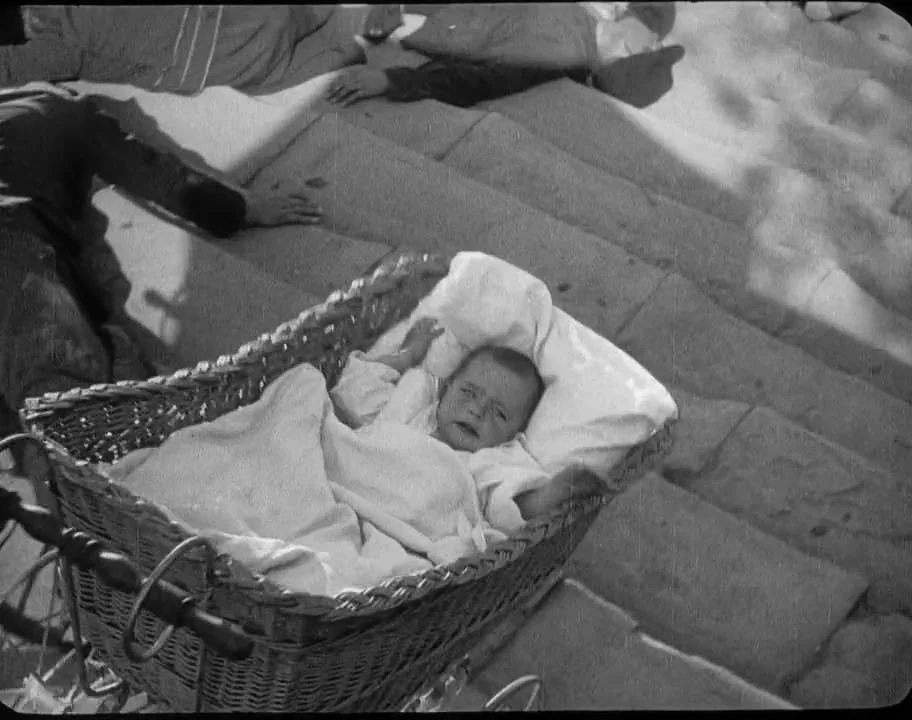
Still from Battleship Potemkin (1925), by Sergei Eisenstein: the baby carriage in the Odesa Steps sequence. Source: Wikimedia Commons, public domain.
Methodological note
This essay distinguishes between verified victims, estimates of military casualties and economic damage. The figures of war are never final: there are inaccessible zones, missing persons, incomplete records and indirect mortality that is hard to attribute. For that reason, the quantities that follow should be read as documented minimums or reasoned ranges, not as a closed accounting.
On 20 June 2026, Russia’s full-scale invasion of Ukraine reaches its 1,577th day. It has exceeded by ten days the duration of the First World War between 28 July 1914 and the armistice of 11 November 1918.1
The comparison is temporal, not moral or historical. It does not equate conflicts with different causes, scales and responsibilities. Russia’s invasion of Ukraine is an aggression against a sovereign state. But the duration matters because it makes it impossible to keep speaking of a passing crisis. After more than four years, the war has become a daily structure that orders bodies, care, housing, school trajectories, work, displacement, languages and expectations of the future.
The US–Israeli offensive against Iran, launched on 28 February 2026, makes it possible to observe the same logic on another scale and within another regional frame. A war can begin under the vocabulary of precision, deterrence or the neutralisation of a threat. Its consequences, however, do not stay within a base, an installation or a map of targets. They reach hospitals, schools, ports, electricity grids, energy routes, fertilisers, food, water and household economies.2
Ukraine shows what happens when that logic is prolonged. Iran shows how fast it can spread. They are not equivalent conflicts. But both make visible an elementary truth: no society should be treated as a surface available for another power’s military demonstration.
Longer than the Great War
The figures are necessary, though never sufficient.
As of June 2026, to state that Russia’s invasion has caused at least 420,000 direct deaths is a prudent formulation, not a final total. The threshold brings together estimates of military casualties and the United Nations record of civilian victims. The United Nations Office of the High Commissioner for Human Rights had verified, by the end of January 2026, 15,172 civilians killed and 41,378 people injured in Ukraine since February 2022; the institution itself warns that the real number is higher, especially in occupied or hard-to-reach territories.3
Estimates of military deaths are more opaque and methodologically heterogeneous. CSIS calculated for the end of 2025 between 275,000 and 325,000 Russian soldiers killed and between 100,000 and 140,000 Ukrainian soldiers killed. Other counts, using different methods, place the overall total of direct deaths above half a million. The figure of 420,000, therefore, does not compete with those calculations: it works as a deliberately conservative minimum.45
Nor does it sufficiently include indirect mortality. War kills when a treatment is interrupted, when an older person is left isolated during a blackout, when a family loses its home, when cold, pollution, precarity or displacement worsen an illness. An anthropology of peace does not replace statistics. It returns to statistics their human density.
A murdered person does not disappear into a table. They leave an empty room, an interrupted conversation, a dependent person without support, a wounded childhood, a community forced to learn to live with an absence.
Odesa and the baby carriage
There is an image that remains hard to look at. In Battleship Potemkin, Sergei Eisenstein filmed a baby carriage descending the Odesa steps while a crowd tries to escape state violence.
The sequence does not document a massacre that happened exactly that way. It is a cinematic construction from 1925. Its power does not depend on being a literal record. Eisenstein understood that violence does not appear only in uniforms, weapons or explosions. It also concentrates in the instant when protection ceases to be possible, in the fall of those who cannot escape and in the extreme exposure of an infant.
Odesa is not a stage set available for the consumption of those who watch from afar. It is a port city, multilingual and plural, crossed by Ukrainian, Jewish, Greek, Moldovan, Russian and Mediterranean memories. The current war forces us to return to that sequence with care. Not as an aesthetic prophecy, but as a warning against the ease with which the suffering of others can become a repeatable image.
The ethical task consists in preventing the bodies of Odesa, Kharkiv, Mariupol, Tehran, Gaza, Tyre or any other bombed city from becoming a succession of photographs before the world moves on to the next piece of news.
Iran is not an empty board
Iran tends to appear reduced to its nuclear programme, theocracy, sanctions, missiles, oil or the Strait of Hormuz. These dimensions form part of the context, but they do not exhaust a complex society, nor do they justify its population paying for the strategic calculations of outside powers.
Narges Bajoghli, an Iranian-American political anthropologist and professor at Johns Hopkins University, has studied how the media, military institutions and revolutionary memories produce legitimacy within the Islamic Republic. Her work makes it possible to avoid two simplifications. The first imagines the Iranian state as a homogeneous bloc. The second turns the Iranian population into a passive mass, with no internal conflicts, family networks, desires, dissent or projects of its own.6
Shahram Khosravi, an Iranian anthropologist and professor of Social Anthropology at Stockholm University, has researched borders, migration, displacement and waiting. His work helps us recognise a less visible violence. Waiting for a phone call, a visa, an evacuation, a medication or news of a missing person is also to live through a war. Violence is not measured only by explosions. It is also measured by the suspended time imposed on millions of lives.7
The conversation must incorporate voices that have produced knowledge from within Iran. Nasser Fakouhi, professor of Anthropology at the University of Tehran, has worked on the city, identity, political violence and cultural transformations. Nematollah Fazeli, a cultural anthropologist linked to the Institute for Humanities and Cultural Studies in Tehran, has researched modernity, education, culture and urban life. They are not cited as spokespeople for a single political position on the offensive. They are included so that Iran is not explained solely from Western diplomatic, military or media centres.89
Nor should the continuity of Persian culture be narrated as an immobile essence or as an immunity to conquest. The Persian empires fell militarily on various occasions and the Iranian territories went through Macedonian, Arab, Turkic and Mongol conquests. But the Persian language, the literary traditions, the intellectual worlds, the administrative practices and the artistic forms were not erased.
They persisted because they were transformed. Persian culture incorporated Arab, Islamic, Turkic and Mongol elements without dissolving into them, and in turn influenced Central Asia, the Caucasus, Anatolia and the Indian subcontinent. This is not about imagining a pure identity or erasing the ethnic, linguistic and religious plurality of Iran. It is about recognising a historical continuity that has survived through its capacity to remake itself.10
No criticism of the authoritarianism of the Iranian state justifies the collective punishment of its population. To defend peace requires rejecting both internal repression and external destruction.
Ukraine and the work of imagining a future
Ukraine is not only the territory where a war is being fought. It is a society that has had to reorganise life under bombardment, blackouts, displacement, grief, loss of housing and the destruction of infrastructure.
Adriana Petryna, an anthropologist born in Ukraine and professor at the University of Pennsylvania, transformed disaster studies with her research on Chernobyl and biological citizenship. In later work she developed the idea of horizon work, the practical and ethical effort of acting when inherited models no longer make it possible to foresee what is coming.11
War forces that horizon work to be done every day. Families deciding whether to leave a city. Health workers attending patients during an attack. Communities improvising shelters, collective kitchens, charging points, electricity networks and underground schools. This is not about admiring that resilience from afar. It is about not normalising the conditions that force people to resist in that way.
Maryna Hrymych, a Ukrainian ethnologist specialising in intangible heritage, popular culture and customary law, shows that songs, stories, crafts, family archives, rituals and celebrations are not cultural ornaments. In situations of destruction they become social infrastructure. A school, a library, a museum, a church, an archive or a local festival sustain a community’s capacity to recognise itself over time.12
Heritage does not arrive after peace: it is one of the conditions that make peace possible. UNESCO had verified 536 damaged cultural sites in Ukraine as of 10 June 2026. Each damaged site is a material loss, but also an attack on the capacity to narrate oneself, to remember and to rebuild bonds.13
Laada Bilaniuk, professor of Sociocultural Anthropology at the University of Washington, has researched the relations between language, identity and popular culture in Ukraine. Her work reminds us that to defend Ukrainian is not necessarily the same as exclusionary nationalism. It can express a response to long imperial hierarchies and to historical forms of linguistic denial.14
To defend Ukraine means defending the right of its population to build bonds, languages, memories and futures without external military imposition.
Russia is not a single voice
To name clearly the responsibility of the Russian state in the invasion does not require reducing the entire Russian population to an extension of the Kremlin. That simplification would be politically convenient and anthropologically poor.
Alexei Yurchak, an anthropologist trained in the Soviet tradition and professor at the University of California, Berkeley, studied how official formulas could be repeated even when many people no longer fully believed in them. His work makes it possible to understand that propaganda, silence, irony, fear and adaptation can coexist within a single society.15
Serguei Oushakine, an anthropologist at Princeton University, has researched how loss, trauma and post-Soviet decline can be turned into social bonds, patriotism and belonging. His work helps us understand that collective suffering can open paths of care, but can also be captured by nationalist discourses that promise dignity in exchange for obedience, sacrifice and enmity.16
Valery Tishkov, a Russian ethnologist and author of an ethnography of the Chechen war, allows us to introduce another caution. Conflicts do not end with the ceasefire: they leave displacement, ruined economies, mourning, fragmented memories and struggles over the meaning of loss. Dmitry Funk, an ethnologist specialising in the Indigenous peoples of southern Siberia, has researched language, memory, heritage and oral traditions among the Teleut and Shor communities. Their trajectories remind us that Russia is not equivalent only to Moscow, the army or state propaganda.1718
Nikolay Kradin, a political anthropologist and archaeologist from Vladivostok, has studied nomadic societies and complex forms of political organisation not reducible to the centralised state. His work does not explain the current invasion, nor should it be used as indirect commentary on it. It serves to avoid the fiction that Eurasian history knows only one institutional, imperial or statist path.19
War runs through peripheral regions, mobilised families, Indigenous peoples, cemeteries, local economies and minority languages that barely appear on media maps. A just peace cannot ignore that plurality.
War in the data chain
Artificial intelligence no longer belongs only to laboratories, technology companies or discourses about the future. It has entered the material chain of war.
It does not always appear as a machine that autonomously decides whom to kill. More often it classifies drone images, cross-references signals, detects vehicles, prioritises threats, helps with navigation in jamming environments, recommends courses of action and accelerates the production of decisions.
Ukraine has declared that it uses AI in the analysis of attacks, in planning, in the detection and interception of aerial threats, and in systems that integrate data from the front. Public evidence also documents the expansion of drones with navigation or visual recognition capable of operating with partial autonomy when the signal is lost. Ukraine’s own AI directorate has warned that the speed and complexity of these systems may come to exceed the human capacity for review.20
Public information about Russia is less transparent, but the war has become a race of unmanned systems, electronic warfare, sensors and automation. The documentary asymmetry matters: it does not authorise asserting degrees of autonomy that cannot be verified, but neither does it permit treating Russian technology as if it were irrelevant.
The United States has developed Project Maven to integrate and analyse large volumes of data from sensors, aerial platforms, satellites and other intelligence sources. Its declared function is to support situational awareness and human judgement. That architecture, however, accelerates the transformation of people, buildings, vehicles and movements into classifiable patterns.21
In Gaza, investigations by +972 Magazine, Local Call and The Guardian described systems such as Lavender and Gospel used to generate or prioritise possible targets during the Israeli offensive. The Israel Defense Forces rejected the claim that those tools autonomously identified people to be attacked and maintained that they were support instruments for analysts. Both statements must be held together: there is journalistic investigation based on intelligence testimony, and there is an official denial.22
Iran has an evolving industry of drones, navigation and reconnaissance. However, independent public information does not make it possible to assert that its forces used algorithmic target selection during the 2026 offensive with the same degree of documentation available for other cases. This uncertainty is not a shortcoming of the analysis. It is an ethical and methodological limit.
Heather Roff, a specialist in military ethics and emerging technologies, has warned that the problem is not limited to a machine that fires. It also affects the generation of target lists, the automation of recommendations and the possibility that human judgement is reduced to a hurried validation. Noel Sharkey set out a clear limit years ago: no system should possess autonomous authority to decide on the death of a person.2324
Artificial intelligence does not eliminate responsibility. It distributes it among companies, technical staff, armies, commanders, contractors, data platforms, governments and those who validate decisions under pressure.
AI has not ended the fog of war. It has displaced part of it into systems of data, images, probabilities and classifications whose logic can rarely be audited by those who suffer their consequences.
Shared worlds and multispecies destruction
To speak of a multispecies war does not mean to equate, in a banal way, human and non-human suffering. It means recognising that people, animals, plants, seeds, soils, rivers, forests, bacteria, infrastructures and atmospheres form shared worlds.
Donna Haraway questioned the fantasy of a humanity separated from the forms of life that sustain it. Anna Tsing showed that ruins are not voids, but places where precarious relations between human and non-human beings persist. Thom van Dooren has insisted that extinction and ecological loss have their own rhythms, often longer than media or military cycles.252627
None of this should romanticise devastation. That there is life after destruction does not make the destruction acceptable.
War turns water into risk, soil into suspicion and the forest into a target, a refuge or a minefield. Companion animals can be separated from their families during evacuations. Livestock remain trapped in combat zones. Wild species lose corridors, food and habitat. Mines and explosive remnants prolong the violence long after the front line has moved.
The destruction of the Kakhovka dam showed this dimension with particular harshness. It altered wetlands, sediments, crops, species and human ways of inhabiting the territory. The United Nations Environment Programme warned that part of the environmental damage could be irreversible and have prolonged consequences.28
The war in Ukraine also has a climatic dimension: arms production, fires, energy destruction, displacement, transport and reconstruction generate new emissions on a planet already subject to a deep ecological crisis. There is no reliable figure that allows all the animals killed, displaced or affected to be counted. That absence of data must not become an absence of responsibility.
A bill that does not fit in an account
War has an enormous economic cost, but there is no single figure that sums it up without deceiving.
The joint assessment by the World Bank, the United Nations, the European Commission and the Government of Ukraine estimated direct damage of around $195 billion through the end of 2025, and recovery and reconstruction needs close to $588 billion over the following decade. The two figures should not be added together as if they were two independent bills. The direct damage forms part of the base from which the recovery needs are calculated.29
SIPRI estimated that Russia’s military budget for 2026 would reach approximately 14.9 trillion rubles, after military and war-related spending of 15.9 trillion in 2025. Not all of that amount can be attributed exclusively to the Ukrainian front, but it expresses the size of an economy reordered by war.30
If one considers Russian military spending, the Ukrainian defensive effort, external military aid, the direct damage and the future recovery needs, the order of magnitude far exceeds one trillion dollars. It is not a closed bill or a perfect accounting sum. It is a signal of scale.
Destruction is not exhausted in the budget. It does not count the work of care, mental health, interrupted educational trajectories, the people who will not return, the separated families, the abandoned animals, the contaminated land or the communities that will have to rebuild trust after the violence.
Peace is not neutrality
To defend peace is not the same as asking Ukraine to accept an occupation. Nor is it the same as asking the Iranian population to endure bombardment, sanctions or collective punishment in the name of a regional stability that never arrives.
Peace does not consist in distributing responsibility symmetrically between the one who invades and the one who resists. It does not require forgetting crimes or demanding silence from those who have lost family members, homes or territories.
A just peace requires halting attacks on the civilian population, ending occupations, protecting sovereignty, guaranteeing safe returns, investigating crimes, repairing damage, clearing mined territories and restoring ecosystems.
It also requires that the affected communities take part in rebuilding their future. Not only governments, defence companies, creditors or international powers.
The invasion of Ukraine and the offensive against Iran are not identical. They do not need to be in order to teach a common lesson. No life can be reduced to collateral damage. No culture can be treated as an available abstraction. No river, forest, city or community should become dispensable material for a demonstration of force.
Peace is not a pause between bombardments. It is the political decision that no border, no resource, no empire and no security doctrine is worth more than the human and non-human lives that make the world possible.
Sources and references
Footnotes
-
Encyclopaedia Britannica, “World War I”. The day count is made between the start and armistice dates given by the source. ↩
-
Associated Press, “A history of Iran’s nuclear program and tensions with the US as an interim deal is signed”, June 2026; Al Jazeera, “World reacts to US, Israel attack on Iran, Tehran retaliation”, 28 February 2026. The second source, published from the Middle East, corroborates the date, the joint character of the attacks and their immediate regional extension. ↩
-
OHCHR/HRMMU, Four Years On: Civilian Harm and Rights Violations in Ukraine, 16 February 2026. ↩
-
Le Monde, “With an estimated 500,000 dead, the Russia-Ukraine war is Europe’s deadliest since 1945”, 27 February 2026. ↩
-
Bajoghli, Narges. Iran Reframed: Anxieties of Power in the Islamic Republic. Stanford University Press, 2019. ↩
-
Khosravi, Shahram. Precarious Lives: Waiting and Hope in Iran. University of Pennsylvania Press, 2017. ↩
-
Fakouhi, Nasser. “Making and Remaking an Academic Tradition: Towards an Indigenous Anthropology in Iran.” In Conceptualizing Iranian Anthropology: Past and Present Perspectives, edited by Shahnaz R. Nadjmabadi, ch. 5. Berghahn Books, 2010. ↩
-
Fazeli, Nematollah. Politics of Culture in Iran: Anthropology, Politics and Society in the Twentieth Century. Routledge, 2006. ↩
-
Encyclopaedia Iranica, “Iranian Identity, III. Medieval Islamic Period”. ↩
-
Petryna, Adriana. “Wildfires at the Edges of Science: Horizoning Work amid Runaway Change.” Cultural Anthropology 33, no. 4 (2018): 570–595. https://doi.org/10.14506/ca33.4.06. ↩
-
Hrymych, Maryna, et al. “The Creation of a Hub for Ukrainian Intangible Cultural Heritage: A Case Study of the Ivan Honchar Museum.” Ethnologies (2023). https://doi.org/10.7202/1111896ar. ↩
-
UNESCO, “Damaged cultural sites in Ukraine verified by UNESCO”. ↩
-
Bilaniuk, Laada. Contested Tongues: Language Politics and Cultural Correction in Ukraine. Cornell University Press, 2005. ↩
-
Yurchak, Alexei. Everything Was Forever, Until It Was No More: The Last Soviet Generation. Princeton University Press, 2006. ↩
-
Oushakine, Serguei Alex. The Patriotism of Despair: Nation, War, and Loss in Russia. Cornell University Press, 2009. ↩
-
Tishkov, Valery. Chechnya: Life in a War-Torn Society. University of California Press, 2004. ↩
-
Funk, Dmitry A. Миры шаманов и сказителей: комплексное исследование телеутских и шорских материалов [Worlds of Shamans and Storytellers: A Complex Study of Teleut and Shor Materials]. Moscow: Nauka, 2005. Cited for his research on heritage, oral tradition and the Indigenous peoples of Siberia, not to attribute to him a position on the invasion. ↩
-
Kradin, Nikolay N. “Nomadic Empires in Evolutionary Perspective.” In Alternatives of Social Evolution, edited by N. N. Kradin, A. V. Korotayev, D. M. Bondarenko, V. de Munck and P. K. Wason, 274–288. Vladivostok: Far Eastern Branch of the Russian Academy of Sciences, 2000. ↩
-
Reuters, “Ukraine’s defence AI chief predicts ‘new paradigm’ of warfare”, 12 June 2026; Reuters, “Ukraine opens battlefield data access to allies’ AI models”, 12 March 2026. ↩
-
National Geospatial-Intelligence Agency, “GEOINT Artificial Intelligence”. The NGA states that the GEOINT components of Maven were transferred to it in January 2023 and that its computer-vision capabilities are integrated into military analytical workflows. ↩
-
The Guardian, “How AI is being used to target Palestinians in Gaza”, 3 April 2024. The attribution to specific systems and the official Israeli responses must be read together. ↩
-
Roff, Heather M. “The Strategic Robot Problem: Lethal Autonomous Weapons in War.” Journal of Military Ethics 13, no. 3 (2014): 211–227. https://doi.org/10.1080/15027570.2014.975010. ↩
-
Sharkey, Noel E. “Saying ‘No!’ to Lethal Autonomous Targeting.” Journal of Military Ethics 9, no. 4 (2010): 369–383. https://doi.org/10.1080/15027570.2010.537903. ↩
-
Haraway, Donna J. Staying with the Trouble: Making Kin in the Chthulucene. Duke University Press, 2016. ↩
-
Tsing, Anna Lowenhaupt. The Mushroom at the End of the World: On the Possibility of Life in Capitalist Ruins. Princeton University Press, 2015. ↩
-
van Dooren, Thom. Flight Ways: Life and Loss at the Edge of Extinction. Columbia University Press, 2014. ↩
-
UNEP, Rapid Environmental Assessment of the Kakhovka Dam Breach, Ukraine. ↩
-
World Bank, European Commission, United Nations and Government of Ukraine, RDNA5, 23 February 2026. ↩
-
SIPRI, A Budget for a Fifth Year of War: Military Spending in Russia’s Budget for 2026. ↩